dailynewsnblog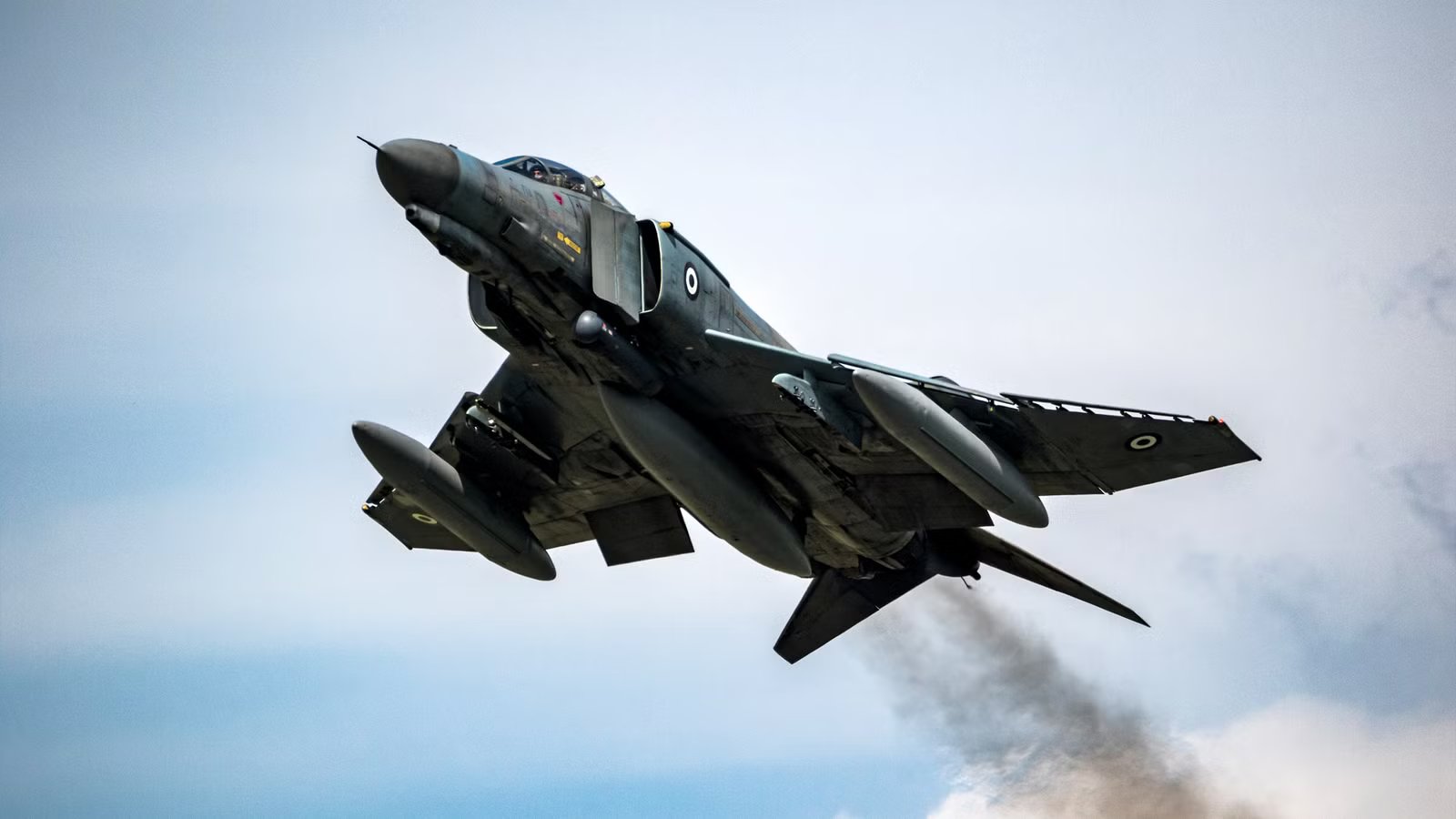
The McDonnell Douglas F-4 Phantom II is an icon of American air power. Once one of the most widely produced supersonic fighter jets, it was a staple of both the US Armed Forces and many allied air forces worldwide. The jet, which was once heralded as a ‘Triumph of Thrust over Physics,’ evolved to become the archetypal multirole fighter on which modern jets like the General Dynamics F-16 and Lockheed Martin F-35 have been molded.
The F-4 Phantom II was capable of such stunning speed that it set over 20 World Records during its first years of service. The trade-off for that watering speed and power was sometimes equally impressive fuel consumption. The F-4 is not alone in this struggle, as virtually any fighter jet operating in combat conditions will run out of gas in an hour or two while ‘turning and burning.’ In an ideal ferry cruise profile, it can fly for about 3 hours, but pulling hard maneuvers in a combat scenario will drain the tanks in as little as 15 to 30 minutes.
Hearts On Fire

The F-4 Phantom II was essentially built around two massive turbojets. Throughout its entire production run, the aircraft was powered by the General Electric J79, with only one exception, which we will get to later. The immensely powerful turbojets that allowed the Phantom II to achieve its performance were revolutionary at the time, with a technology called ‘variable stators’ that allowed the engine to adapt to different conditions and performance profiles.
Every variant that rolled off the assembly line during the F-4’s epic production run of 5,195 airframes received the same engine; however, its refinement and evolution over time meant that it eventually produced a little more than 10% higher thrust. That figure comes from comparing the F-4A, the F-4B, and the most popular model, the F-4E. The early models produced a known afterburning thrust of 10,300 pounds while the F-4E made 11,870 pounds. With afterburners lit, the difference is proportional: early models making 16,150 pounds and the latter producing 17,900 pounds.
While the F-4A was a pure interceptor, the engines in the F-4E were designed to support both high-speed interception and lower-altitude, higher-drag combat scenarios, including dogfighting, by adding slats. The F-4E uses the ‘smokeless’ -17 engines, eliminating the heavy black smoke trails characteristic of the earlier -2 and -8 engines in the F-4A/B.
Not The Average Cup Of Tea

There was one exception to the F-4 family tree, which was exclusively flown by the Royal Navy (RN) in the United Kingdom. This aircraft was specifically designed to use the Rolls-Royce Spey turbofan, which was more powerful but had a lower top speed due to higher drag. The engine required a 20% greater air intake, which increased the frontal profile but produced 10% more thrust than the F-4E.
Notably, owing to its more modern design, the F-4K’s Spey engines were roughly 10% to 15% more fuel-efficient than the F-4E’s J79s during subsonic cruise. This gave the British Phantom better ‘loiter’ time, which was crucial for Royal Navy carrier patrols. Yet, due to its higher thrust output and greater air volume intake, turning on the afterburners of the Spey engines could actually drain the fuel tanks of the F-4K faster than the F-4E would with its J79.
The reason for the engine swap was to give the F-4K enough extra ‘punch’ to make it off the short deck of the HMS Ark Royal, which used a ‘ski ramp’ configuration as opposed to the catapult found on US Navy aircraft carriers. Its high-thrust takeoff also used a massive ‘gulp’ of fuel right at the start of the mission, slightly offsetting its cruising efficiency, so the F-4E would often have the same or better actual endurance time.
Specification | F-4B (USN) | F-4E (USAF) | F-4K (Royal Navy / FGR.2) |
|---|---|---|---|
Engine Type | 2 x GE J79-GE-8A/B/C | 2 x GE J79-GE-17 | 2 x RR Spey 203 |
Max Thrust (each) | 17,000 pounds | 17,000 pounds | 20,515 pounds |
Max Speed | Mach 2.23 | Mach 2.23 | Mach 1.9 |
Internal Fuel | 1,994 gallons | 1,994 gallons | 1,994 gallons |
Combat Radius | 400 miles | 422 miles | 550 miles |
Max Range | 2,300 miles | 1,885 miles | 1,750 miles |
The F-4K produced 12,150 pounds of thrust in cruising conditions with no afterburners and maxed out at 20,515 pounds of thrust running at full military power. To accommodate the larger Spey engines, the F-4K required extensive structural changes that the F-4E did not. Because of the extra drag from the larger intakes and the Spey’s temperature limitations at high speeds, the F-4K was limited to roughly Mach 1.9, while the F-4E could comfortably hit Mach 2.2 or more.

Why The F-4 Phantom Won’t Be Retired Anytime Soon
A Cold War icon defies expectations, remaining relevant in the 21st century. Discover the secrets behind the F-4 Phantom’s enduring legacy.
The Long Range Leader

The F-4 Phantom is classified as a third-generation fighter jet by the categorization of technological features for warplanes. When the jet debuted in the early 1960s, it had substantially longer loading times and total flight range than all of its contemporaries. Specifically, going head-to-head against the near-peer adversary of the era, the Soviet MiG-21F ‘Fishbed,’ the F-4 absolutely dominated in endurance.
It wasn’t efficiency, but rather pure payload that gave the F-4 its advantage. Using a broad estimate of real-world performance, the F-4B Phantom II could take off with a total of 12,800 pounds of internal fuel and fly for 2 to 3 hours, with around 1.5 to 2 hours on station for air patrol missions. The MiG-21F could only carry 5,000 pounds of internal fuel, which gave it a total flight time of 45 to 60 minutes and roughly 20 to 30 minutes on station for the same mission.
The F-4B carried more than double the fuel of the MiG-21F and was capable of around three times more flying endurance. So not only did it fly with a bigger tank of gas, but it was also more efficient at using that gas to produce power. This was an important mission requirement for the US Navy, which was the original procurer of the F-4, as its barrier combat air patrol (BarCAP) mission relied on station time as one of the most important performance factors to defend the fleet and intercept Soviet bombers or fighters.

Is It True That The F-4 Phantom Is A Long-Range Supersonic Fighter?
For a period the F-4 was the workhorse of US airpower able to fill many roles thanks to its large aircraft, range, and supersonic flight.
Thirsty Bird: Fuel To-Go

The F-4 had good endurance when it first entered service, but as technology advanced and aircraft became more capable, missions became more demanding. The use of drop tanks to extend its range became a critical force-multiplying factor. The addition of external fuel tanks made the Phantom capable of deep-strike missions, intercontinental ferrying for strategic repositioning, and marathon-like loiter time over the battlefield.
Of course, adding external fuel tanks to the ‘Lead Sled,’ as the F-4 was often called, came with a weight and drag penalty. The Phantom was often equipped with three external tanks, consisting of one small, 370-gallon tank on each wing and a larger, 660-gallon centerline tank. This configuration increased the F-4’s fuel capacity by roughly 65%. But with three external tanks, the F-4 was generally restricted to subsonic speeds or very low supersonic speeds.
The ‘drag count’ of three tanks slowed the F-4’s acceleration significantly. An F-4E with tanks might take twice as long to reach Mach 1.0 compared to a ‘clean’ aircraft. While carrying full 370-gallon wing tanks, the F-4 was typically limited to 5.5 Gs or less. Pilots were trained to ‘punch’ (jettison) the tanks the moment they entered a dogfight to regain the airframe’s 7.3 G capability.
The Navy often only used a 600-gallon centerline drop tank. This single external fuel pod extended the F-4B’s clean loiter time from 40 minutes to nearly 2 hours. The basic tactic was for the pilot to simply ditch the drop tank if an enemy was detected in order to regain full speed and maneuverability before engaging. The Air Force leveraged the additional fuel capacity for extended range to execute deep strikes that would not be possible without it.

How Many F-4 Phantoms Are Left?
Almost 100 McDonnell Douglas F-4 Phantom IIs are still in service around the world today.
Getting Gas On The Fly

The F-4 was designed from conception with the capability of aerial refueling. Aerial refueling gave the Phantom virtually unlimited range and transformed it from a point-defense interceptor into a global strike platform. It was the bridge that allowed a 1960s fighter to perform 8-hour missions that the airframe was never originally designed for. But because the F-4 was used by both branches, it had two completely different ways of taking on gas.
The US Navy and Marines used a retractable probe that extended from the right side of the cockpit. This allowed the pilot to fly the probe into a drogue basket that was dragged behind a carrier-borne KA-3 Skywarrior or a land-based KC-130 Hercules. This was easier for the tanker but harder for the pilot, especially in rough weather or at night.
The Air Force used the flying boom comment on its KC-135 Stratotankers. Phantom pilots would fly their jet up to the boom and align with the Universal Aerial Refueling Receptacle Slipway Installation (UARRSI) located on the upper side of the jet spine. The F-4 pilot simply flew into a stable formation, and a boom operator on a KC-135 tanker steered a rigid pole into the hole on the Phantom’s back. This allowed for much faster fuel transfer rates of more than 1,000 gallons per minute.