dailynewsnblog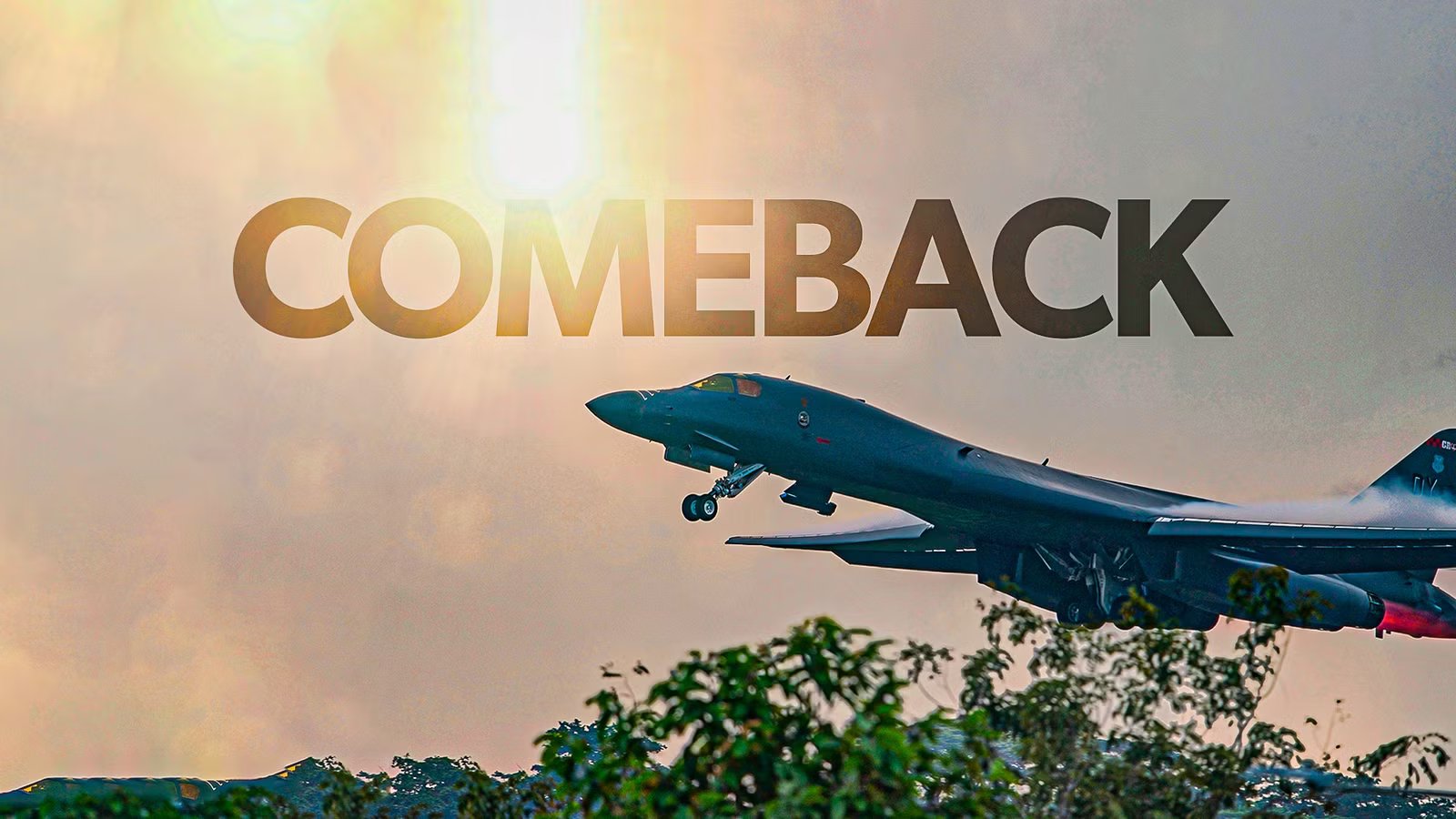
The Rockwell B-1B Lancer, affectionately known as ‘The Bone,’ is the second-largest supersonic aircraft to enter mass production after narrowly avoiding being permanently canceled by US President Jimmy Carter. The next President, Ronald Reagan, famously supported the program. And despite the rise of stealth technology as the preeminent weapon in aerial warfare, it has remained a vital strategic strike platform for the US Air Force thanks to its enormous payload.
The B-1 has the highest internal payload of any US Air Force aircraft, making it one of the most versatile and flexible air assets in the entire inventory of the US Armed Forces. Although the B-52 can carry a very large arsenal into the air as well, and the B-2 can carry many weapons while also flying invisibly past enemy defenses, the B-1 still fills a vital role.
Unlike its counterparts, which are purely focused on strategic missions, the B-1 is actually extremely effective at close air support (CAS), where speed can make the difference between life and death. The first prototypes were even faster than the current iteration, and it was once outfitted with the ability to carry nuclear weapons. Today, the Bone is arguably the best conventional strike asset in the USAF.
Resurrection Of The Bone

President Carter canceled the B-1A program in 1977 as he believed it was a redundant expense for a mission already under the umbrella of the Boeing B-52 Stratofortress, given the advent of air-launched cruise missiles. Carter felt that the high-speed and low-altitude penetration mission by a manned bomber platform was riskier and more costly, with no apparent benefit compared to long-range standoff air-to-ground missiles.
During the 1980 campaign, Ronald Reagan used the cancellation as a symbol of ‘military weakness.’ Upon taking office, he revived the program as the B-1B, modifying it to be slower but stealthier with a reduced radar cross-section as well as modifications for a larger payload. The dramatic reversal of fortunes for the Bone would play out again in the 1990s as the fall of the Soviet Union rendered its nuclear deterrence mission irrelevant.
Under the START I treaty with the Soviet Union to begin nuclear disarmament, the B-1B fleet was stripped of its capability to carry nuclear weapons. The decision actually proved to save the fleet’s role in the Air Force, with the deterrence mission transitioning to other platforms and the B-1B becoming more important for conventional ‘bomb truck’ missions. Its enormous payload and high performance proved to make it an excellent platform for employing conventional precision-guided munitions on CAS and ‘surgical strike’ missions.
The Bone performed so well during the two decades of conflict that the United States has endured in Iraq and Afghanistan that it became even more valuable to the US Armed Forces. Just in Operation Enduring Freedom, the B-1B fleet dropped nearly 40% of all munitions by the Coalition in the first six months. In 2026, even as the Air Force finally plans to retire portions of the fleet due to structural fatigue and high maintenance costs, it has faced resistance.
The Unwanted Bomber

The USAF was also a reluctant customer during the procurement phase alongside President Carter. The Air Force was initially eager to replace the B-52 with the supersonic B-1, but shifting technology in the air defense realm later made the Air Force reconsider its desire for a high-speed strike platform. Critics argued it would be a ‘white elephant’ that was obsolete before it even flew.
By the late 1970s, intelligence indicated that Soviet ‘look-down/shoot-down’ radar and improved surface-to-air missiles (SAMs) like the S-300 would likely intercept the B-1A at its intended Mach 2.2 altitude. The development of the Air-Launched Cruise Missile (ALCM) offered a cheaper way to strike the Soviet Union. President Carter argued that B-52s carrying cruise missiles could achieve the same goals as the B-1 at a fraction of the cost.
Some argue the B-1B’s public revival served as a distraction to keep Soviet attention on conventional supersonic threats while the US secretly funneled resources into the highly classified Northrop Grumman B-2 Spirit stealth flying wing. In 1977, the USAF was already secretly developing Advanced Technology Bomber (ATB) technology, which eventually became the B-2 Spirit. Defense leaders preferred to bypass the B-1’s speed-based approach in favor of its superior survivability.
The Air Force’s Heaviest Hitter

The B-1B’s variable-geometry wings allow it to ‘change shape’ to optimize performance for vastly different mission requirements. The swing-wing design, combined with small structural vanes on the nose, helps stabilize the aircraft during high-speed, low-altitude flights, providing a stable platform for precision targeting in turbulent air.
With wings fully extended, the B-1B generates maximum lift, allowing it to take off from shorter runways and loiter over a battlefield for hours at fuel-efficient speeds. When wings are swept back, the aircraft becomes a ‘supersonic penetrator’ capable of Mach 1.25. This allows it to rapidly transit to a crisis zone or egress quickly after a strike.
Despite its size, the B-1B is a highly precise ‘surgical’ instrument thanks to advanced avionics. Using the Sniper Advanced Targeting Pod and Link 16 data links, crews can receive updated coordinates from ground troops in real-time to perform precision CAS. It can carry up to 75,000 pounds of ordnance internally. This massive capacity allows a single B-1B to engage dozens of individual targets in a single pass.
Its Synthetic Aperture Radar (SAR) can track, target, and engage moving vehicles even in poor weather or at night. Its ability to carry the Long Range Anti-Ship Missile (LRASM) has recently turned it into a premier maritime strike platform, capable of finding and destroying enemy ships from hundreds of miles away.

New Pylons Will Drastically Increase Capabilities For US Air Force B-1B Bombers
The mighty BONE is getting a big upgrade.
Two-Pronged Strategic Strike

In a strategic two-pronged strike, the B-1B and B-2 act as a ‘Hammer and Scalpel’ combination. While the B-2 stealthily dismantles the enemy’s ‘eyes and ears,’ the B-1B provides the overwhelming mass required to shatter their remaining infrastructure. Once the B-2 has neutralized the deadliest threats, the B-1B Lancer arrives to exploit the opening with massive volume.
The B-2 Spirit is the USAF’s primary ‘door kicker.’ It uses its stealth profile to penetrate A2/AD (Anti-Access/Area Denial) bubbles or areas protected by advanced systems like the S-400. By blinding the enemy and suppressing their surface-to-air missiles (SAMs), the B-2 creates a ‘sanitized’ corridor for non-stealthy aircraft to enter.
While a B-2 can carry 16 heavy bombs, a B-1B can carry 24 to 48, depending on the configuration. The Bone provides high-capacity saturation. It focuses on ‘wide-area’ targets that require sheer tonnage: airfields, motor pools, industrial complexes, and troop concentrations. Even if the air defenses aren’t fully suppressed, the B-1B can launch JASSM-ER missiles from 600 miles away, allowing it to contribute to the ‘Scalpel’ phase without entering the danger zone.

How Many B-2 Spirit Bombers Are Left?
The US’ B-2 stealth bomber is an awesome warplane, but how many are there?
Beat Out By The BUFF

The B-52 Stratofortress is slated to remain in service until at least the 2050s, potentially reaching a century of flight. In comparison, the much younger B-1B Lancer is scheduled for retirement in the early 2030s. Designed in the 1950s using conservative engineering and ‘overbuilt’ airframes, the B-52 has shown remarkable resistance to structural fatigue. The B-52 excels as an arsenal plane and is slated for a host of upgrades with plans for air-launched hypersonic missiles in the future.
The B-1B was ‘flown to the limit’ during decades of constant use in the Middle East. Its variable-sweep wings and low-altitude mission profile are far more taxing on the airframe, leading to chronic structural issues and abysmal readiness rates. At one point, as few as six B-1Bs were mission-capable across the entire fleet. The B-1B requires roughly 74 to 150 maintenance hours for every flight hour, or about double that of the B-52.
The Air Force is currently investing billions to transform the fleet into the B-52J. In January 2026, the Air Force awarded Boeing a $2 billion contract to begin replacing the original engines with modern Rolls-Royce F130 commercial engines, as Defense News covered. While the B-1B was designed to penetrate enemy airspace, modern defenses have made that nearly impossible for non-stealth aircraft.

The Last USAF Bomber Without A Stealth Profile
This aging bomber continues to adapt, proving its resilience in a changing world.
The Bone’s Successor

The B-21 Raider replaces the B-1B and B-2 by shifting from a high-maintenance ‘niche’ force to a high-readiness, digitally-integrated fleet. It specifically adapts the B-1B’s close air support (CAS) and surgical strike missions for the 21st century’s more dangerous airspace. Unlike the B-1B, which must remain at a distance from advanced air defenses, the B-21’s 360-degree stealth allows it to loiter directly over a high-threat battlefield, providing on-call support for ground forces.
The B-21 is a cornerstone of the Agile Combat Employment (ACE) strategy, which requires aircraft to operate from austere or remote airfields rather than just massive, centralized bases. The B-21 acts as a networked sensor node. Using advanced AI and sensor fusion, it can identify and strike moving targets, such as mobile SAM launchers or tanks, in real time, fulfilling the B-1B’s role with greater precision and survivability.
Designed for simpler logistics, the B-21 requires a smaller footprint of maintainers and specialized equipment, making it easier to ‘hop’ between bases to stay ahead of enemy targeting. While it supports forward deployment, the B-21’s intercontinental range and advanced fuel efficiency allow it to strike globally directly from the U.S. if regional bases are compromised.
The B-21 solves the chronic readiness failures of the B-1B and B-2 with a more resilient design, and its open systems architecture allows it to carry a broad mix of direct-attack and standoff munitions. These advances replicate the B-1B’s massive firepower, but with the ability to ‘plug and play’ as future, smarter weapons are introduced.