dailynewsnblog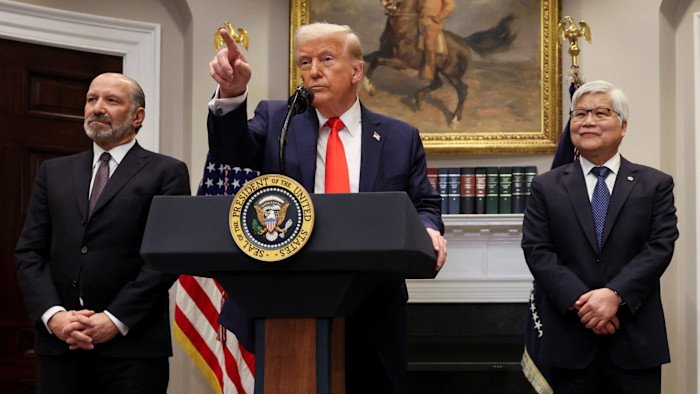
Unlock the White House Watch newsletter for free
Your guide to what Trump’s second term means for Washington, business and the world
The US and Taiwan have agreed to reduce tariffs on a range of food imports and other products as they officially signed a trade agreement on Thursday.
Donald Trump last week announced that the US would slash tariffs on Taiwan to 15 per cent in exchange for a $250bn investment in the US chip industry, as Washington moves to secure semiconductor supply chains and boost investment in American manufacturing.
The move brings duties on Taiwanese products in line with those levied on Japan and South Korea, and comes with a US promise to waive tariffs on generic drugs, aerospace parts and natural resources unavailable in the US.
The agreement also ends a disadvantage for Taiwan as its new bilateral tariff rate puts it on a par with other important US trading partners.
According to the full text of the deal, the US will remove the “reciprocal” tariffs on some imports from Taiwan including fruits, spices and coffee.
The Trump administration has already moved to exempt many agricultural products from its broader reciprocal tariffs as part of efforts to control grocery prices for US consumers.
The text of the deal contained large purchasing commitments from Taiwan, which has agreed to spend $44.4bn on liquefied natural gas and crude oil, $15.2bn on civil aircraft and engines, and $25.2bn on power equipment over the next three years.
Taiwan also agreed to reduce tariffs on US goods, including on autos and auto parts, chemicals, seafood, machinery, health products, electrical products, metals and minerals, as well as many US agricultural products.
US trade representative Jamieson Greer said the agreement would “significantly enhance the resilience of our supply chains, particularly in high-technology sectors”.
Greer added it would also “eliminate tariff and non-tariff barriers facing US exports to Taiwan, furthering opportunities for American farmers, ranchers, fishermen, workers, small businesses and manufacturers”.