dailynewsnblog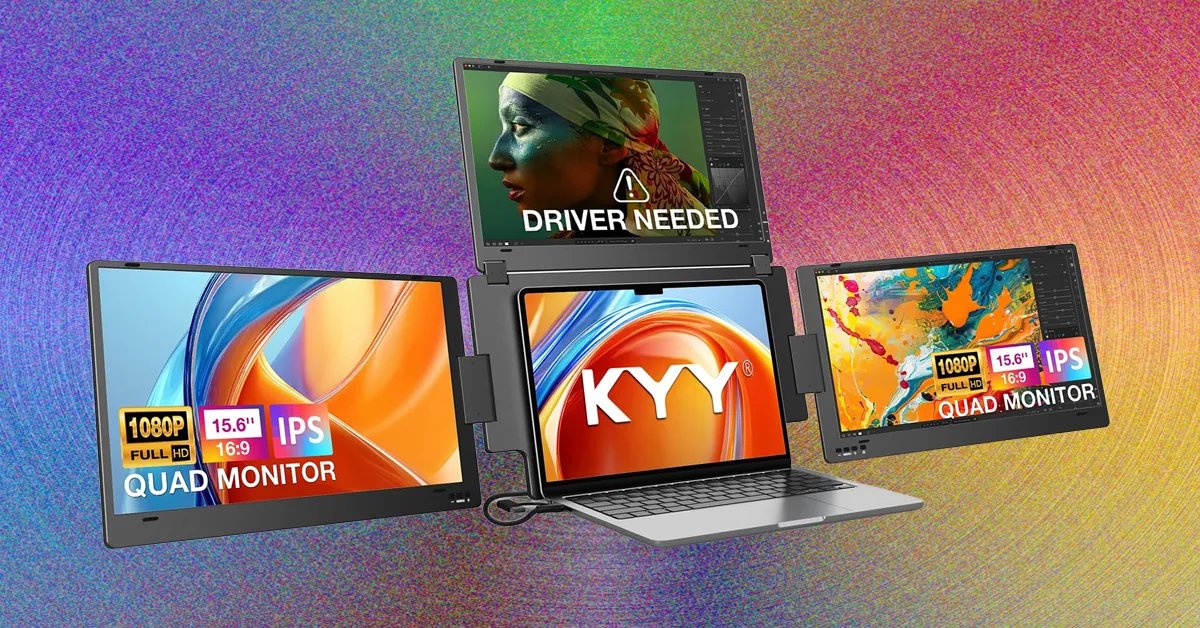
One folds out to the left, one to the right, and one upwards; your laptop (there’s room for up to a 17.3-inch machine) is meant to sit in the middle of this arrangement, providing the fourth screen in a quad-display setup. The screen on top can swivel back so that it faces away from the user, offering the potential to use that screen for presentation purposes (while still giving you three forward-facing screens to work on yourself). The panels have no audio capabilities.
Fully extended, the thing is a monster, stretching nearly 46 inches (nearly 4 feet) from side to side and 18 inches vertically. With a weight of 6.4 pounds, it also adds significantly to your travel load, though it’s clearly not designed for use in situations where real mobility is required.
Size isn’t the only challenge on the portability front: The KYY X90G also draws a significant amount of power—up to 30 watts. If your computer’s USB port can output that amount of wattage, the X90G can run via a single USB-C cable connection to one of the two ports on the backing board. Mine seemed to offer enough juice at first, but once I started turning the brightness up to something usable (and drawing more juice), the screens began to flicker and fail. Fortunately, KYY includes an extra USB-C cable and power adapter that, once connected to an outlet, ensured I ran into no further power consumption issues. That does, however, mean you’ll likely need access to two AC outlets for a typical laptop setup to work properly—another strike against attempting to fire all of this up at a Starbucks.
Each screen includes its own hardware controls, allowing for individual configuration, a traditional three-button affair that launches a simple menu system whereby you can adjust brightness, color, and contrast, and fine-tune the positioning of the screen. The default brightness of 30 (out of 100) was far too dim for usability, but otherwise I found the factory settings to be workable. I tested the X90G with a Windows laptop, and it was simple to arrange the three screens around my central display in the Display settings control panel to extend my desktop in all directions.
Resolution Restrictions

Photograph: Chris Null
In today’s laptop world, 1080p resolution doesn’t get you far, and I found this to be the major limiting factor for the device, restricting the utility of the three extra screens due to the limited amount of content I could populate each of them with. Realistically, a minimum 1920 x 1200-pixel resolution is needed to make this extra screen real estate practical for knowledge work, though it’s fine for more casual content.