dailynewsnblog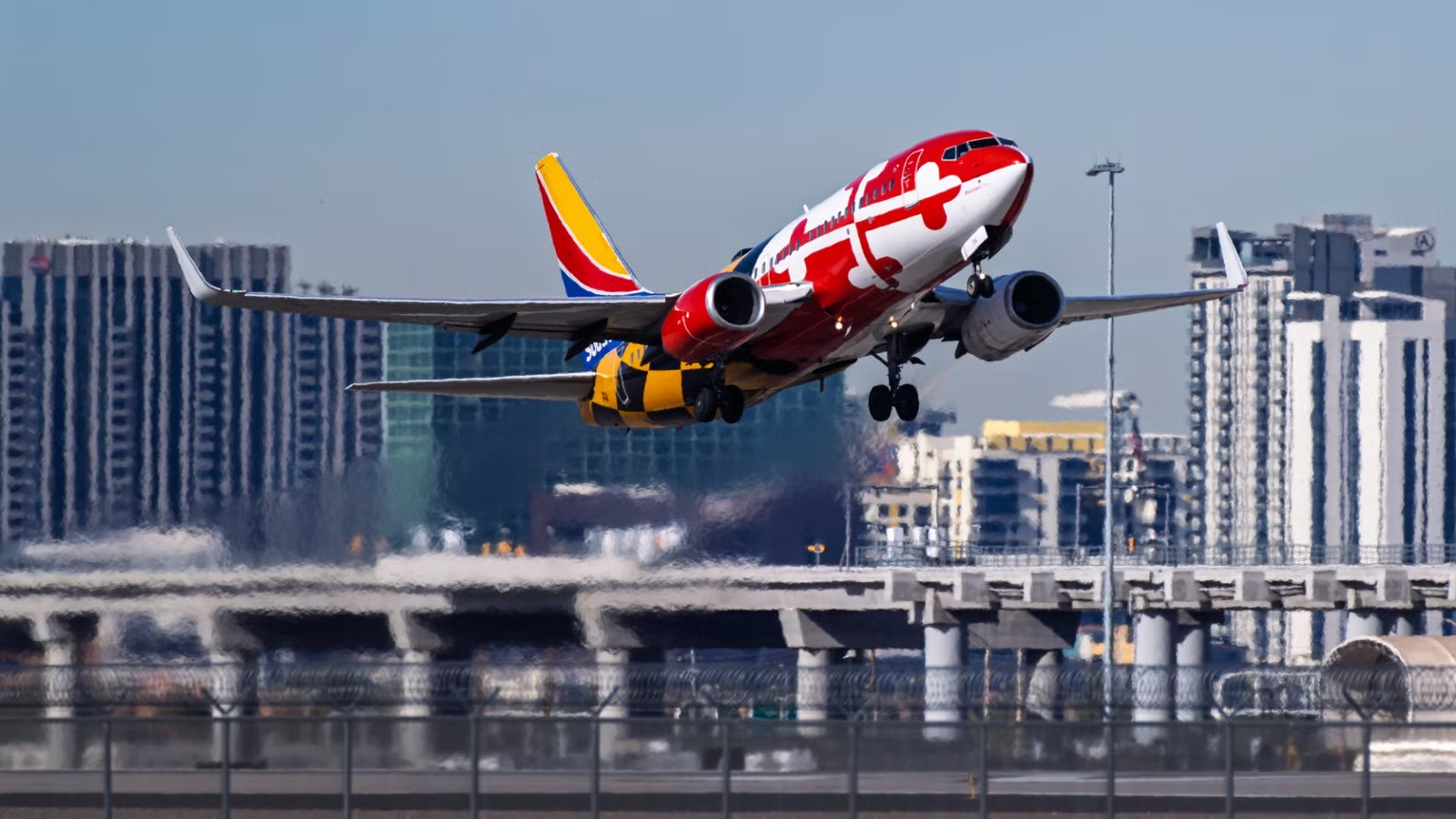
 Southwest Airlines made its on-board Wi-Fi free for the first time in late 2025. Now in 2026, America’s biggest affordable air carrier is slated to get the fastest in-flight internet service available thanks to a deal with Starlink. The program will start with 300 of the airlines’ Boeing 737s, which accounts for roughly one in three of the 799-strong all-Boeing fleet.
Amid the widely unpopular policy changes to its baggage and boarding policies, free high-speed Wi-Fi is likely to make a major difference in customer satisfaction overall. The Points Guy reports that the first batch of 300 Starlink-equipped jets is expected to be completed by the end of this year.
The Starlink Difference

The innovative space-based Wi-Fi company, Starlink’s constellation of over 9,400 satellites in Low Earth Orbit (LEO) is powered by SpaceX. Starlink offers true global coverage, including international waters, high latitudes, and polar regions. Starlink’s aviation service takes advantage of its unique network to provide a smooth and reliable internet experience even at 35,000 feet.
The satellites use optical space lasers to transmit data, allowing for continuous service even when far from ground stations, like over the open ocean. Starlink service delivers download speeds of up to 250 megabytes per second or more, which is significantly faster than traditional rivals like Viasat. Its download and upload rates enable 4K streaming and lag-free video calls during flight.
Hawaiian Airlines was the first major commercial carrier in the United States to offer Starlink service on its Jets when the fleet introduced the Airbus A321 Neo in February 2024, followed by the A330 in October of that same year. United Airlines followed with a deal late in 2024 and installation on Regional Jets as well as Boeing 737s throughout 2025.
Alaska Airlines also announced early this year that it will be rolling out Starlink to its Fleet, beating Southwest to be the third carrier in the US by mere weeks. Tony Roach, Executive Vice President, made these remarks in the Southwest announcement:
“Starlink delivers that at-home experience in the air, giving Customers the ability to stream their favorite shows from any platform, watch live sports, download music, play games, work, and connect with loved ones from takeoff to landing.”
New Year, New Southwest

This year marks the most significant transformation in Southwest Airlines’ 55-year history. After decades of a ‘no-frills’ model, the carrier is shifting toward a premium-focused strategy to compete with legacy airlines. As of January 27, 2026, Southwest officially retired its signature open seating policy, and all passengers now board in a one-to-eight numbered group system with assigned seats.
The airline is retrofitting its fleet to offer tiered comfort levels for the first time. Extra Legroom (ELR) seats offer up to 5 inches of additional pitch and occupy roughly one-third of the cabin. Passengers in these seats receive Group 1 or 2 boarding, complimentary premium beverages, and snacks.
High-speed USB-A and USB-C ports are also being installed across the fleet. All new 737 MAX deliveries coming from the factory with them. Older 737-700s are being retrofitted with the work beginning in early 2026.

“You Used To Be The Best”: Southwest Airlines’ Assigned Seats Continue To Cause Uproar
Unhappy American flyers blast corporate change ups.
All 737s, All The Time

Southwest Airlines operates the fourth-largest fleet of commercial aircraft in the world. Yet with its enormous number of jetliners, the American low-cost carrier continues to fly only one type of plane: the Boeing 737. Even after the crashes of the Lion Air and Ethiopian Airlines 737 MAXs, which killed nearly 350 people and resulted in the longest industry-wide grounding of any airliner in history, Southwest stood by Boeing.
Southwest’s entire business model is built on the efficiency of a single fleet type. Thanks to that loyalty, Southwest also enjoys an extremely preferential relationship with Boeing. Industry experts estimate it would cost Southwest billions of dollars to introduce a second aircraft type.
This relationship creates massive cost savings in three specific areas: pilot interchangeability, maintenance simplicity, and unified ground operations. While most competitors mix Airbus and Boeing to hedge their bets, Southwest has stuck with the 737 for over 50 years.