dailynewsnblog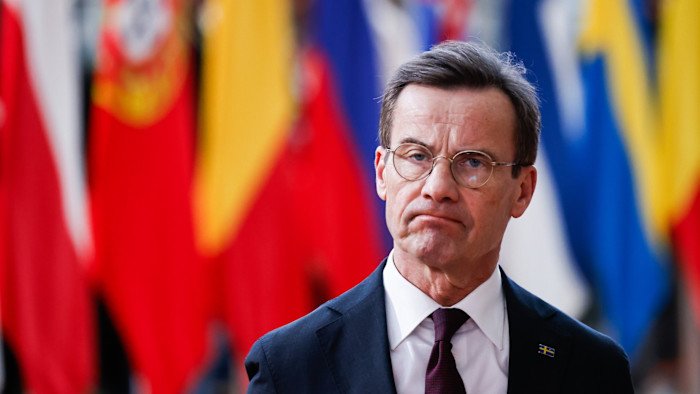
This article is an on-site version of our Europe Express newsletter. Premium subscribers can sign up here to get the newsletter delivered every weekday and fortnightly on Saturday morning. Standard subscribers can upgrade to Premium here, or explore all FT newsletters
Good morning. A scoop to start: Ukraine has started planning presidential elections alongside a referendum on a peace deal with Russia after the Trump administration pressured President Volodymyr Zelenskyy to hold the votes by May 15 or risk losing US security guarantees, officials told the FT.
Today, Sweden’s Prime Minister Ulf Kristersson tells us that the EU must stop blaming geopolitical crises for its inaction to rescue the bloc’s economy. And our climate correspondent hears why the bloc’s emissions trading system may not be doomed after all.
Eyes on the prize
The EU needs to focus on rebooting its economy and stop blaming its inertia on external crises or geopolitical distraction, Sweden’s prime minister has said.
Context: EU economic growth is tepid at best and the continent has spent the past two decades falling behind global rivals such as the US and China. EU leaders meet tomorrow for a summit focused on finding solutions.
“Big crises always consume all the oxygen and we have seen quite a few of them from Greenland to . . . Ukraine,” Ulf Kristersson told the FT in an interview in which he outlined his vision of how to revive the EU economy. “If we can’t do it now, I wonder what crisis could actually help us do it, honestly.”
US President Donald Trump’s threat to annex the Danish Arctic island of Greenland is the latest example of a crisis that distracted Europe, but also made stark the need to better stand up for itself and reform.
“What the Americans have done recently, not least regarding Denmark and Greenland, is damaging in the sense of credibility or trustworthiness,” Kristersson said. “[But] building up European competitiveness has been a problem far before that happened. So we shouldn’t use that too much as a reason for becoming more self-reliant.”
“There is a growing consensus that Europe simply cannot continue as [if] nothing has happened in the world,” he added.
That approach is echoed in other capitals. “Europe needed to do this for a while, irrespective of the relationship with the United States,” Romania’s foreign minister Oana Toiu told the FT. “What changed is that the United States has created this acceleration effect.”
Toiu added: “We need to realise that inside our single market, inside the European Union, we haven’t yet made enough effort of cutting the red tape between countries . . . a lot of these barriers are created by [EU] nations themselves.”
Yet even Kristersson is wary of expecting major breakthroughs tomorrow given the multitude of national red lines on reform.
“There are a lot of legitimate competing interests, of course, and there are different kinds of governments and different kinds of [political] majorities. And there are lots of obstacles to doing things,” Kristersson said. “Different countries prioritise different things, even though we all would benefit from a more competitive Europe.”
Chart du jour: Gender roles

Why are fertility rates collapsing? For many women, a big part of the decision to have children depends on how they expect their husbands to behave, argues Martin Wolf.
Trading barbs
The EU’s climate commissioner has hit back against criticism of the bloc’s emissions trading system, saying that it was “lazy” to lay the blame for Europe’s waning competitiveness on its flagship climate policy, writes Alice Hancock.
Context: The EU is home to the world’s oldest emissions trading system (ETS), which charges companies for the carbon dioxide they emit. Businesses have the right to a number of free allowances, which will decrease over time.
Carbon costs — alongside high energy prices, bureaucracy and global competition — are among the complaints of industry leaders who will meet with heads of state and EU commissioners today in Antwerp to air their concerns about the state of the EU’s economy.
EU climate commissioner Wopke Hoekstra, however, told the FT that he thought it was “intellectually lazy to bash the ETS”.
“No policy is perfect. But it is, at least the way it is designed, as good as it gets. And many, many companies have had very substantial amounts of free allowances which should have been a trigger to invest,” Hoekstra said.
A review of the ETS due later this year has prompted lobbying from national politicians and heavy industries calling for more free allowances to reduce costs.
Hoekstra noted that the European Commission was “looking at the design”, but that there were also many companies “very much in favour” of the system.
He also said that there was more opportunity “at national level” for ETS revenues to be recycled back to industries to support decarbonisation.
What to watch today
EU leaders attend European industry summit in Antwerp.
Nato secretary-general Mark Rutte holds press conference ahead of tomorrow’s defence ministers meeting in Brussels.
Now read these
Recommended newsletters for you
Free Lunch — Your guide to the global economic policy debate. Sign up here
The AI Shift — John Burn-Murdoch and Sarah O’Connor dive into how AI is transforming the world of work. Sign up here
Are you enjoying Europe Express? Sign up here to have it delivered straight to your inbox every workday at 7am CET and on Saturdays at noon CET. Do tell us what you think, we love to hear from you: europe.express@ft.com. Keep up with the latest European stories @FT Europe