dailynewsnblog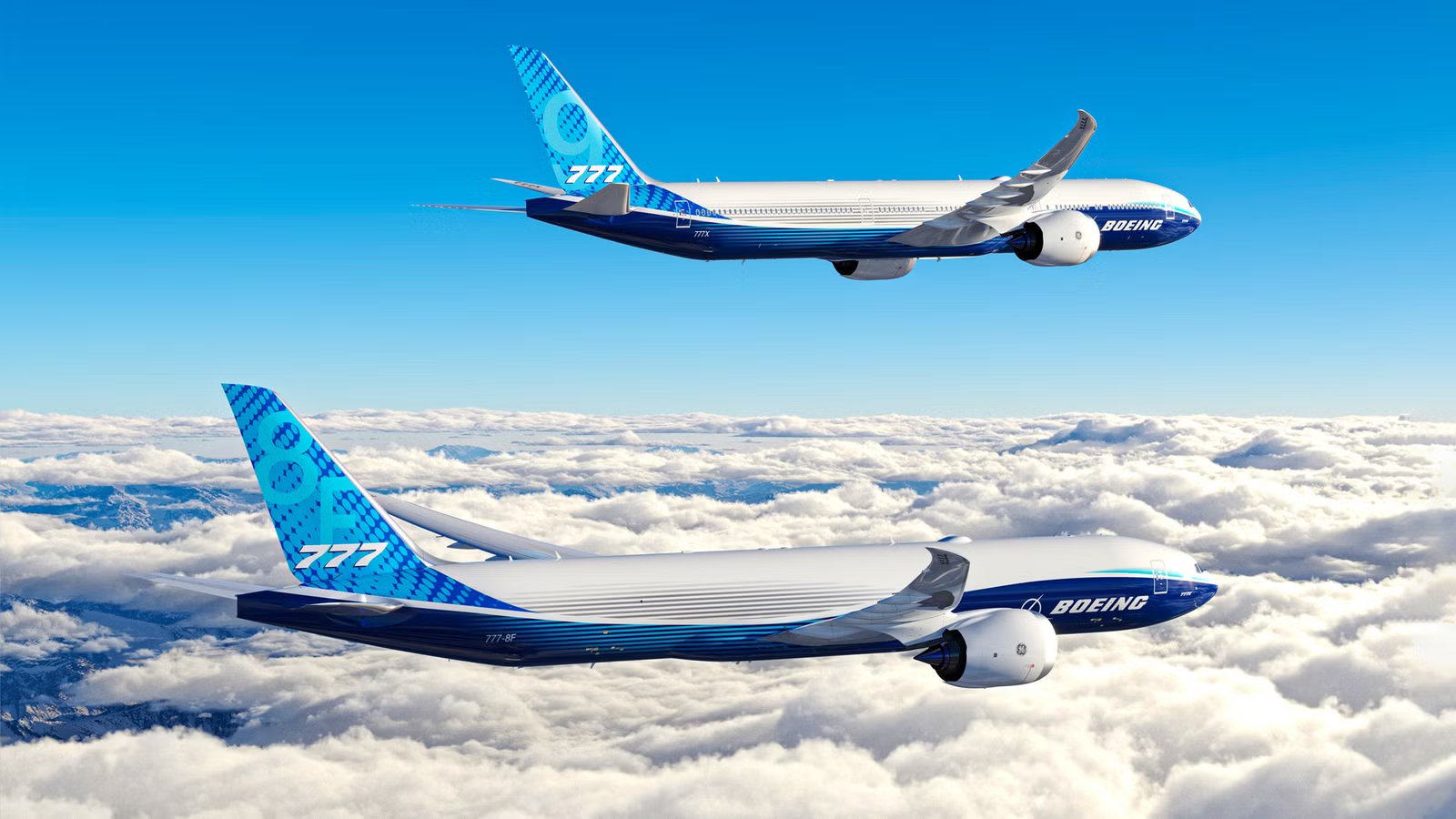
As the global air cargo market demands greater efficiency and sustainable operations, the aviation industry is turning its attention to the next generation of heavy-lift freighters. The Boeing 777-8 Freighter has emerged as the most significant contender in this space, promising to combine the massive payload capabilities of legacy quadjets with the fuel economy of a modern twin-engine airframe. This guide provides a detailed look at the aircraft’s specifications, its current production status, and how it compares to its primary rival, the Airbus A350F, in the race to dominate the future of logistics.
The importance of the 777-8F cannot be overstated, particularly as operators look to replace aging fleets of Boeing 747-400Fs and MD-11Fs that are nearing retirement. With production officially commencing in July 2025 at Boeing’s Everett facility, the program has transitioned from a design concept to a tangible industrial reality. Supported by a backlog that had grown to 68 firm orders by the end of 2025, including major commitments from  Qatar Airways and Cargolux, the 777-8F is poised to become the centerpiece of long-haul freight for the next two decades.
Outclassing An Icon

The primary selling point of the Boeing 777-8 Freighter is its ability to offer payload performance that rivals the legendary Boeing 747-400F while burning significantly less fuel. The aircraft is designed with a maximum structural payload of 118 tonnes or approximately 118,000 kg, making it the most capable twin-engine freighter ever built. This capacity allows carriers to transport high-density goods, such as automotive parts and heavy machinery, on long intercontinental routes that were previously the exclusive domain of four-engine jumbo jets.
In terms of reach, the 777-8F offers a range of 4,410 nautical miles or 8,167 km at max payload, which provides operators with fewer fuel stops and faster connection times between major trade hubs like  Hong Kong and Anchorage. This range is achieved through the use of the new carbon-fiber composite wing, which spans 71.8 meters, and the massive General Electric GE9X engines, which are 10% more efficient than the GE90 engines powering the current 777 Freighter. This combination ensures that the aircraft can serve the major international cargo lanes without the payload penalties often associated with older twin-jets.
Critically, the 777-8F is designed to integrate seamlessly into existing 777 operations. It features a fuselage length of 70.9 meters, between the 777-200 and 777-300 sizes, which allows it to use standard airport infrastructure while maximizing internal volume. For cargo operators, this family commonality means that pilots certified on the passenger 777X or existing 777F can transition to the new freighter with minimal additional training, a significant cost-saving factor that  Boeing is banking on to secure orders over the Airbus A350F.
All New Design For The Cargo Industry

The 777-8 Freighter achieves its performance gains through the General Electric GE9X engines and an all-new high-aspect-ratio composite wing. The GE9X is the largest and most powerful commercial aircraft engine ever built, featuring a massive 134-inch fan. These innovations allow the engine to deliver a 10% improvement in fuel efficiency compared to the GE90-115B engines found on the current 777F, while simultaneously reducing NOx emissions by 50%.
Perhaps the most visually distinctive feature of the 777-8F is its folding wingtips, a design necessity driven by the aircraft’s massive 235-foot 5-inch (71.8 m) wingspan. While this span provides an improved lift-to-drag ratio, classifying it as a code F aircraft in flight, the tips fold upward on the ground to reduce the span to 212 feet 8 in (64.8 m). This crucial mechanism allows the freighter to taxi and park at existing code E gates and taxiways used by the Boeing 777-300ER and Boeing 747-400, ensuring that operators do not need to invest in specialized airport infrastructure.
|
Feature |
777-8 Freighter |
777 Freighter (Current) |
|
Engines |
2x GE9X |
2x GE90-110B |
|
Max Revenue Payload |
112.3 tonnes (247,500 lbs) |
102.0 tonnes (224,900 lbs) |
|
Main Deck Capacity |
31 pallets |
27 pallets |
|
Range |
4,410 nm (8,167 km) |
4,970 nm (9,200 km) |
|
Wingspan (Ground) |
212 ft 8 in (Folded) |
212 ft 7 in (Fixed) |
The 777-8F is designed to meet strict environmental standards. By offering significantly lower fuel burn and CO2 emissions per tonne compared to the 747-400F it replaces, the aircraft provides a future-proof solution for airlines facing tightening carbon regulations. This efficiency increase is a primary reason carriers like Qatar Airways and Cargolux have committed to the 777-8F to anchor their long-haul logistics through the 2030s.

Which Airlines Have Ordered The Boeing 777X? A Complete List
Around a dozen airlines have placed orders for around 500 Boeing 777X, with the first set for delivery in 2026.
Efficient, Not Just Because Of Performance

The transition to the 777-8 Freighter represents a significant leap in volumetric efficiency, specifically tailored to the main deck requirements of modern global logistics. While previous sections focused on aerodynamic and engine innovations, the aircraft’s interior is where the operational value truly resides, offering a total cargo volume of 27,056 cubic feet (766.1 cubic meters). This design provides approximately 17% more volume than the current 777 Freighter, allowing it to accommodate 31 standard 96 x 125-inch pallets on the main deck alone.
To support this increased volume, Boeing has reinforced the floor and optimized the large cargo door to handle the 777-8F’s 118-tonne structural payload. The loading system is designed for rapid turnaround times, utilizing an automated power drive unit system that allows ground crews to reposition heavy pallets with precision. While the 777-8F lacks the nose-loading capability of the 747-400F, its superior side-door height and width allow for the transport of tall cargo, up to 118 inches or 3 meters high, that was previously difficult to fit on smaller twin-engine platforms.
|
Aircraft Type |
Main Deck Pallet Count (96″ x 125″) |
Maximum Cargo Height |
|
Boeing 777-8F |
31 Positions |
118 inches |
|
Boeing 777F |
27 Positions |
118 inches |
|
Airbus A350F |
30 Positions |
118 inches |
|
Boeing 747-400F |
30 Positions |
120 inches |
Beyond the main deck, the 777-8F features a versatile lower lobe that accommodates an additional 13 pallets or a mix of bulk cargo and unit load devices. This dual-level capacity ensures that even when the main deck is full of heavy machinery, the belly can be utilized for lighter, time-sensitive parcels. By balancing these loading zones, operators can achieve a more favorable center of gravity, further enhancing the efficiency gains provided by the GE9X engines and ensuring the 777-8F remains a flexible asset for diverse cargo types.
The Rivalry Continues

Airbus, Simple Flying
The Boeing 777-8 Freighter enters a market where it must directly confront its most formidable rival, the Airbus A350F. While the 777-8F builds on the massive capacity legacy described in previous sections, the A350F utilizes a clean-sheet design primarily constructed from advanced carbon-fiber composites. This material difference creates a distinct performance split, where the A350F is approximately 28-30 tonnes lighter in operating empty weight, allowing it to offer a superior range of 4,700 nautical miles (8,704 km). This makes Airbus a specialist for long-haul, lower-density e-commerce routes, whereas the 777-8F remains the unrivaled choice for carriers prioritizing maximum structural payload over ultra-long distances.
From a volumetric and loading perspective, the 777-8F maintains a clear advantage for high-density logistics. As noted earlier, Boeing’s freighter accommodates 31 main deck pallets compared to 30 on the A350F, and its total cargo volume of 766 cubic meters is about 10% greater than that of its European competitor. Airbus has countered this by introducing an extra-large cargo door that is 175 inches wide, specifically designed to simplify loading massive Trent XWB engines and oversized machinery. However, Boeing’s code E airport compatibility, achieved through the folding wingtips, gives it an edge in operational flexibility at existing 747 and 777 hubs where ramp space is at a premium.
As of early 2026, the battle for market dominance is closely contested. While Airbus enjoyed an early advantage and secured 82 firm orders by late 2025, Boeing has seen a significant resurgence in widebody confidence, trailing slightly with roughly 60 confirmed orders for the 777-8F. Most airlines’ decisions currently depend heavily on fleet commonality. Existing A350 passenger operators are gravitating toward the A350F to minimize training costs, while loyal Boeing 747 and 777 operators view the 777-8F as the only logical successor capable of maintaining their current pallet-heavy networks.

The Aircraft Replacing The Boeing 767 In Cargo
The most likely candidate to replace the 767 freighter is the 777-8F, the freighter variant of the upcoming and long-delayed 777X.
Still Being Delayed?

A frequent question among industry analysts and logistics providers is when the 777-8 Freighter will actually begin moving revenue cargo. Following the commencement of production in July 2025 at Boeing’s Everett facility, the program has entered a critical phase of structural assembly and systems integration. Current projections from Boeing and launch customer Qatar Airways suggest that the first delivery is on track for 2028, though delays have become persistent, allowing for a rigorous one-year flight testing and certification campaign that will lean on data from the already-flying 777-9 passenger variant to accelerate the process.
This timeline is strategically aligned with the retirement wave facing many legacy fleets. Already, hundreds of MD-11Fs and early-model 747-400Fs are reaching the end of their economic lives due to mounting maintenance costs, stricter noise regulations and safety concerns. Boeing is prioritizing the 777-8F production line to ensure that as these older trijets and quadjets depart, the 777-8F is ready to fill the void, providing a much-needed capacity bridge for global trade hubs that cannot afford a lapse in heavy-lift capabilities.
The transition from production to operation also involves a massive logistical undertaking in pilot training and ground support. The 777-8F shares the same advanced cockpit architecture as the rest of the 777X family, allowing airlines to utilize universal flight simulators to train crews well before the physical aircraft arrive. This approach ensures that on the day the first 777-8F touches down in Doha or Luxembourg, there will be a fully qualified cohort of pilots ready to take the controls, minimizing the downtime typically associated with introducing a new aircraft type.
The Face Of The Future

The arrival of the Boeing 777-8 Freighter marks a definitive shift toward a twin-engine-only future for the world’s heavy-lift networks. While the aviation industry has long relied on the four-engine power of the 747, the 777-8F demonstrates that modern materials and propulsion can deliver comparable performance with a much smaller environmental footprint.
For operators, the 777-8F offers the lowest ton-mile cost in its class, ensuring that long-haul cargo remains profitable even in a volatile fuel market. The integration of high-density loading, which accommodates 31 main-deck pallets, ensures the aircraft can handle the rapid growth of global e-commerce without sacrificing its ability to carry heavy industrial machinery. The 777-8F is set to become the standard by which all other long-range freighters are measured, providing a versatile platform that balances raw power with unprecedented efficiency.
Ultimately, the 777-8F is the final piece of the 777X puzzle, completing a family of aircraft designed to dominate the ultra-long-haul market for decades to come. The aviation world is witnessing the birth of a new cargo king. For the pilots, ground crew, and logistics managers who will interact with this aircraft, the 777-8F represents a feat of engineering that will define the next era of global trade.