dailynewsnblog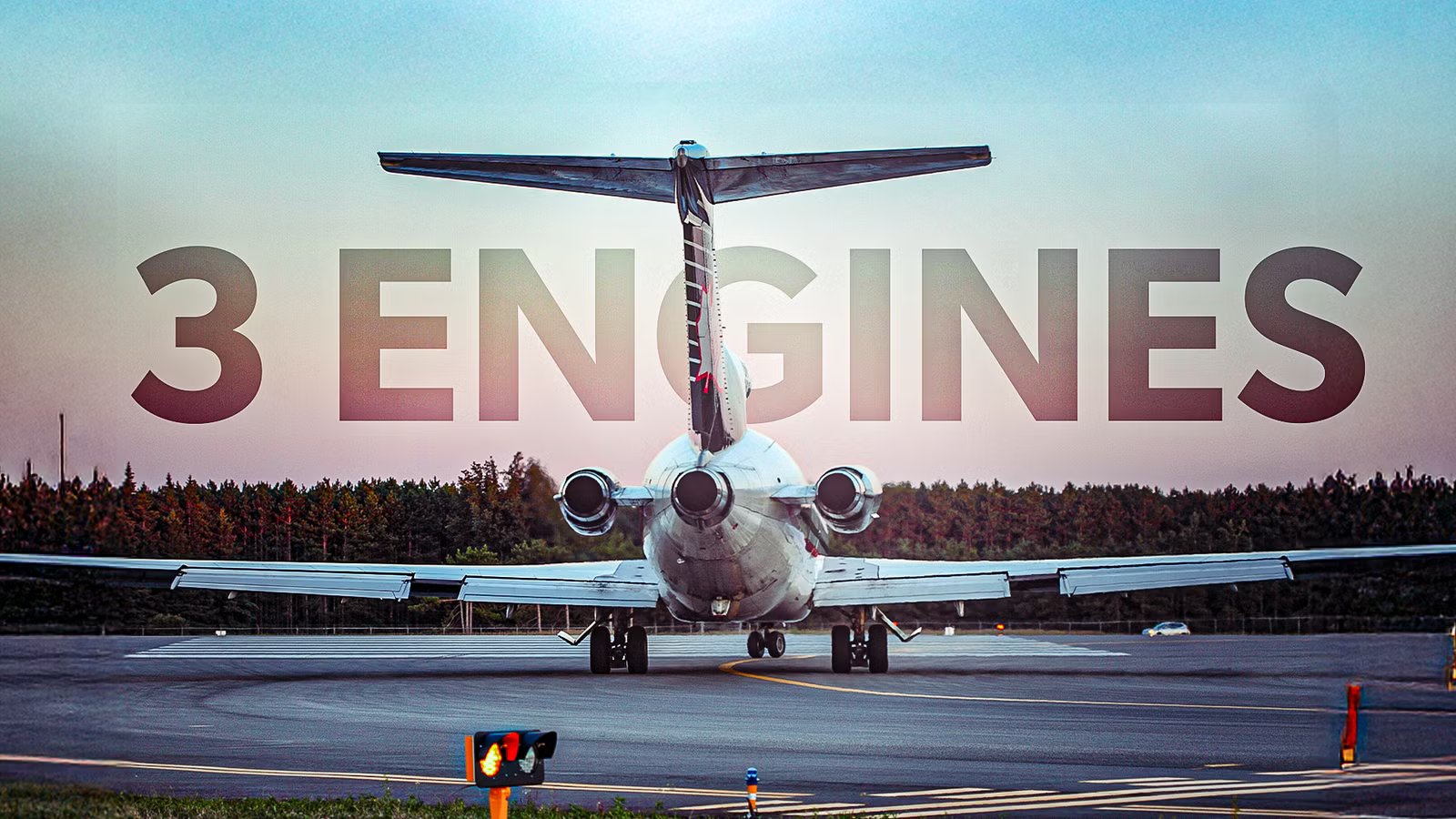
When the  Boeing 727 first entered service in the early 1960s, its distinctive trijet configuration immediately stood out. With one engine mounted in the tail and two more flanking the rear fuselage, the design diverged from the twin-engine and quad-engine jets emerging at the time. So why did Boeing choose this setup? Understanding the rationale behind the 727’s three-engine layout reveals a complex mix of airline demands, regulatory challenges, and the technological constraints of the early jet age.
The 727 emerged as Boeing’s answer to shrinking runways, high-altitude hubs, and evolving overwater safety rules. This article unpacks the rationale behind its three-engine arrangement, examining the commercial negotiations, engineering constraints, and competitive pressures that shaped one of aviation’s most iconic workhorses.
What Is The Short Answer?

Boeing ultimately settled on three engines for the 727 as a compromise between its three launch customers:
-
 United Airlines
needed an aircraft capable of operating from “hot and high” airports like Denver. -
 American Airlines
wanted the fuel efficiency and simplicity of a twin-engine jet. -
Eastern Airlines
required a third engine to meet overwater flight regulations, which, in the early 1960s, prohibited twinjets from flying more than 60 minutes away from a diversion airport.
By placing two Pratt & Whitney JT8D low-bypass turbofans on the rear fuselage and one fed through an S-duct under the tail, Boeing delivered a jet that met all three carriers’ priorities.
Behind the simple count lies a web of technical and commercial factors: engine power and reliability at the time, runway length constraints, evolving ETOPS rules, and the need to avoid heavy wing reinforcements. The three-engine layout struck a balance, offering sufficient thrust for short-field performance without the weight and drag penalty of four pods, while granting regulatory clearance for Caribbean and Gulf routes that a pure twin could not yet enjoy.
Historically, the 727’s compromise paid off spectacularly. Launched in 1960 with just 40 initial orders, it eventually surpassed Boeing’s 200-unit break-even target, becoming the company’s top-selling airliner until the advent of the 737. Its trijet configuration, paired with triple-slotted flaps and the industry’s first onboard APU, powered Boeing into dozens of smaller markets around the globe. Today, only 19 aircraft remain in active service.
The Technical Drivers Behind The Trijet Choice

The decision to go trijet was not purely marketing; several intertwined factors forced Boeing’s hand.
- Engine Power Limitations: Early versions of the JT8D engine delivered 13,600–16,100 pounds of thrust, not enough for a two-engine aircraft with 130+ passengers operating from short or high-elevation runways. A four-engine setup would have added unnecessary drag and complexity, while a twin simply lacked thrust redundancy.
- Overwater Regulations: At the time, U.S. regulations restricted twin-engine aircraft to routes within 60 minutes of an emergency landing field. This severely limited their use on the Caribbean and Gulf of Mexico routes. By adding a third engine, Boeing ensured that Eastern Air Lines could serve these lucrative markets without regulatory obstacles.
- Short Runway Requirements: Many second-tier airports had runways of just 4,500 feet (1,372 m), too short for aircraft like the Boeing 707. The 727’s triple-slotted flaps provided superior lift on takeoff, and its rear-mounted engines left the wings clean, enhancing aerodynamics. Three engines were the minimum needed to achieve the required performance while keeping structural weight in check. The 727’s swept wing and advanced triple-slotted flap system generated extra lift, and its tail-mounted engines avoided wing-mounted drag, but only three engines could deliver the necessary takeoff thrust without overburdening the wing structure.
These variables illustrate why Boeing chose three engines: it provided adequate overall thrust (comparable to a four-engine layout), reduced the need for costly wing structural reinforcement, and immediately cleared overwater legislative hurdles, without the twinjet’s certification wait.
The Signature T-Tail And A Legendary Mystery

One of the Boeing 727’s most recognizable features is its T-tail configuration, with the horizontal stabilizer mounted atop the vertical fin. This design wasn’t just aesthetic; it allowed Boeing to position all three engines at the rear of the fuselage, freeing up the wings for clean aerodynamics and eliminating the need for heavy reinforcement to carry engine nacelles.
The high-mounted tail also enhanced the aircraft’s lift during takeoff and landing, crucial for operations from short or high-altitude runways. However, it did bring trade-offs, such as the risk of deep stalls and increased structural complexity. Despite these challenges, the T-tail helped define the 727’s sleek silhouette and performance edge.
The rear airstair, another hallmark of the Boeing 727, enabled passengers to board without jet bridges, especially at smaller airports. But it also became a part of aviation lore on November 24, 1971, when a man known only as D.B. Cooper hijacked a Northwest Orient 727 , extorted a $200,000 ransom, and parachuted from the rear stairwell midflight, never to be found. The incident led the FAA to mandate an anti-hijack modification known as the “Cooper vane,” a simple mechanical latch that prevented rear stair deployment while airborne. The 727’s tail and its hijacking legacy remain uniquely linked in aviation history.
The Boeing 727 And Its Competitors

Had Boeing gone with two engines, the fledgling Pratt & Whitney JT8Ds of 1963 would barely generate sufficient thrust for the 727-100’s 106 to 129 passenger loads, especially in hot, high fields. That twinjet concept later evolved into the McDonnell Douglas DC-9, BAC One-Eleven, and McDonnell Douglas MD-80 series once ETOPS and engine thrust improved, but those came years after the 727’s 1964 introduction.
Rather than burden airlines with the quadjet’s inefficiencies or expose them to twinjet overwater limitations, the 727’s trijet layout struck a middle ground. It preserved low-drag T-tail aerodynamics, kept fuel burn competitive on 200- to 2,400-mile flights, and leveraged overwater clearance to open Caribbean and Mediterranean markets without waiting for longer ETOPS rule-making.
But Boeing was not alone in experimenting with this architecture. On the other side of the pond, Hawker Siddeley produced another trijet airliner, the Trident, and a few years after the 727’s introduction, the Soviet Union was also inspired by the trijet formula, building the Tupolev Tu-154M.
|
Specification |
Boeing 727-200 |
Hawker Siddeley HS-121 Trident 2E |
Tupolev Tu-154M |
|---|---|---|---|
|
First Flight |
Feb 9, 1963 |
Jan 9, 1962 |
Oct 4, 1968 |
|
Introduction |
Feb 1, 1964 |
April 1, 1964 |
1972 |
|
Total Units Built |
1,832 |
117 |
~1,025 |
|
Engines |
3 × P&W JT8D (14–17.4k lbf) |
3 × RR Spey Mk512 (12k lbf) |
3 × Soloviev D-30KU-154 (25k lbf) |
|
Max Passenger Capacity |
189 |
149 |
180 |
|
Range |
2,550 nm (4,720 km) |
2,084 nm (3,860 km) |
3,280 nm (6,100 km) |
|
Cruise Speed |
Mach 0.84 (539 kt) |
Mach 0.82 (526 kt) |
Mach 0.86 (567 kt) |
|
Service Ceiling |
42,000 ft (12,802 m) |
36,000 ft (10,973 m) |
39,400 ft (12,000 m) |
|
Wingspan |
108 ft (32.9 m) |
97 ft 12 in (29.87 m) |
123 ft (37.5 m) |
|
Length |
153 ft (46.68 m) |
114 ft (34.98 m) |
157 ft (47.9 m) |
The Hidden Costs Of 727’s Engines

While the Boeing 727’s trijet configuration offered a balanced solution for performance, regulation, and range, it was not without significant challenges. The central number-two engine, embedded in the tail and fed by a distinctive S-duct, was a particular point of concern. Although this layout allowed for a clean wing design, it introduced complex airflow dynamics. Disrupted air entering the S-duct could trigger compressor stalls, particularly during aggressive throttle changes. To mitigate these early issues, Boeing introduced vortex generators and reshaped inlet contours in later production blocks.
From a maintenance perspective, the number-two engine’s position created significant accessibility issues. Technicians frequently cited the difficulty of performing borescope inspections, leak checks, and line replacements due to the tight, elevated space. Access ladders and platforms were often required, increasing turnaround times and labor costs, especially compared to wing-mounted engine layouts on aircraft like the 737 or 757.
Another drawback was noise. The 727’s low-bypass JT8D engines emitted far higher decibel levels than later high-bypass turbofans, keeping the aircraft at FAA Stage 2 noise compliance throughout much of its life. As noise regulations tightened globally in the 1990s and early 2000s, many 727s had to be retrofitted with hush kits, bulky and expensive modifications that slightly reduced thrust and increased weight.
For airlines, this became a tipping point: the cost of compliance with Stage 3 noise rules often outweighed the value of continuing to operate the type. Combined with the arrival of quieter, more fuel-efficient twinjets like the 737NG and A320, the trijet was gradually retired from passenger service in most markets.
The Legacy Of The 727’s Three-Engine Layout

The Boeing 727’s three-engine design stands as a textbook case of compromise in aircraft development. It balanced power, performance, and regulatory compliance at a moment when engine reliability and certification frameworks were in flux. By merging Eastern’s call for overwater authorization, American’s thrust-to-weight efficiency concerns, and United’s hot-and-high requirements, Boeing created a versatile jet that dominated short- and medium-haul markets.
Today, the trijet configuration survives primarily in freighter and VIP conversions, but its legacy informs every engine-number decision in modern airliners. The trade-offs baked into the 727’s DNA still resonate as manufacturers weigh twin-engine ETOPS extensions against four-engine payload-range missions. Besides the few flying survivors, some 727s were scrapped, others ended their lives in museums, and one was converted into a private residence!