dailynewsnblog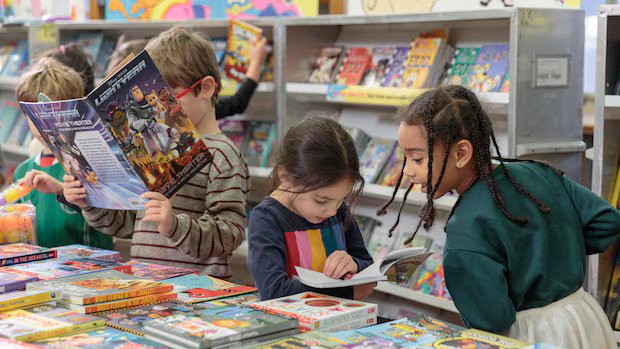
Cost of Living10:35How Scholastic became entrenched in Canadian schools
For many Canadians, Scholastic brings about an instant wave of nostalgia.
Memories come flooding back of flipping through colourful catalogues, circling must-have books, and browsing tables stacked with trinkets — from scented erasers to posters and pencils — set up in school auditoriums during book fair week.
For generations of elementary school students, Scholastic brought excitement and joy — and for many kids today, even in an age dominated by screens, that magic hasn’t faded, say educators.
“Kids bought one [book], then the next month, they were looking forward to [another], and it was just a great way to inspire kids to read,” Roberta MacDonald, who spent 53 years as an elementary school teacher, told Cost of Living.
Scholastic book fairs and catalogues run in 88 per cent of the more than 10,000 publicly funded elementary schools across Canada, according to the company.
On average, three million books are shipped across Canada each year through these initiatives.
Last year, Canadian schools hosted nearly 9,000 book fairs, and they are on track for similar numbers this school year.
So how has Scholastic built and maintained its prominence in children’s lives?

From classroom flyers to worldwide reach
Mark Leslie Lefebvre, former president of the Canadian Booksellers Association who has worked in the book industry for more than 30 years, says no Canadian children’s publisher seems “to have the footprint that Scholastic does.”
Founded in 1920 in Pennsylvania by Maurice R. “Robbie” Robinson, Lefebvre says Scholastic started off as a magazine publisher for young readers. Then, in 1926, it published its first book.
According to Lefebvre, Scholastic’s defining moment came in 1948, when the company launched book clubs, giving students the chance to order books directly using paper forms.

In 1957, Scholastic launched its first subsidiary in Canada.
It hosted its first school book fair in 1981, and two years later, brought the event to Canada, piloting programs in Vancouver and Toronto. The concept quickly caught on and became a recognized program within Canadian elementary schools.
Supporting literacy in underfunded schools
Joseph Jeffery, a district-level teacher-librarian in northern B.C. and chair of the non-profit Canadian School Libraries, says the book fairs offer critical incentives for schools.
Teachers receive a percentage of book fair sales, he says, with the option to take cash or Scholastic credit, which can be used to purchase books and materials directly from Scholastic.
When Jeffery ran Scholastic book fairs, he says he typically generated about $3,000 in funding — money that was essential in helping schools bridge what he describes as a growing gap in funding across Canada.
Education spending, he says, has failed to keep pace with rising costs, leaving school libraries particularly strained.
Without supplemental fundraising such as book fairs, many schools can afford little more than half a new book per student each year, he says.
According to Scholastic, Canadian schools earned a combined $20 million in rewards through book fairs and clubs last school year, with 90 per cent redeemed for books and materials for classrooms and libraries.
While Jeffery has explored partnerships with local bookstores for school book fairs, he says logistics remain a major barrier.
Scholastic’s warehouses, transportation networks and rapid delivery — often within one to two days — are difficult for smaller retailers to match.
Rethinking school book fairs
Still, Danika Ellis, an editor at Book Riot and former bookseller, says she is increasingly skeptical about school book fairs, calling them a form of “really conspicuous consumption” inside schools.
“If the goal is to celebrate books and reading and get kids excited about that, is a for-profit book fair the best way to do that?”
“We have kids who are walking away with huge stacks of books and posters and toys, and then kids who can’t have anything or have a lot less.”
As well, Lefebvre says one long-standing criticism of Scholastic book fairs within the industry is that they have become “a trinkets and trash show.”
Even so, he argues that the merchandise can still play a role in nurturing children’s interest in reading.
“A wand from Harry Potter or a stuffy of Clifford the Big Red Dog … can intrigue somebody into saying, ‘Where did this come from? Oh, it came from this series of books.’” Lefebvre said.

In an email statement to CBC, Scholastic said it aims to “spark a love of reading by meeting kids where they are.”
The company said items such as pens and journals can encourage children to write and draw, adding that schools ultimately decide what products are offered at their fairs.
As an alternative, Ellis suggests book swaps, where students bring books they no longer want and everyone leaves with something new — removing financial disparities from the equation.
Books spark a lifetime of curiosity
MacDonald, now retired, began teaching elementary school in the U.S. in 1969 before moving to Nova Scotia.

She credits Scholastic with fostering a lifelong love of reading in her students.
The book selection had a “great variety,” said MacDonald, ranging from how-to guides on cooking and drawing to titles that celebrated different cultures.
“When they discovered the Titanic, out came a Scholastic book on the Titanic,” she said. “As things are discovered in Egypt, there were more books about the pyramids.”
To ensure no student was left out, MacDonald used Scholastic rewards to order additional copies, which she put in her students’ report card envelope.

(Submitted by Roberta MacDonald)
Lefebvre says Scholastic’s scale — it is now the world’s largest publisher and distributor of children’s books — gives it enormous purchasing power, allowing it to keep prices relatively low.
“It’s really important for young people to have the autonomy of owning a book,” he said. “They can read it again and again and again, it doesn’t have to be returned, and it can be re-gifted.”
“The work that Scholastic can do in schools helps bring more of that access to students and young people.”