dailynewsnblog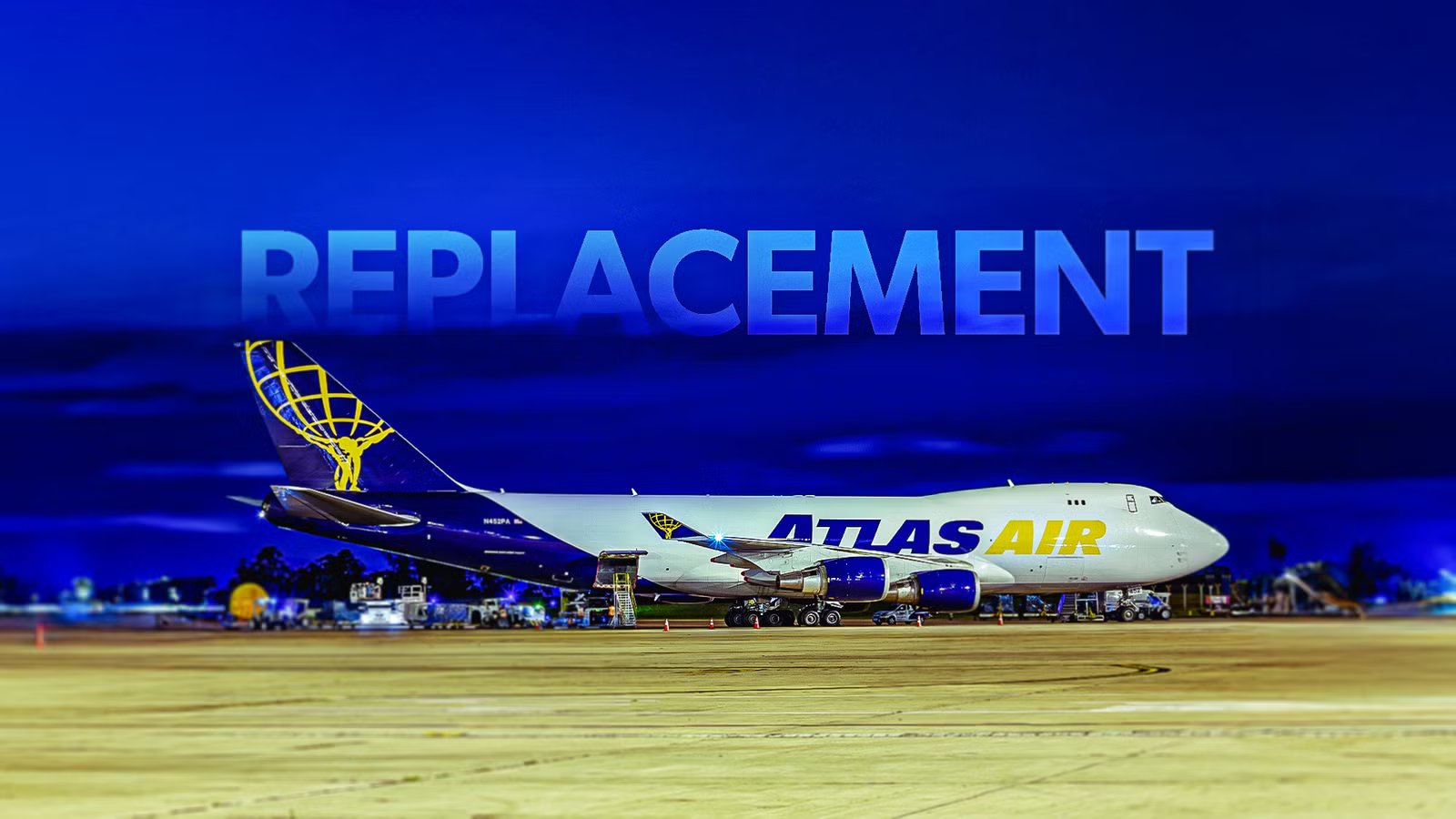
The Boeing 747 is the most iconic aircraft ever made, and although the passenger variants are rare today, even for newer variants, the 747 freighters continue to be popular. Cargo airlines care less about fuel costs and maintenance expenses, instead focusing more on capital costs. This means that a cheap 30-year-old Boeing 747 is an appealing aircraft, even if its age and quadjet configuration make it far thirstier than a modern twinjet freighter like the Boeing 777F.
There are hundreds of Boeing 747s in service with cargo airlines around the world. The famed “Queen of the Skies” is used by a wide variety of operators, including package giant UPS Airlines, charter carrier Atlas Air, as well as airlines such as CargoLux and freight divisions of passenger airlines. Today, the 747 is a cheap aircraft with massive interior volume as well as high lifting capacity, and factory-built freighters include a nose loading door, too. However, although they’ve soldiered on for decades, the sun may soon be setting on the Boeing 747 freighter.
Looking At The Boeing 747 Freighter

While the 747 has been produced in several variants across its 55 years in production, it’s primarily the 747-400 and 747-8 variants still in service today. The 747-8 was produced as a passenger and a freighter (of which there are 107 in service), while the 747-400 was sold as numerous subvariants. For the freight market, this included the standard 747-400F and the less common 747-400ERF. Although the 747-400ERF was less popular than the standard model, it still sold 40 units as opposed to the six passenger 747-400ERs that were only ever operated by Qantas.
In addition to these models, Boeing started a freighter conversion program for the passenger 747-400 in the 2000s, with the aircraft becoming known as the 747-400SF (later the 747-400BCF). Israel Aerospace Industries later launched its own 747 conversion program, with the model designated as the 747-400BDSF. These aircraft feature the stretched upper deck of the passenger 747-400, and are not equipped with the nose cargo door. They’re heavier and less capable, but also cheaper to buy than a 747-400F.
The 747-400F can carry up to 120 tons of payload and boasts an interior volume of just under 26,800 cubic feet (760 cubic meters). Not only is it one of the largest freighters ever built, but it has exceptional lifting capacity, making it ideal for a wide variety of operators. In addition, the 747-400F boasts the nose cargo door, which allows the plane to transport outsized cargo. The Boeing 747-8F, meanwhile, is even larger with a higher payload capacity, improved range, and superior fuel efficiency.
Replacing The Boeing 747 Freighter

There are over 300 Boeing 747 freighters in service as of 2026. Of these, however, 107 are the newer 747-8F model. Equipped with the General Electric GEnx-2B, these planes are relatively efficient, and they were delivered to airlines from 2011 to 2023. They’re extremely young, and while some cargo airlines could retire these planes relatively early, many of them are new aircraft that will continue to serve for decades. As such, a replacement for the 747-8 is not yet necessary.
The Boeing 747-400F, however, is a different story. Even the youngest 747-400F is now nearly 17 years old, while most 747-400Fs in service are over 20 or even 30 years old. The age of these planes means that reliability can suffer, and maintenance costs rise dramatically. In addition, the 747-400F is a quadjet equipped with either the General Electric CF6-80, the Pratt & Whitney PW4000-94, or the Rolls-Royce RB211-524. These are all older engines that are inefficient by today’s standards.
|
Aircraft |
Entry Into Service Year |
|---|---|
|
Boeing 747-400F |
1993 |
|
Boeing 747-400ERF |
2002 |
|
Boeing 747-8F |
2011 |
The 747-400F has a place in today’s cargo market due to low capital costs, as well as its blend of lifting capacity, interior volume, and range. Until now, the closest alternative has been the Boeing 777F, but the 777F is a fundamentally smaller plane that’s expensive to procure as a new-build. Today, however, manufacturers are finally selling new freighters that closely match the 747-400F’s capabilities, while reducing fuel burn enough to offset the high purchase price.

The Aircraft Replacing The Boeing 747
As Boeing’s flagship, the Boeing 777X is the closest thing to replacing the Jumbo, although it is not a direct replacement.
The Airbus A350F, The Best Airbus Freighter Yet?

While the Airbus A300 proved to be a successful freighter, Airbus has since struggled in the cargo market. Its last new-build freighter model, the A330-200F, was a slow seller, with only 38 orders, while Boeing has run away with the cargo market, selling the 767-300F and 777F. The Airbus A350F is meant to change this, and based on its design as well as its current sales figures, Airbus may have a winner on its hands. The A350F is projected to enter service in 2027 and has logged 82 orders already.
Rather uniquely, the A350F is a shrink of the A350-1000, as it keeps the A350-1000’s wings, Rolls-Royce Trent XWB-97 engines, landing gear, and structure, while having a shorter fuselage ahead of the wing. The A350F is roughly 232 feet (70.8 meters) long, which is roughly the same length as the Boeing 747-400F. The 747 does not carry freight on its upper deck, and it has less capacity in its lower cargo hold than the A350F. With the A350F using the newest state-of-the-art engines, it should be fuel-efficient enough for many 747 operators to make the switch.
The A350F has been ordered by several prominent Boeing 747-400F operators, including Singapore Airlines, Cathay Pacific, and Martinair, with the explicit goal of replacing the 747s. The A350F nearly matches the 747-400F on maximum payload while flying roughly the same distance, and it sips fuel in comparison. Operators of passenger A350s can lower costs through commonality, and Airbus promotes that the A350F will come with the industry’s largest main deck side cargo door, in an attempt to offer an equivalent to the 747’s nose door.
Boeing’s Replacement For The 747-400F

Boeing, not one to let its long-time dominance in the freight market slip away, launched a freighter variant of the Boeing 777-8 in 2022. Although development of the passenger 777-8 is on pause due to a lack of demand, the 777-8F is moving full steam ahead and has received 62 orders, close to the A350F, while outselling the passenger 777-8. Just like the A350F, the 777-8F is being promoted as a replacement for the Boeing 747-400F, with its entry into service currently targeted for 2029.
The Boeing 777-8F will be virtually the same length as the 747-400F and A350F. Although it will have more interior volume than the A350F on account of its wider fuselage, the two planes will have virtually the same capacity in practice. In addition, the 777-8F will have a slightly higher maximum payload rating of 112.3 tons, as opposed to the A350F’s rating of 111 tons. The two planes will have roughly the same range, and the 777-8F’s fuel burn advantage over the 747-400F should be enough to offset the high purchase price for cargo airlines.
While there are significant differences between the passenger variants of the Airbus A350 and Boeing 777X, the A350F and 777-8F are nearly identical in specifications. The biggest difference is that the 777-8F’s main deck side cargo door will be smaller than that of the A350F, as Boeing is not looking to replicate the 747’s nose door capability. However, this might not be a significant disadvantage for Boeing, as the 747’s nose door is rarely used for outsize cargo.

The Aircraft Replacing The Boeing 767 In Cargo
The most likely candidate to replace the 767 freighter is the 777-8F, the freighter variant of the upcoming and long-delayed 777X.
A Replacement Already In Service?

The Boeing 747-400 was largely replaced by the Boeing 777-300ER in the passenger market, and now, the same aircraft is arriving in the freight world. Three companies (Israel Aerospace Industries, Kansas Modification Center, and Mammoth Freighters) are operating freighter conversion programs for the Boeing 777-300ER. The three programs have material differences, and as such, the aircraft will receive a different designation depending on how it’s modified, but the end result remains the same: a Boeing 777-300ER freighter.
Kalitta Air was the launch customer of the IAI-converted 777-300ER in 2025, named the 777-300ERSF, with the other two aircraft sent to enter service shortly. The three companies have booked dozens of orders, as the 777-300ER freighter will be more efficient than a 747-400F and cheaper to buy than a 777-8F or A350F, while having more interior volume than all three aircraft. This raises the question of the long-term viability of the new-build freighters, given the freight industry’s preference towards low capital costs, but the 777-300ER freighter fits a fundamentally different mission profile.
|
Conversion Company |
Model Designation |
|---|---|
|
Israel Aerospace Industries |
Boeing 777-300ERSF |
|
Kansas Modification Center |
Boeing 777-300ERCF |
|
Mammoth Freighters |
Boeing 777-300ERMF |
The Boeing 777-300ER has a lower Maximum Takeoff Weight (MTOW) than a 777-8F, but is a heavier aircraft. As such, the 777-8F will be able to lift more payload despite its smaller size. Instead, the 777-300ER freighter’s advantage is its higher volume. This will make it an appealing option for e-commerce shipping and lightweight packages. For denser, heavier cargo, the 777-8F will be the preferred option.