dailynewsnblog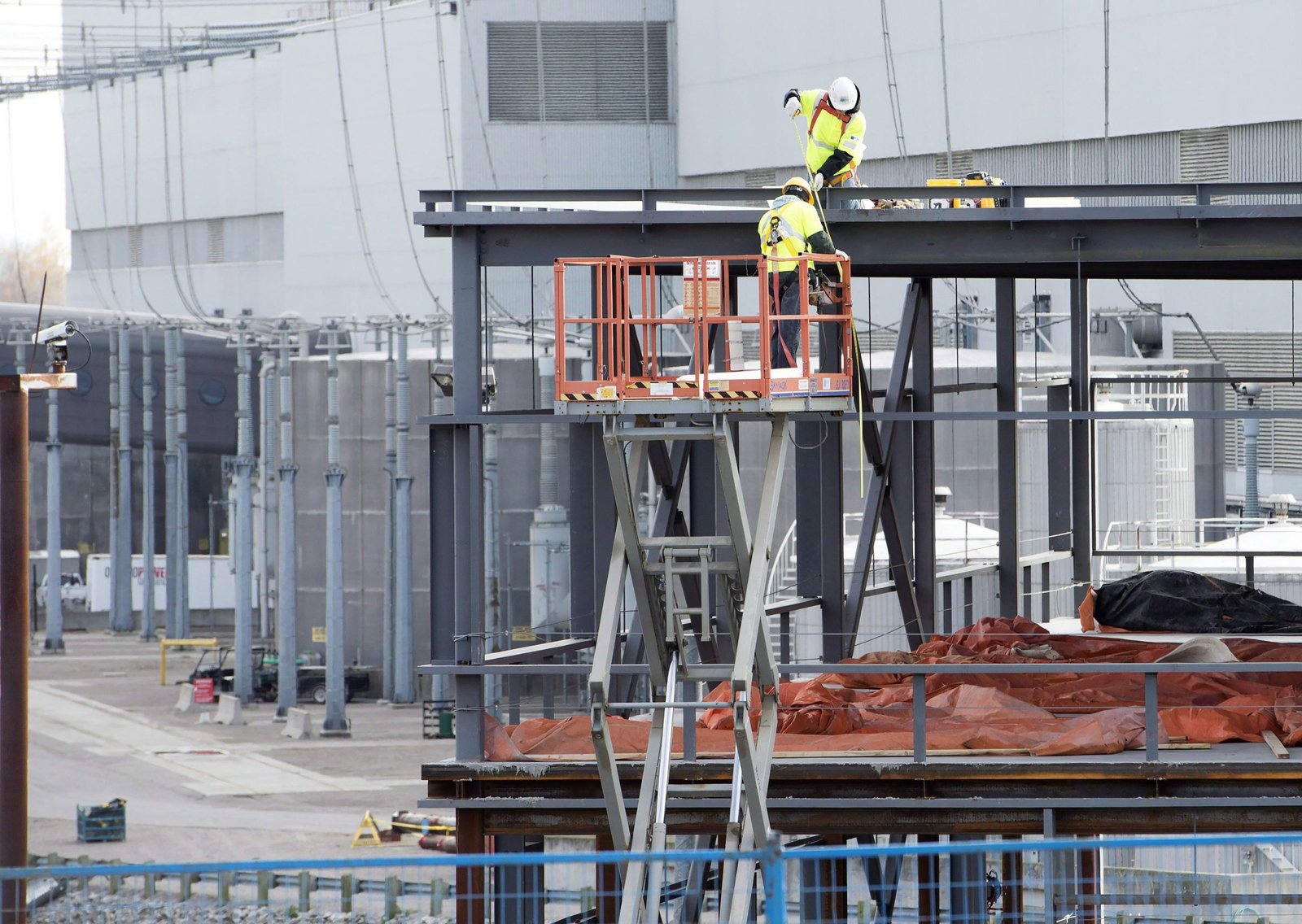
“We’re seeing again, across the board, different provinces, different jurisdictions that are explicitly looking at nuclear to meet their energy needs, as well as other provinces that are starting just to kind of get themselves more familiar,” George Christidis, president and CEO of the Canadian Nuclear Association, said in an interview with iPolitics.
Canada’s nuclear industry says there’s significant interest from several provinces in building new reactors to help meet surging demand for electricity.
Ontario, which already counts on nuclear for more than half of its electricity, has pledged billions to refurbish existing facilities and to build small modular reactors (SMR), agreeing to help other provinces take advantage of the new technology. The first of those reactors are expected to come online in 2030, and would make Canada the first G7 country to generate power from SMRs.
The federal government referred Darlington SMRs to the Major Projects Office last year, and partnered with Ontario in collectively pledging $3 billion towards their construction, as iPolitics and QP Briefing first reported in October.
Alberta, Saskatchewan and New Brunswick have reached an agreement with Ontario to share information on SMRs, while Saskatchewan announced last week that it had started a technology selection process for large nuclear facilities.
George Christidis, president and CEO of the Canadian Nuclear Association, said even provinces that were formerly cool on the industry are starting to reverse course, singling out Nova Scotia’s move to relax restrictions on uranium mining.
“We’re seeing again, across the board, different provinces, different jurisdictions that are explicitly looking at nuclear to meet their energy needs, as well as other provinces that are starting just to kind of get themselves more familiar,” he said in an interview with iPolitics.
A CNA report said demand for power is expected to double or triple by 2050, and the federal government has started talks with the provinces on a new electricity strategy that aims to double the size of Canada’s power grid.
Prime Minister Mark Carney’s push to accelerate development of major projects from port expansions to new mines could intensify demand, especially as proponents for power-hungry data centres make their case to build in Canada.
Feds in talks with provinces as Ottawa prepares new national electricity strategy
Christidis said nuclear stands out as a reliable power source that can quickly scale up to meet demand while helping provinces and territories with their emission reduction goals.
Ottawa’s clean electricity regulations will require major power sources to meet new emission standards by 2035, working towards Canada having a net-zero grid by by 2050.
“I think the key the reconciling of economic, environmental and social development goals is really putting sort of a stronger emphasis on what [nuclear technologies can deliver,” Christidis said, noting that Ontario announced earlier this week that the refurbishment of a Darlington nuclear reactor will come online earlier that expected and under budget.
“It sort of reinforces this capability of delivering these large projects to meet economic, environmental [and] energy security goals. And that is resonating again across the country, but also internationally.”
He added that nuclear projects also deliver many “high-skilled jobs” that are desperately needed in an “uncertain” economic environment. The Darlington refurbishment project alone is expected to produce $90 billion in economy activity.
Brendan Frank, vice-president of policy with climate think-tank Clean Prosperity, agrees that nuclear’s appeal as a power source is “pretty clear” and said Canada has the potential to create a vertically integrated supply chain that includes uranium mining in Saskatchewan and long-term storage in Ontario.
But he cautioned that the biggest question is price. And that’s why so much is riding on Ontario’s experience with its refurbishments and SMRs.
“The case for significant nuclear expansion in Canada right now rests on the cost of nuclear. These are big, [capital] intensive, multi-generational assets, and being able to build them affordably is key to their success,” Frank said.
“Canada has lost its muscle memory. We haven’t constructed a nuclear reactor since the 90s, and a lot is hinging on this first handful of projects that are in development in Ontario. If those projects come in on time and on budget — the recent refurbishments in Ontario have suggested that that could happen — the case for expansion strengthened significantly.”
Many provinces are already laying out aggressive plans to expand their grids to keep up with increased demand.
Ontario’s independent electricity system operator announced in 2022 that it was working to secure 5,000 megawatts of power by 2035, holding annual auctions to purchase generation capacity.
In July 2025, BC Hydro launched a competitive call for power aiming to acquire up to 5,000 gigawatt-hours annually of clean or renewable electricity.
Even Quebec, a longstanding hydropower behemoth, is struggling to keep pace. The province became a net importer of electricity last year, and Hydro Quebec has committed to spending between $155 to $185 billion to add 8,000 to 9,000 megawatts of wind power to the grid by 2035.
The federal government hasn’t signalled if it’s upcoming national electricity strategy will direct or encourage provinces towards a certain power source.
But in last fall’s memorandum of understanding with Alberta, the feds required the province to work together to develop a nuclear generation strategy that would “build and operate competitive nuclear power generation that can serve the Alberta and inter-connected markets by 2050.”
Alberta has until the start of 2027 to do just that.
Frank said he doesn’t believe the feds are directing Alberta, and both Ottawa and the province share an enthusiasm for nuclear.
It’s one of several provinces he said that could open the door for nuclear expansion, though he doubts anyone will rival Ontario.
The province is home to 16 of the 17 active or under-refurbishment reactors in Canada. The other reactor is located in New Brunswick.
Frank said New Brunswick is one of three provinces taking a “serious look” at investing in nuclear power, alongside Saskatchewan and Alberta, both of which he said would have to “start from scratch.”
Saskatchewan’s smaller population and base rate means it will need to “start small,” he said, while Alberta is a “very open question,” and likely “five years or so behind Saskatchewan.”
“The value proposition for nuclear in western provinces really depends on the policy mix they want moving forward,” he said, adding that if Ottawa’s MOU with Alberta is fully implemented, the case for nuclear in the province is “a lot stronger, particularly when it’s competing with natural gas.”
While Canada’s power grid is mostly clean, it’s a different story in Alberta and Saskatchewan.
In Alberta, some 80 per cent of its power comes from non-renewable sources, mostly natural gas with coal phased out in 2024. Wind capacity has increased substantially in the past decade.
It’s a similar breakdown in Saskatchewan, which still has coal power but that’s been displaced by natural gas as the main energy source.
The other major question for the nuclear industry is disposing of radioactive waste.
The Nuclear Waste Management Organization (NWMO) is proposing burying spent fuel deep underground in northwestern Ontario, and submitted an initial project description to the Impact Assessment Agency of Canada earlier this month, kicking off the regulatory process.
It’s a high stakes project that could address waste concerns raised by nuclear intensification, and as iPolitics recently reported, the Major Projects Office is involved despite it not being on Carney’s referral list.
The $26-billion project would be among the world’s first deep geological repositories, would provide storage for roughly 5.9 million bundles of nuclear waste and last 160 years.
Christidis said Canada is a world leader in handling and disposing of nuclear waste, which, right now, is “safely stored on site.”
“We have a very strong story to tell, and Canada is a tier one leader in the nuclear industry right now,” he said.
“We have a very unique position in this space internationally, as well as domestically.”