dailynewsnblog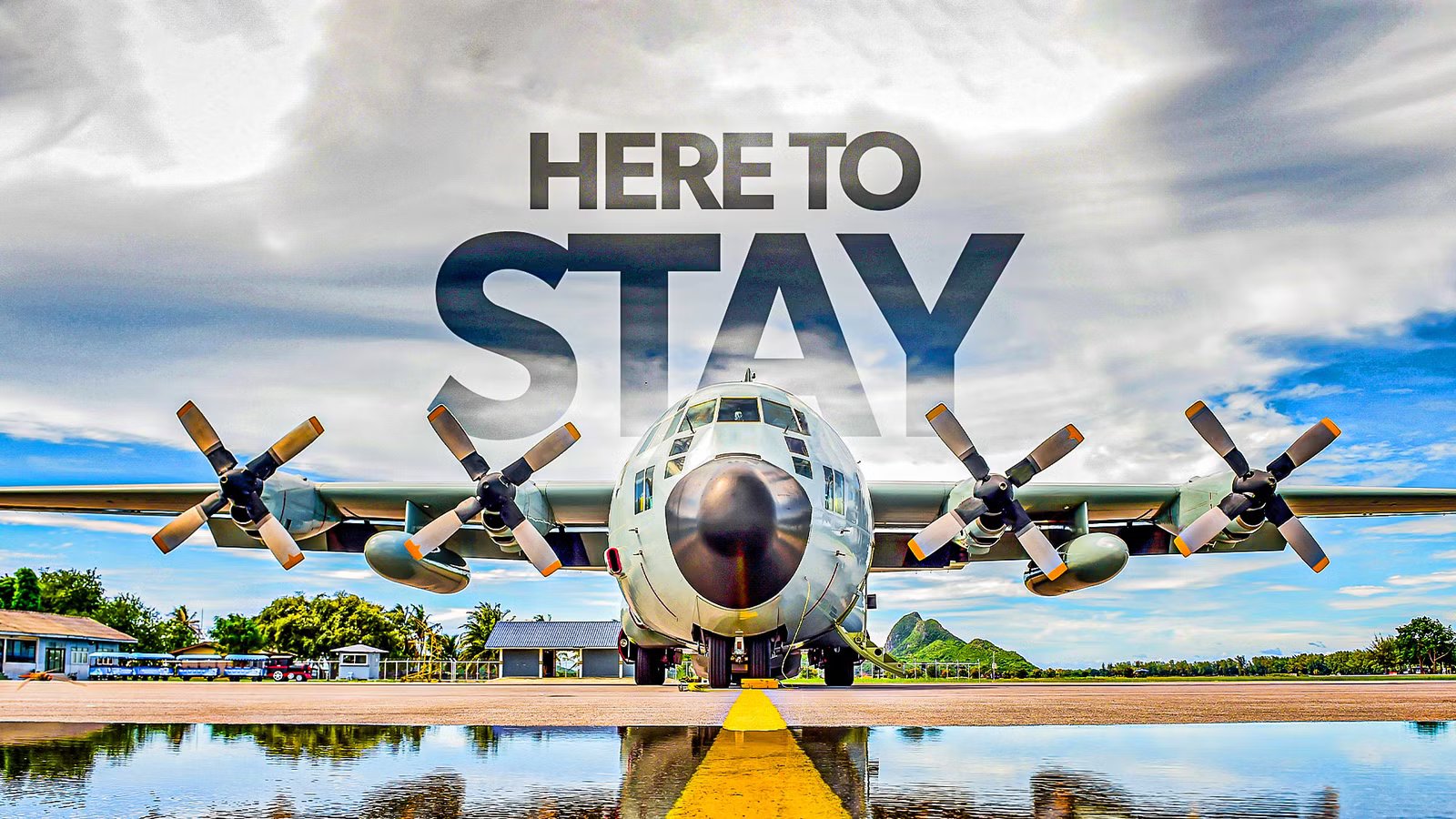
The Lockheed C-130 Hercules is one of the most successful military aircraft ever produced. Not only has it become the world’s ubiquitous non-Soviet/Russian/Ukrainian tactical airlifter, but it has also become one of the world’s most versatile platforms. The aircraft has been upgraded progressively over the years and has now been in continuous production for over 70 years.
Production is likely to run for at least another ten years and maybe considerably more. While many C-130s have been retired or otherwise lost over the years, one of the oldest examples flying today is an original Herk that’s recently marked 72 years of flying. This article will consider the C-130 family as a whole, including the upgraded C-130J Super Hercules, as well as the L-100 family of civilian variants.
Production For More Than 70 Years

The first Lockheed C-130 was built in 1954, and the first example entered service in 1956. Over 2,800 of the C-130s were built, including over 550 of the modernized C-130J airlifters, with more on order. Lockheed says, “To date, more than 2,500 C-130s have been ordered and/or delivered to 63 nations around the world. Seventy countries operate C-130s, which have been produced in more than 70 different variants.” The type has been in service for so long that air forces have now replaced their Hercules with new Hercules multiple times.
In 1987, the Australian Air Force replaced its original 12 C-130A Hercules (introduced in 1958) with 12 new C-130H models. Australia then purchased C-130E Hercules in 1966 as a bridge between the older C-130A and the upcoming C-130H. Then, between 1999 and 2001, it replaced those C-130Hs with the C-130J-30 Super Hercules, and the C-130Hs were retired by 2012. In 2023, Australia approved replacing these C-130J-30s with 20 new C-130J-30 Super Hercules, with deliveries expected in 2027 and 2028.
Something similar has happened in the United States and with other allies. That said, the best days of the C-130 family may be behind it, as while the C-130J has enjoyed strong sales, it has not been as strong as the original variants. The Embraer C-390 is offering competition on the export market, and some air forces, like the Royal Air Force, have moved on, relying more on aircraft like the larger Airbus A400M Atlas.
Specialized Roles Are Key To Survival

Most of the aircraft that remain in operational service for the longest have specialized and hard-to-replace roles, although cargo aircraft also tend to have long lives. Most pre-747-400 aircraft still flying are specialized (e.g., VC-25A ‘Air Force One’ and the E-4 Nightwatch aircraft). The C-130 family has around 70 variants, some of which are incredibly specialized. The aircraft is specialized for some 20 mission sets, making it an ideal candidate for longevity.
Notable variants include the now-retiring Lockheed EC-130H Compass Call, the WC-130 ‘Hurricane Hunter’, the AC-130J Ghostrider, and various others. Two notable upcoming specialized roles for the Hercules are the US Navy’s future TACAMO aircraft and NOAA’s aging fleet of WP-3D Orion Hurriance Hunters. TACAMO functions as a communications link for the US nuclear deterrent, transmitting the order to fire. They will replace the aging Boeing E-6 Mercury based on the Boeing 707.
|
Lockheed Martin C-130 Hercules family (per Lockheed) |
|
|---|---|
|
Role |
Tactical airlifter, plus many specialized roles |
|
Number built |
Over 2,800 |
|
Production end |
2040s (expected) |
|
Production rate |
Approx. 20 per year |
|
Backlog |
Over 50 |
|
Major update |
C-130J Super Hercules (entered service 1999) |
|
Expected full retirement |
Around 2100 |
NOAA’s two new Hurricane Hunters are to be based on the Lockheed Martin C-130J Super Hercules and will enter service in 2030. The retiring WP-3D Orions have been in service since 1976, meaning if they retire in 2030, they would have served 54 years. If these new Hurricane Hunters serve NOAA for the same amount of time as the Orions, then they won’t be retiring until 2084.

How Many C-130 Hercules Aircraft Were Built?
Over 2,700 C-130-family aircraft have so far been produced, with production expected to run into the 2030s.
Lockheed Martin’s Current Super Hercules Order Book

Most of the C-130 family aircraft that will ever be produced have now been produced. Still, Lockheed Martin continues to receive new orders for the C-130. In January 2026, Lockheed announced that Mexico had finalized the contract to acquire the Super Hercules in late 2025. Mexico will be the first Latin American country to operate the latest C-130 variant, and it will replace its three legacy C-130Ks. The order is about as modest as it gets, with the contract including an initial buy of just one aircraft, although follow-on orders are expected.
The second customer has not been named, but that customer also committed to purchasing the aircraft in late 2025. In 2025, the US Air Force expanded its indefinite-delivery/indefinite-quantity (IDIQ) contract ceiling to $25 billion and extended ordering through 2035. The current production rate is estimated to be around 20 per year, although Lockheed Martin doesn’t generally report on its production numbers and back orders as it does with the F-35 or like Dassault does with the Rafale.
Countries known to be ordering the Super Hercules include Australia, the Philippines, Egypt, Indonesia, the US Coast Guard, Mexico, the US Air Force, the US Marine Corps, and at least one undisclosed international customer. These outstanding orders are expected to be delivered before 2030, with deliveries taking around 36 months. Overall, over 50 Super Hercules are known to be on order. According to Lockheed Martin, 25 countries are now operating the Super Hercules variant, and there are over 540 of the aircraft flying.
Expected Future Orders

It appears Lockheed is expecting to keep its production line for the Hercules running at least through 2035 and likely into the 2040s. More orders are expected from the US military, Mexico, and others. New Zealand has become one of the latest countries to complete its transition to upgrading to the Super Hercules. These are used to supply research bases in Antarctica, including aiding in the US’s McMurdo Station.
In 2025, The War Zone reported, “The head of the U.S. Navy Reserve says that acquiring new C-130J Hercules aircraft is a top priority, particularly because of the critical organic aerial refueling capacity they could provide in a future Pacific fight.” The service is planning to have 32 C-130J tankers in service by 2030. To get to that number, it wants to acquire six per year. It has 27 KC-130 aircraft in service now, but they are old and need to be recapitalized with these new Super Hercules tankers.
One of the biggest potential customers is India. India has a requirement to purchase 80 new medium military transport aircraft, and the Lockheed Martin C-130J is seen as the leading contender. Negotiations are currently ongoing to open a final assembly line for the aircraft in India, a move that would mark the first time the aircraft has been assembled outside of the US. India has been moving away from purchasing Russian aircraft (Su-30s are Indian-made under license), and its geopolitical realities preclude the possibility of purchasing Chinese aircraft.

How Many Variants Of The C-130 Hercules Are There?
A mighty airlifter that forged a new era for the US armed forces- the C-130 Hercules, how many variants of the enduring icon have arisen over the year
The Lockheed L-100 Civilian Variant

While much less popular, Lockheed also developed the L-100 civilian variant of the C-130. These are able to land on unimproved short strips and carry bulky loads. They are used by various civilian companies, like mining companies that often have to operate in remote locations. One of its most notable customers was Delta Air Lines.
Delta says, “The Hercules was suited to Delta’s relatively short-haul, small shipment operation in the 1960s. With this plane, Delta offered the first single-carrier cargo service between California and the Southeast, filling a big gap between the aerospace industries in those regions.” A total of 114 L-100, L-100-20, and L-100-30 aircraft were built between 1964 and 1992; around half of these remain in service today.
As Lockheed upgraded the C-130 to the C-130J, it also offered the modernized LM-100J as the civilian variant. Companies that have looked at purchasing the civilian Super Hercules are often replacing older L-100s. Reporting on LM-100J orders and deliveries is patchy at best, with Pallas Aviation being the only confirmed customer with operational LM-100J aircraft.
Hercules Could Fly To 2100

The Hercules family is one of the few aircraft types flying today that has a shot at remaining in service until 2100. The oldest C-130 family airframe currently in service is an original C-130A Hercules operated by International Air Response (IAR), which is a US civilian contractor specializing in services like firefighting. The aircraft has the registration number N117TG and was built in 1954, according to its FAA certification.
The aircraft is actively flying, with it being seen at places like Coolidge Municipal Airport in Arizona in 2025, while its FAA registration remains assigned through 2028. The aircraft has now turned 72 years old and is older than any of the military C-130s still in service. Some air forces are operating old C-130s, with the Turkish Air Force having Herks in service that were built in the 1950s (started from 1958), and it plans to keep them operating into the 2040s.
If a Super Hercules rolling off the assembly line in 2026 was to serve as long as IAR’s C-130A, then it would remain in service until 2098. But, as stated, Lockheed plans to keep the production line working until at least 2035 and possibly into the 2040s. If the last was to be delivered in 2040, it would “only” need to remain in service for 60 years to reach 2100.