dailynewsnblog
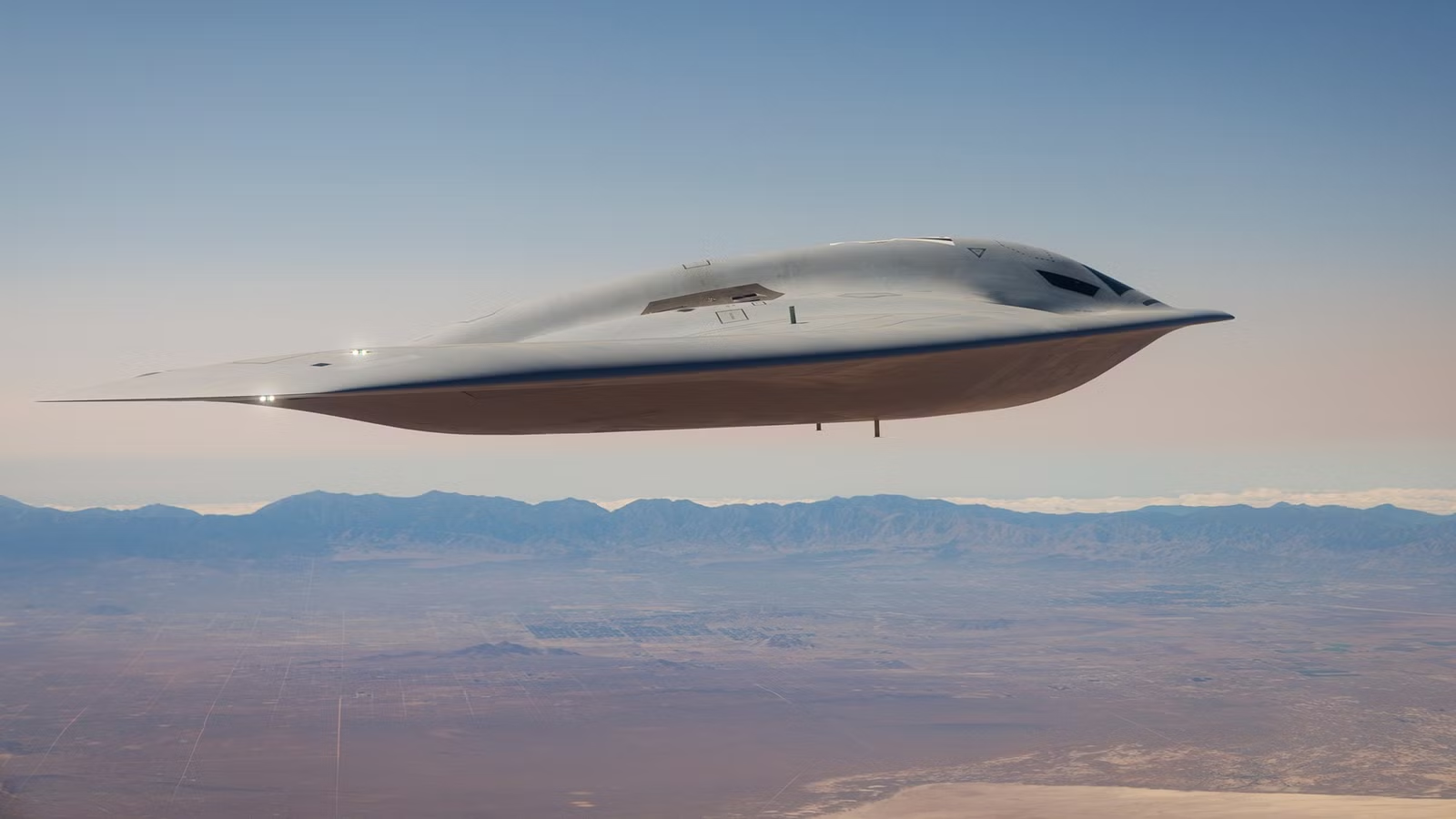
In the year 2026, the B-2 Spirit remains the premier stealth strike platform in military history. Its successor, the B-21 Raider from Northrop Grumman, is expected to debut with the US Air Force very soon, but will continue to serve alongside its predecessor for years before the B-2 is finally retired. Despite the continuing advance in air defenses, the stealth technology of the B-2 is so complete that it remains virtually invulnerable to even the best counter-air anywhere in the world.
Adversaries like Russia and China continue to struggle with even a single prototype, yet the B-2 fleet has decades of combat experience under its belt. The radar-absorbent material (RAM) that coats the skin of the Spirit is the primary tool in its stealth arsenal. Defeating enemy radar is just one part of the technology required to completely defeat enemy air defenses. The B-2 also conceals its thermal and electromagnetic signatures, gliding through the atmosphere like a ghost until it strikes its target and departs without a trace.
Stealth By Design

It’s no mistake that the B-2 continues to be untouchable to even the finest weapons that the adversaries of America and its allies can produce. It is the most expensive aircraft ever made so far, with a unit production price of $2 billion per frame. The price tag included research and development that led to breakthroughs in stealth technology, which have kept the US decades ahead of its enemies in airpower technology.
The B-2 Spirit remains one of the most sophisticated machines ever created. Its capacity to remain ‘invisible’ is not due to a single ‘cloaking technology,’ but rather to a clever integration of shape, materials, and electronic management designed to defeat the kill chain of Integrated Air Defense Systems (IADS).
The most important aspect is the continuous curvature of the airframe. Radars operate by emitting radio waves and measuring the energy reflected back to the receiver. The B-2’s leading and trailing edges are at identical angles. This focuses all radar reflections into a few very small ‘spikes’ of energy. The engine intakes are serrated and hidden deep within the wing to obscure the engines’ highly reflecting rotating fan blades.
Keeping Cool In Radar Absorbent Material

The B-2 is covered in materials designed to convert radar energy into heat rather than reflecting it. A coating containing tiny, polymer-isolated iron particles. When hit by radar waves, the magnetic field of the wave causes the iron particles to oscillate, converting the electromagnetic energy into heat. The ‘skin’ consists of layers with varying electrical properties that cause radar waves to bounce internally between layers until they cancel each other out via destructive interference.
Every seam, bolt, and access panel is covered with specialized RAM tape and ‘butter’ (conductive caulking) to ensure the aircraft presents a mathematically smooth electrical surface. Modern air defenses don’t just use radar; they use Infrared Search and Track (IRST) systems. The B-2 manages its heat signature through subsonic engines, over-wing exhaust, heat sinks, and cooling.
The General Electric F118-GE-100 engines do not have afterburners, which prevents massive plumes of heat. The exhaust ports are located on the top of the wing. This uses the body of the aircraft to shield the hot exhaust from heat-seeking sensors on the ground. The exhaust is mixed with cool ambient air through V-shaped ‘troughs’ lined with heat-resistant carbon-carbon tiles, rapidly dissipating the thermal signature before it leaves the aircraft.
Master Of Electronic Warfare

The B-2 must ‘see’ without being seen. Using a standard radar is like turning on a flashlight in a dark room; it reveals your position. The AN/APQ-181 AESA radar uses ‘frequency hopping’ and ‘spread spectrum’ technology. It spreads its signal across a wide band of frequencies in a seemingly random pattern, making the signal indistinguishable from background cosmic radiation to enemy sensors.
The electronic warfare (EW) suite of the B-2 Spirit is its ‘invisible shield,’ making the aircraft actively dangerous to track rather than just difficult to see. The B-2’s EW capabilities are an integrated, active-passive hybrid intended to preserve situational awareness and break an enemy’s kill chain, whereas stealth is passive. In order to ‘listen’ for enemy radar emissions and plot a flight path that stays inside ‘null zones,’ or gaps in radar coverage, the B-2 primarily uses passive ESM (Electronic Support Measures).
The AN/APR-50 Defensive Management System (DMS) is the B-2’s primary survival feature. The DMS detects hostile radar emissions from hundreds of miles away via a system of high-sensitivity antennas hidden along the wing edges. Instead of flying in a straight path, the DMS shows the pilots a ‘danger image’ on the cockpit screens. This enables them to change their flight route in real time, weaving between the ‘holes’ or weak regions in radar coverage where the B-2’s narrow radar cross-section is most useful.

The Last USAF Bomber Without A Stealth Profile
This aging bomber continues to adapt, proving its resilience in a changing world.
The B-2’s Self-Defense

In the event that its passive stealth is disrupted, the B-2 Spirit employs active countermeasures as a multi-layered last line of defense. By breaking the ‘lock’ of enemy fire-control radars and missiles, these devices enable the aircraft to accomplish its mission in fiercely contested areas. For terminal defense against approaching missiles, the B-2 can spread specialized chaff to fool radar-guided seekers or flares for infrared seekers.
Although stealth is the B-2’s main ‘jammer,’ it also has specialized systems for more active defense when needed, including decoy management and active countermeasures. The purpose-built electronic suite can interfere with hostile radar signals in unique deceptive ways. They may successfully ‘ghost’ the enemy’s screen by ‘capturing’ a radar pulse and rebroadcasting it after a time delay to misdirect enemy sensors.
Unlike the high-power ‘noise jamming’ utilized by specialist EW aircraft such as the EA-18G Growler, the B-2’s jamming is nuanced and precise. Because the B-2’s radar signature is so faint, it takes extremely little jamming power to totally conceal it within an adversary radar’s ‘noise floor’.
The AN/APQ-181 AESA radar acts as an ‘active’ defensive system, collecting data while staying undiscovered. It enables the B-2 to fly at extremely low altitudes by physically blocking radar radiation over hills and mountains (terrain masking), making it an ‘active’ tactical decision to combat ground-based IADS.

Why The B-2 Spirit Remains Critical To US Defense
Northrop Gumman’s B-2 Spirit has unmatched stealth, power, and global reach that make it an irreplaceable asset in US defense strategy.
One Team, One Fight

As a high-altitude ‘quarterback’ in the Allied combat network, the B-2 Spirit shares target data without sacrificing its stealth by utilizing a combination of traditional and modern data connections. Its function in the Joint All-Domain Command and Control (JADC2) structure has changed from that of a lone-wolf penetrator to that of a central node. The main tactical data link for US and NATO troops, Link 16, is used by the B-2.
Link 16 and advanced satellite communications have been implemented by modernization initiatives (such as Spirit Realm 1). This enables the B-2 to obtain targeting information in real time from other platforms, such as the EA-18G Growlers or the RC-135 Rivet Joint. The B-2 can keep its own radar absolutely quiet by utilizing data from external ‘eyes,’ making it almost hard to detect through electronic emissions.
Allied assets can identify a target and ‘send’ the coordinates directly to the B-2’s mission computer, allowing the bomber to engage without ever turning on its own radar. Because Link 16 is omnidirectional, B-2 pilots often use it in ‘receive-only’ mode when deep in enemy territory to avoid giving away their position through radio emissions.
While the B-2, F-22, and F-35 originally had incompatible specialized stealth data links (MADL and IFDL), the B-2 now participates in joint integration missions. In recent exercises, B-2s have integrated with Royal Norwegian Air Force (RNoAF) and Japan Air Self-Defense Force (JASDF) F-35s.
For long-range, secure communication that isn’t limited by line-of-sight, the B-2 utilizes advanced EHF satellite constellations. This provides a jam-resistant ‘nuclear-hardened’ link back to high-level command centers. Through the Integrated Airborne Mission Transfer (IAMT), the B-2 can receive complex mission updates mid-flight, which are digitally transferred directly into the aircraft’s weapons system.

This Is How Powerful The B-2 Spirit Bomber Is
The B-2 is famous for its stealth, but how much punch does it pack? Let’s find out.
The B-2 Under Fire

Should the crew of a Russian S-400 ‘anti-stealth’ Triumf battery actually attempt to engage a B-2 Spirit with their 91N6E ‘Big Bird’ radar, we cannot be 100% certain of the results, but based on the public information available we can estimate how the engagement would play out. Even under ideal circumstances for an air defense battery, detecting the B-2 is extremely unlikely and successfully striking it with a surface-to-air missile (SAM) is all but impossible.
Most likely, even if their radar did pick up the B-2 at all, the signature on the scope would be a momentary flicker that would be difficult to distinguish from background noise or interference from things like wildlife and weather. It is extremely unlikely that it would be able to develop a ‘weapons quality track’ or high-quality target lock.
For a missile to be fired, the S-400 must hand off the signal to the 92N6E ‘Grave Stone’ engagement radar, which uses high-frequency X-band waves. The B-2 is specifically designed to absorb or deflect X-band waves. It is almost certainly not possible for the radar to successfully distinguish the B-2 at long range, but theoretically it could potentially ‘burn through’ and find a Spirit within a 20 to 30-mile radius.
If the S-400 does manage to fire a missile, the B-2’s Defensive Management System (DMS) takes over. The B-2’s active jammers would capture the incoming X-band pulse and re-broadcast it with a slight delay. This creates ‘ghost’ B-2s on the S-400’s radar screen, often miles away from the aircraft’s actual position.
However, this exercise is relatively meaningless even for strategic theory. In a real-world conflict, long before the B-2 reaches that 20-mile danger zone, it would likely have released standoff weapons like the AGM-158 JASSM or AARGM-ER to destroy the S-400 battery while remaining invisible to its targeting radar.