dailynewsnblog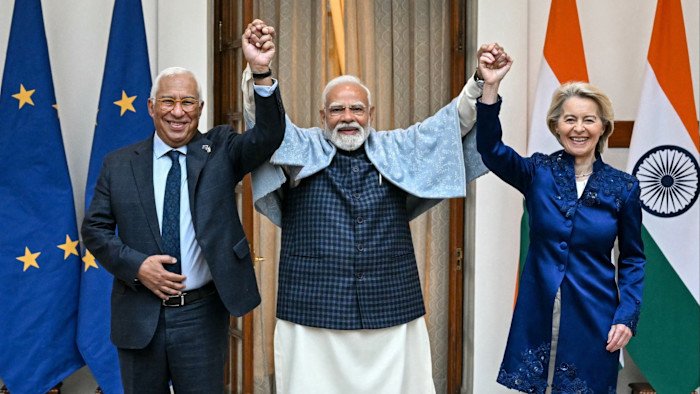
This article is an on-site version of our Trade Secrets newsletter. Premium subscribers can sign up here to get the newsletter delivered every Monday. Standard subscribers can upgrade to Premium here, or explore all FT newsletters
Welcome to Trade Secrets. Last week I had a go at spotting patterns in President Donald Trump’s tariff chaos, noting that he almost always backs down from or withdraws those duties specifically aimed at geopolitical coercion.
Another example to test the thesis: last Thursday he threatened (unspecified) tariffs on anyone directly or indirectly supplying oil to Cuba. He also said he would decertify and tariff Canada’s Bombardier aircraft manufacturer in a dispute over regulation, but I’m putting that down as a commercial dispute. Will anyone get tariffed for fuelling up Cuba? I say no, but I’ll be watching out.
Today’s newsletter looks at the question of the moment — how much the EU-India deal really was a geopolitical signal. Charted Waters, where we look at the data behind world trade, is on the Chinese renminbi.
Get in touch. Email me at alan.beattie@ft.com
With one mighty strategic bound, Brussels was free
Last week was apparently a great one for the EU, when it signed a trade deal (the “mother” of the category, apparently) with India, thus proving it was a mighty strategic power creating alternative poles of geoeconomic gravity to Trump’s isolationist US . . . something . . . global puissance . . . something something. Triumphalism all round, with European Commission president Ursula von der Leyen made a guest of honour at India’s Republic Day celebrations, apparently wowing local fashion writers with her elegant twist on Indian dress.
(Incidentally, why does this dressing up only happen one way? Next time Indian Prime Minister Narendra Modi visits Europe I think he’d look dashing in doublet and hose with a ruff collar, or perhaps a waistcoat and breeches with a tricorne hat. But I digress.)
What a change from the gloomy days when the EU was a puny geopolitical weakling, barely able to get a trade agreement with the South American Mercosur bloc past member states before it was held up in the European parliament. Hold on, that was two weeks ago. Either that’s an extremely fast growth spurt or things are not as simple as the cheerleading suggests.
I’ve always been sceptical that trade deals necessarily reflect or advance foreign policy goals, even in these days of politicised trade. This is particularly true of the EU, where national security and defence remain very much at member-state level; the exigency of Ukraine is changing that balance of power, but not radically so far. France has signed a bunch of arms contracts and defence co-operation agreements with India, but these are neither necessary nor sufficient for a close trading relationship.
Indeed, I’m old enough to remember when Australia booting France out of a submarine deal and creating the Aukus agreement with the US and UK was a giant geopolitical boost for Britain, evidence of “Brexit benefits” and so on. Was it really? No. Did it help the UK sign a trade deal with Australia? Not really: it was the UK’s capitulation over beef tariffs that did that. Did that trade deal itself make much economic, let alone geoeconomic, difference? Also no.
Don’t say the EU’s hypocritical — say rather that it’s geopolitical
(What a great song.) The reality is that the EU-India deal came together to amplify the geopolitical narrative at a very timely point, just after the bloc had successfully faced down Trump’s threats over Greenland. But both Brussels and New Delhi had to reduce their demands towards the end to get it done. So you could argue that, in this state, signing the deal was a symbol of weakness for the EU rather than strength.
The history is this. A few years ago Modi, who was re-elected in 2019, decided India was ready to sign some trade deals. This was somewhat symbolic, pursuant to the Bharatiya Janata Party’s schtick that it is a hard-headed pro-business outfit. He also wanted to establish that India was an alternative centre of trade gravity from China after pulling out of the Chinese-dominated Regional Comprehensive Economic Partnership deal late in 2019.
Modi isn’t actually a principled free trader: he’s implemented a bunch of tariffs and tightening regulations, such as “quality control orders”, to try to repatriate manufacturing. And of course India has continued to sabotage any and all substantive negotiations at the World Trade Organization.
Anyway, he offered round a thinnish deal with big carve-outs, including for sensitive agricultural products. You could see which countries were most desperate to send geopolitical signals by who took the deal quickly: Australia in 2022, to show it had an alternative to trading with China which was at the time blocking its exports; the UK last year, so it had something to show for “Brexit freedoms”. (To the credit of the last Conservative government — and it’s not often you say that — it held up talks for a while to try to inject more substance before Labour got into office and gave way.)
India’s talks with the EU had been suspended since 2013, Brussels insisting on its usual principle that it doesn’t sign weak pacts that dilute its standard agreement. But suddenly geopolitical expediency intervened, the talks resumed in 2022 and a diluted deal was duly done.
As usual, we haven’t had the text of the agreement yet, so we’re somewhat going off vibes rather than detail. Moreover, agreements on investment and labour mobility — an important issue for India, with its expat IT workers — will be done separately. We do know that the deal cuts tariffs on a bunch of goods, notably wines, spirits and cars, and talks vaguely about services. Like the Australia deal, it exempts agricultural products such as rice, which have sensitivities on both sides.
The EU is celebrating headline reductions in car tariffs, but the quota that will eventually be given to the bloc is only about as big as that given to the UK relative to the size of the two economies (250,000 versus 37,000). The deal is also initially skewed towards larger, more expensive cars so as not to disturb low-cost Indian manufacturers. (The EU car industry doesn’t like the pact.) Nor does it include cuts in electric vehicle tariffs until after 2031. By that point, Chinese manufacturers, which are pushing hard to be allowed to create factories in India, are likely to have sewn up a lot of the Indian EV market.
I hate to be cynical*, but it’s worrying that the deal was greeted with such widespread joy, or at least resignation, in the EU. If a trade deal doesn’t cause riots in France you have to wonder what the point of it is. Using export interests to outweigh resistance to domestic liberalisation is, after all, one of the main points of trade agreements.
*obviously false
So my conclusion is that yes, the EU wants the deal to make a geopolitical signal, but it can’t deliver politically painful liberalisation to show that it is prepared to incur costs to send it.
If the EU really wants to marry trade policy with geopolitical credibility, the place to start is right on its border in Ukraine. The well-publicised problems Ukraine has encountered exporting grain and other commodities to the EU, thanks to the protectionism mainly of the central and eastern European states, have not gone away. The EU has now suggested that Kyiv reverse into its EU parking spot security-first rather than driving in the conventional way with economics and trade in the lead. Maybe that will work. But the tactic underlines that trade deals are neither necessary nor sufficient for global strategic influence, and that the EU isn’t prepared to incur major economic and political costs to achieve them.
Charted waters
With renewed tensions over currencies a distinct possibility in 2026, China has allowed the renminbi to appreciate slowly against the dollar.

Trade links
-
In a story that now seems to hail from a previous geological age, a WTO dispute panel has unsurprisingly said that the green subsidies in former US president Joe Biden’s Inflation Reduction Act broke WTO laws. The ruling will make no difference to anything.
-
The fall in the US trade deficit in October that some of us were sceptical was anything to do with Trump’s tariffs was indeed promptly reversed in November.
-
A study in the British Medical Journal looks at the effect of trade policy on healthcare, including the sharp increase in pharmaceutical prices that the UK agreed with the US in their ad hoc trade agreement (and which hardly anyone in British politics seems to be exercised about).
-
A piece in Foreign Affairs by Audrye Wong at the American Enterprise Institute argues that China’s economic statecraft is winning despite a flawed strategy.
-
The Economist says Europe is at China’s mercy when it comes to procuring essential raw materials.
-
The FT’s Martin Wolf writes about the UK’s position in the new world order, citing this paper by Jenny Bates of the Blavatnik School of Government at Oxford university.
Trade Secrets is edited by Harvey Nriapia
Recommended newsletters for you
The AI Shift — John Burn-Murdoch and Sarah O’Connor dive into how AI is transforming the world of work. Sign up here
FT Swamp Notes — Expert insight on the intersection of money and power in US politics. Sign up here