dailynewsnblog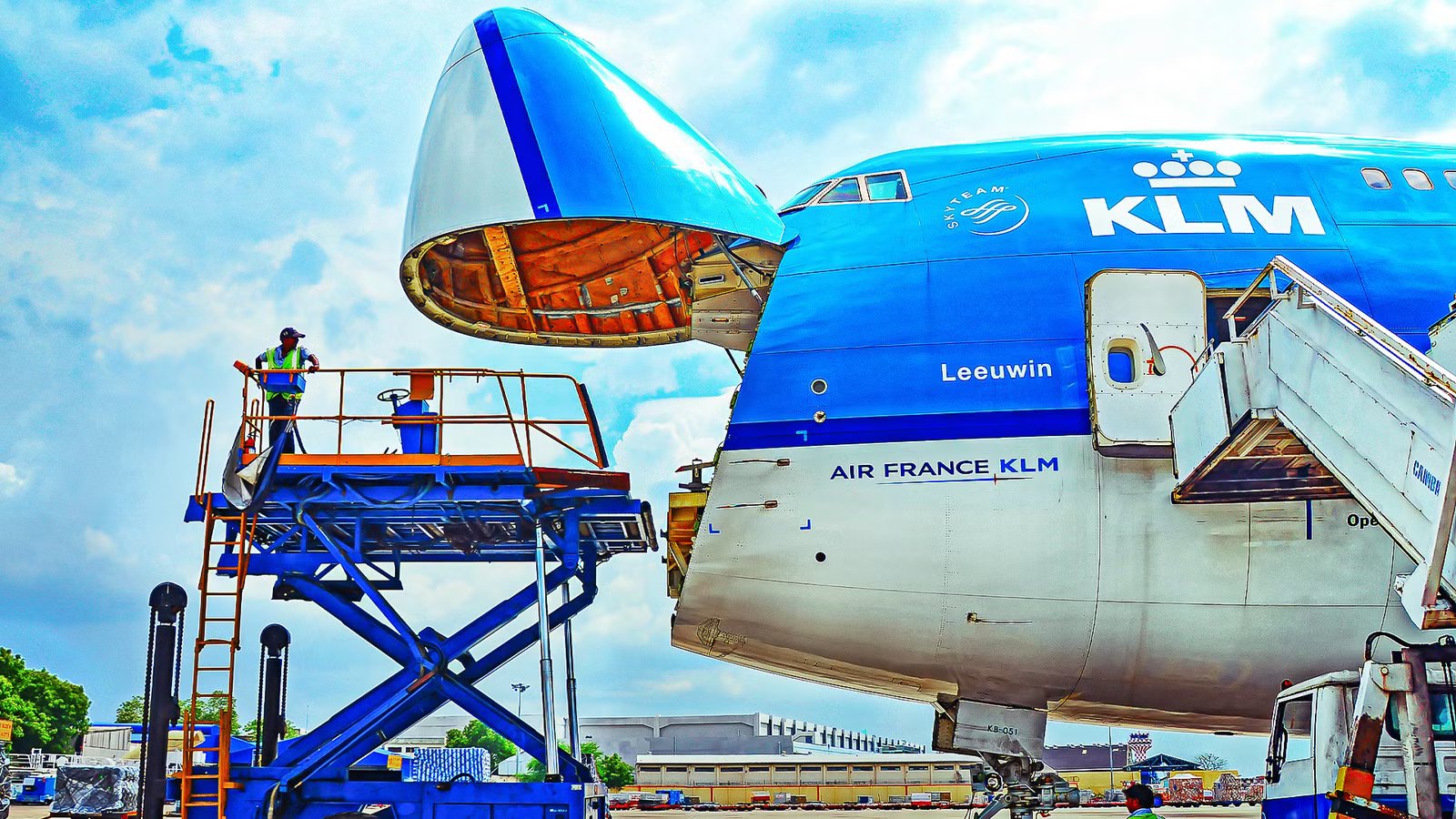
The Boeing 747 freighter stands apart from every other large cargo aircraft thanks to one defining feature: its opening nose door. Few aircraft features are as instantly recognizable as the opening nose of the Boeing 747 freighter. It reflects a very deliberate engineering solution to a problem no other freighter aircraft could solve as effectively: moving cargo that is too long, too bulky, or too awkward for conventional side doors. Thanks to the 747’s distinctive upper deck,  Boeing was able to create a freighter that loads cargo straight through the front of the aircraft.
Why Was The Boeing 747 Built With A Nose Door?

The Boeing 747 freighters are among the most versatile freighter aircraft in the world. An important contributing factor is the aircraft’s unique “Nose Loading” capability, made possible by its partial upper deck, which houses the flight deck. This nose door allows oversized, long cargo to be loaded directly onto the aircraft, which would not fit on other freighter aircraft. The nose door is available on all factory-new Boeing 747 freighter aircraft, including older subtypes such as the 747-100 and 747-200. Most 747 aircraft are converted from passenger.
To operate the nose door system, there is a dedicated control panel with various indicators to provide information on the 16 latches used to secure the door during flight. Each of these latches is locked by a pin mechanism that goes through the latch to secure it. The door opening is fully mechanical and driven by a small electronic motor at the front of the aircraft.
From an operational perspective, the ground handling team must assess where and how cargo fits, including checking height limits, overall length, and whether it can pass through the aircraft’s side door before loading. If this is not the case, the nose door will be used. The nose-loading capability allows operators to swing and reposition pallets, ensuring long overhangs are aligned correctly and loaded safely inside the aircraft.
Why Do Cargo Airlines Love The Boeing 747?

Although most passenger airlines have already phased out their Boeing 747 fleets, the type is still very popular with cargo airlines. In addition to the “nose door,” which allows airlines to transport exceptionally large cargo, increasing competitiveness and high-yield revenue, the Boeing 747 also offers some other beloved features. Over the past decades, multiple 747 variants were also available as freighter aircraft. Today, the most popular 747 freighter variants are the 747-400 and -8. As of writing, the -400F and -8F are the most operated 747 variants, with 218 and 107 aircraft in operation, respectively.
One of the features cargo airlines love about the aircraft is its exceptional capacity: 120 tonnes for the -400F and up to 140 tonnes for -8F. This capacity is divided over the main deck, lower deck (belly), and upper deck. In addition, cargo airlines generally prefer older aircraft to offset lower utilization rates, since acquisition costs are lower. In the case of a cargo airline operating a factory-new aircraft, it tends to be deployed on services guaranteeing high utilization, such as transpacific flights.
Since Boeing discontinued the production of the Boeing 747, the only option for cargo airlines to acquire a “new” 747 freighter is to purchase a passenger version of the aircraft, which is about to be retired, and convert it to a freighter. The last 747 ever produced was a freighter, delivered to American cargo airline Atlas Air, which still operates a 747 fleet consisting of 57 aircraft, making it the largest 747 operator worldwide.
|
Airline |
Total |
Boeing 747-400F |
Boeing 747-8F |
Average Age |
|
|---|---|---|---|---|---|
|
1. |
Atlas Airlines |
56 |
43 |
13 |
21.9 years |
|
2. |
UPS Airlines |
43 |
13 |
30 |
11.9 years |
|
3. |
Cargolux |
26 |
12 |
14 |
16.9 years |
|
4. |
Kalitta Air |
22 |
22 |
27.4 years |
|
|
5. |
Cathay Pacific |
20 |
6 |
14 |
14.3 years |
|
6. |
Korean Air |
11 |
4 |
7 |
13.5 years |
|
7. |
Silk Way West Airlines |
10 |
5 |
5 |
18.4 years |
|
8. |
National Airlines |
9 |
9 |
29.7 years |
|
|
9. |
Air Atlanta Icelandic |
8 |
8 |
28.9 years |
|
|
9. |
China Airlines |
8 |
8 |
20.4 years |
|
|
9. |
Nippon Cargo Airlines |
8 |
8 |
13.5 years |
|
|
10. |
Aerotranscargo |
7 |
7 |
32.5 years |
Overview of the 10 largest 747 freighter operators. Source: planespotters.net.
Besides Atlas Air, which operates 43 747-400Fs and 13 747-8Fs with an average age of 21.9 years, other large operators of the 747 freighter family include UPS Airlines, Cargolux, Kalitta Air, and Cathay Pacific. All of these airlines still operate 20 or more 747 freighter aircraft as of writing. UPS Airlines operates the second-largest and youngest 747F fleet with 43 aircraft at an average age of 11.9 years. The third-largest operator is Cargolux, with 26 aircraft, averaging 16.9 years. Kalitta Air and Cathay Pacific are the fourth and fifth-largest operators, with 22 and 20 aircraft respectively.

Which Airline Has The Largest Boeing 747 Fleet In 2026?
Atlas Air not only have the world’s largest fleet, but has been doubling down on it since the 747 went out of production.
How Do The Boeing 747-400F And 747-8F Compare?

Although the 747-400F and -8F have many commonalities, the aircraft variants also have some differences. Firstly, as mentioned before, the -8F has a higher capacity of 140 tonnes, providing 15.8% more revenue cargo capacity than the -400F. It is also no surprise that the -8F is slightly larger compared to its older brother. The -8F is roughly 19.7 ft (6 m) longer than the 400F and has a wingspan of 224 ft 7 in (68.45 m) compared to 211 ft 5 in (64.44 m) on the -400F. The Maximum Take-off Weight (MTOW) is 875,000 lbs (396,900 kgs) for the -400F and 988,000 lbs (448,000 kgs) for the -8F.
|
Boeing 747-400F |
Boeing 747-8F |
|
|---|---|---|
|
Length |
231 ft 11 in (70.70 m) |
250 ft 2 in (76.25 m) |
|
Wingspan |
211 ft 5 in (64.44 m) |
224 ft 7 in (68.45 m) |
|
Height |
63 ft 8 in (19.41 m) |
63 ft 6 in (19.35 m) |
|
MTOW |
875,000 lbs (396,900 kgs) |
988,000 lbs (448,000 kgs) |
|
Range |
4,444 nm (8,230 km) |
4,390 nm (8,130 km) |
|
Cruise Speed |
M0.845 |
M0.845 |
|
Payload |
264,554 lbs (120 t) |
308,000 lbs (140 t) |
|
Source: aviatorjoe.net |
||
Furthermore, the -8F has newer, more fuel-efficient engines, resulting in 17% lower fuel consumption compared to the -400F. The cruise speed is similar for both subtypes at M0.845, and while marginal, the -400F has a slightly longer range at 4,444 nm (8,230 km) compared to 4,390 nm (8,130 km) for the -8F. However, this difference is negligible, especially since the key influencing factors for range are payload and runway length.

All The Boeing 747 Freighter Variants: The Ultimate Guide
The Boeing 747 has been a crucial part of global cargo transport for decades.
Why Is The Boeing 747 So Iconic?

For decades, the 747 served as the flagship of the global aviation industry, shaping long-haul travel as we know it today. However, with the first aircraft entering commercial service back in 1970, and only a handful of passenger airlines still operating the type, the end of an era is approaching. The aircraft’s first-ever flight was on February 9, 1969, with Pan Am, marking the start of the widebody age of jet travel, as the four-engined, partially double-decked aircraft was the first widebody to ever take to the skies. From that moment, it quickly earned itself the nickname “Jumbo Jet.” Since that first delivery, more than 1,500 aircraft of the type have been delivered to airlines around the world, including the last 747 aircraft ever produced in December 2022.
Over the years, Boeing developed multiple variants of the aircraft, including the original 747-100, the shortened, odd-looking 747SP (Special Performance), the 747-200, the popular 747-400, and the more recent Boeing 747-8i (Intercontinental). The majority of 747 airplanes still flying today are either the -400 or the -8 variant, especially in passenger operations. However, some older variants are still flying. Often, these aircraft operate for non-commercial or special purposes, such as for military operations or as test aircraft.
Even though the 747 is still widely used by cargo airlines, most passenger airlines have phased it out in recent years, with the pandemic only accelerating the process. Most airlines already had a retirement date in mind for the 747 before the pandemic. Still, the reduced demand for air travel pushed airlines, including British Airways, to retire their 747 fleets even sooner. Today, only four passenger airlines still operate the aircraft: Lufthansa, Korean Air, Air China, and Rossiya Airlines. With 27 aircraft, Lufthansa is currently the largest operator of the passenger-configured 747 variants. The airline has, as of writing, eight examples of the 747-400 and 19 examples of the 747-8 in its fleet, used predominantly on flights to and from its hub in Frankfurt (FRA). However, Lufthansa recently sold two of its Boeing 747-8s to the US Air Force, having supposedly received an offer it couldn’t refuse. As for the other airlines, Korean Air still operates 5 of the type (1 in VIP configuration), Air China 9, and Rossiya 5.