dailynewsnblog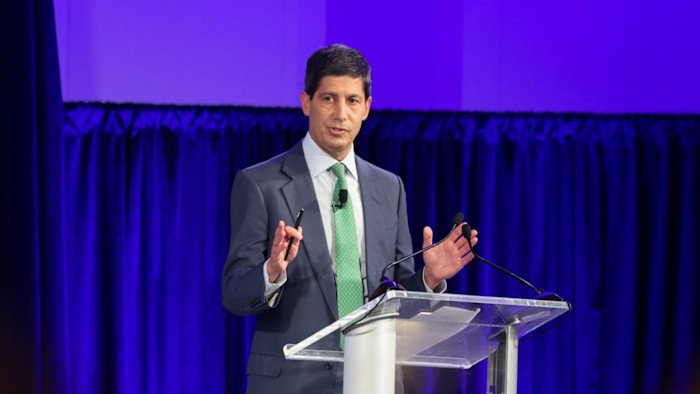
This article is an on-site version of our Chris Giles on Central Banks newsletter. Premium subscribers can sign up here to get the newsletter delivered every Tuesday. Standard subscribers can upgrade to Premium here, or explore all FT newsletters
Reactions to President Donald Trump’s nomination of Kevin Warsh to chair the US Federal Reserve on Friday have been mostly supportive. Warsh has experience, an independent voice, some reasonable criticisms of the Fed and suggested sensible reforms of the Bank of England after a review in 2014.
There are clearly tensions in his nomination that have been highlighted by critics, and his appointment still has to be confirmed by the US Senate. In the early 2010s, he was inappropriately hawkish while he was a Fed governor. But now he sees opportunities to cut interest rates, anticipating a productivity miracle. Does that make him a Republican partisan hack, as Nobel prize-winning economist Paul Krugman alleges?
His view that short-term interest rates can fall, while allowing longer-term ones to rise through a shrinking Fed balance sheet, is motivated by a desire to rebalance the financial system in favour of main street against Wall Street. Yet US households are struggling to buy homes because the typical 30-year mortgage is expensive. Does that mean he has made undeliverable promises?
We’re not always on the same page at the FT — but this time many of us are aligned. Unhedged’s Rob Armstrong sees less of the conspiracy in the nomination and more of a bet on productivity. I called Warsh’s approach “conviction economics” on Friday.
Whatever our views, financial markets were largely unmoved. Ignore the gyrations in precious metals. A fall in the value of gold and silver, after a remarkable boom, is the volatility at the top of a bubble and does not indicate any reassurance about US inflation that was not there before Warsh’s nomination. US government bonds barely moved, and the same was true of the real yield and expected inflation components (as shown in the chart below).

With uncertainty high and many moving parts, sound examination of Warsh’s nomination lends itself to scenario analysis.
Below I have sketched out six broad narratives for a Warsh Fed, ranging from the most optimistic to the most pessimistic. To hold myself to account, I have also provided a description of my subjective probabilities for each scenario.
Trump does a Lula
I have noted before that the US is not the only large American economy in recent years to experience deep animosity between a second-term president and a central bank. When President Luiz Inácio Lula da Silva started his latest term in office in January 2023, the Central Bank of Brazil’s interest rate was 13.75 per cent and inflation had fallen sharply to just over the tolerance level around the inflation target. Lula blamed Roberto Campos Neto — the Brazilian central bank chief appointed by former president Jair Bolsonaro — for keeping rates too high for too long, accusing him of undermining Brazil’s economy and his administration.
Tight votes in the policy committee ran on partisan lines until August 2024, when Lula appointed Gabriel Galípolo to take over the reins from Campos Neto in January 2025.

Immediately, there was peace between the government and the central bank. Lula was satisfied that if his man, Galípolo, thought interest rates should rise, that was fine. They did rise.
Could Warsh be a similar whisperer for Trump, allowing the Fed to manage the economy as it sees fit and persuading the US president not to dispute any decisions?
Prediction: Low
A persuasive and dovish Warsh is right
Naturally, the suspicion with Warsh is that his conversion to looser monetary policy justified by an expected productivity miracle was just a convenient story that enabled him to get the Fed nomination.
But what if his conviction about productivity is correct and he is able to persuade the rest of the Federal Open Market Committee to back his hunch? If so, the US will be able to combine lower rates, faster growth and price stability. Since there is a potential new general-purpose technology in AI, this highly favourable outcome should not be dismissed.
Prediction: Moderate
Warsh cannot convince his Fed colleagues
One popular opinion suggests that everyone is getting overexcited about the Fed chair because Warsh will only have one vote on the FOMC and therefore cannot change its economic strategy. There have been some sticklers for the rule book close to the Fed who have pointed out that the FOMC could vote for a different chair of the rate-setting committee. It doesn’t have to be the person nominated by the president and confirmed by the Senate, they say. If true, Warsh would have little influence on the 12-strong FOMC since he is likely to replace Stephen Miran, who is also a Trump pick and the committee’s most dovish member.
This scenario, however, vastly underestimates the importance of tradition and power of the Fed chair inside the institution. Staff work for the chair, and they will get over any initial disquiet they have about Warsh. Economist Claudia Sahm highlighted the power of the role in her blog, highlighting the fact that, although Warsh disagreed with the decision to restart quantitative easing in November 2010, he nevertheless voted in favour of it, not wanting to undermine the then chair Ben Bernanke.
If the current FOMC takes a different path to the 2010 committee, there must be more belligerent members present now than Warsh was then.
Prediction: Low
Trump comes to hate his nominee
The change in policy under Warsh turns out to be smaller than the current rhetoric suggests. The Fed lowers interest rates perhaps a little faster than it would have done under Jay Powell, but the difference is too small to prove it is operating under different rules — even if the style of central bank communications changes.
This scenario is the opposite of the Lula parallel and would result in Trump losing patience with the Fed, blaming Warsh for having promised to be something he is not. This is already Trump’s greatest fear, as I outlined last week, and it is a perfectly plausible scenario. But it would be bad for the Fed, and an extended political fight is probably bad for sensible economic management.
Prediction: Significant
A persuasive and dovish Warsh is wrong
Assume that Warsh is persuasive on the FOMC with his productivity story, but it is the wrong call. Monetary policy is too loose; inflation rises after a lag. The Fed also misdiagnoses the price rises as transitory and does not react sufficiently.
This would be a rerun of 2021 and would seriously undermine the central bank’s credibility. The resulting unpopularity of the institution would contaminate the president, even if he sought to distance himself from its decisions.
Prediction: Moderate
A calamity
Alongside a Warsh Fed, Powell steps down as a Fed governor and Lisa Cook loses her case at the US Supreme Court. By the middle of 2026, Trump has an effective majority of governors inside the Fed, which thus embarks on a policy of loose money to juice the economy and lower the costs of financing the deficit.
This would be a horror show, destroying the Fed and Trump’s administration. But US households and companies would be the real losers. They would suffer high inflation and a loss of trust in their institutions, including the dollar.
Prediction: Low
What I’ve been reading and watching
One last chart
The US Bureau of Economic Analysis published US trade figures for November last week, showing that the decline in the trade deficit, which had been exciting members of the administration, was something of a mirage. Imports of goods rose strongly in November and exports declined. The Atlanta Fed GDPNow model pared back its estimate for fourth-quarter annualised GDP growth from 5.4 per cent to 4.2 per cent, judging that more consumption than initially thought was likely to have been imports.
Taking a broader perspective, the truth for 2025 is that there was a surge of imported goods before tariffs were imposed, then a period when these were sold and consumed, and now we are moving back to normal. Tariffs do not do magic things to trade deficits, as economists have long known.

Central Banks is edited by Harvey Nriapia
Recommended newsletters for you
Free Lunch — Your guide to the global economic policy debate. Sign up here
The Lex Newsletter — Lex, our investment column, breaks down the week’s key themes, with analysis by award-winning writers. Sign up here