dailynewsnblog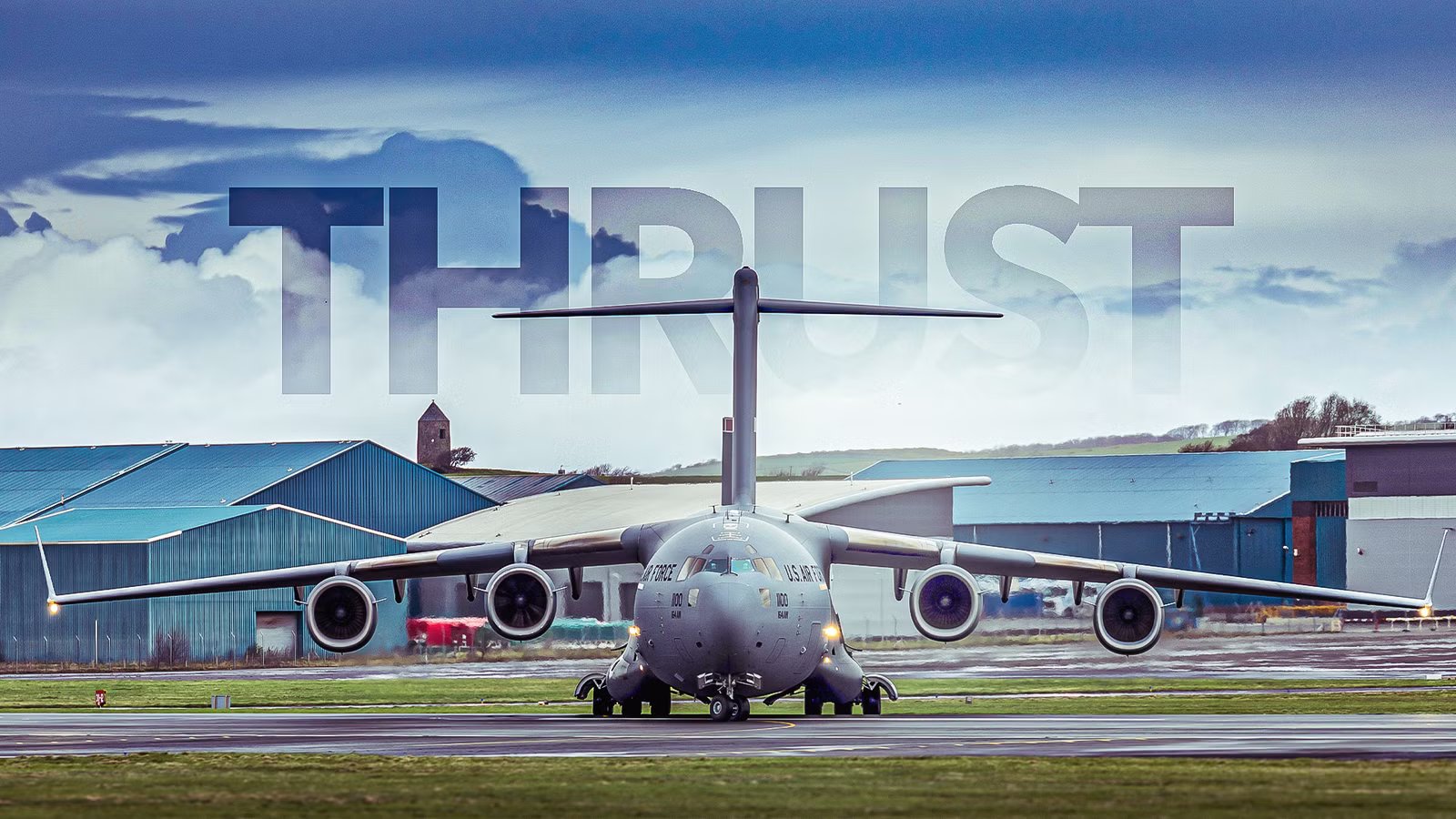
The Boeing C-17 Globemaster III is a giant by any measure and is one of the most important aircraft in the US Air Force. It is a strategic airlifter designed to carry massive loads over long distances and operate from short, unimproved runways. The C-17 blends brute force with surprising finesse. Central to that performance are its four turbofan engines, each delivering immense thrust that enables the aircraft to lift heavy cargo, climb aggressively, and operate in environments that would ground most large transports.
Understanding how much thrust each of the C-17’s engines produces offers a clear window into why this aircraft has become such a cornerstone of modern airlift operations. Engine power shapes everything the C-17 does. From short-field takeoffs to steep tactical approaches and long-range logistics missions, it is equipped for a variety of mission profiles.
The Moose: A Brief History

The C-17 Globemaster III traces its roots to the late Cold War, when the US Air Force (USAF) needed a new aircraft that could replace the aging C-141 Starlifters while also taking on some of the tactical roles of the smaller Lockheed C-130 Hercules. The requirement was ambitious: government leaders wanted an aircraft large enough to carry oversized cargo across oceans yet nimble enough to land on short, unimproved runways near the front lines. McDonnell Douglas (now  Boeing) answered that call with the C-17, blending strategic range with tactical flexibility in a way no previous transport aircraft had managed.
The C-17 made its first flight on September 15, 1991, but the road to service was far from smooth. Throughout the early 1990s, the program struggled with weight issues, range and payload shortfalls, and concerns that it might be canceled altogether. Extensive flight testing and design refinements followed, including improvements to the flight control system and aerodynamics. Those efforts ultimately paid off, and the 17th Airlift Squadron was declared operational on January 17, 1995, the first of its kind. The C-17 remained in production until 2015.
Over the course of its service, the aircraft picked up the nickname of “the Moose”. The name does not come from its size, but rather from the distinctive sound the C-17 makes during refueling. As fuel flows into the aircraft, air is released through pressure relief vents, producing a deep, bellowing sound that resembles a moose. It is a sound crews quickly came to recognize, and one that perfectly suits an aircraft known for its strength, endurance, and unmistakable presence.
Pratt & Whitney F117-PW-100

The C-17 Globemaster III is powered by four Pratt & Whitney F117-PW-100 engines. It is a high-bypass turbofan derived from the proven PW2000 commercial engine family used on aircraft like the Boeing 757. The F117 engine is certified to 40,440 pounds of thrust, and with four engines mounted under the wings, C-17 pilots command well over 160,000 pounds of total thrust. That immense power output is what allows the aircraft to lift heavy armored vehicles, helicopters, and humanitarian cargo while maintaining impressive takeoff and climb performance.
Even though the F117 is based on a commercial engine, it was tailored specifically for military airlift operations. It features a full-authority digital engine control (FADEC) system for precise power management, improved durability in austere environments, and enhanced resistance to foreign-object damage when operating from unpaved or debris-strewn runways. The high-bypass design not only boosts thrust but also improves fuel efficiency and reduces noise. Fuel efficiency is a critical factor for long-range missions, and while many military aircraft are exempt from FAA noise abatement protocols, it is always a benefit for engines to be quieter. The F117 also features a directed-flow thrust reverser that can be deployed in the air; more on this later.
|
F117 Engine Specifications |
|
|---|---|
|
Metric |
Value |
|
Max. thrust (pounds force) |
40,440 |
|
Weight (pounds) |
7,100 |
|
Length (inches) |
146.8 |
|
Max. diameter (inches) |
84.5 |
|
Overall pressure ratio |
30.8:1 |
|
Bypass ratio |
5.9:1 |
Source: Florida International University with Pratt & Whitney
Overall, the F117 provides exceptional throttle response and reliability across a wide range of operating conditions. No matter the mission set, the engines deliver consistent, predictable power, making the C-17 an extremely dependable aircraft for the Air Force. In many ways, the F117-PW-100 is the unsung hero of the Globemaster, giving the aircraft the muscle it needs to perform missions that few other aircraft can match.
Powering A Massive Airlifter

The necessity of such a high total thrust becomes clear once you look at the dimensions of the C-17. With a broad wingspan, tall stance, and a cargo hold large enough to accommodate armored vehicles and helicopters, the aircraft has a truly massive footprint. Every major dimension reflects its mission as a heavy airlifter designed to move very large loads in a single trip.
|
Principal Dimensions of the C-17 |
|
|---|---|
|
Dimensions |
Value |
|
Length |
174 feet |
|
Wingspan |
169 feet 10 inches |
|
Height |
55 feet 1 inch |
Source: US Air Force
The massive physical size of the C-17 brings equally substantial weight. Even before cargo and fuel are added, the C-17 is a heavy aircraft, and at maximum weight, it rivals large widebody commercial airliners. Unlike airliners, however, it must be able to fly into and out of unimproved runways and operate in challenging environments that airliners would avoid. The combined thrust of its four F117 engines provides the margin needed to overcome those demands.
|
Principal Weights of the C-17 |
|
|---|---|
|
Dimensions |
Value |
|
Empty weight (pounds) |
282,500 |
|
Max. takeoff weight (pounds) |
585,000 |
|
Max. payload weight (pounds) |
170,900 |
Source: US Air Force
Looking at both tables of dimensions and weights, the engine thrust figures gain real context. They explain how an aircraft of this size can lift off quickly, climb confidently, and remain flexible across a wide range of missions.
Mission Profiles And Design Considerations

At its core, the C-17 Globemaster III is a strategic airlifter, designed to move large payloads over intercontinental distances without relying on intermediate bases. That strategic role includes missions such as transporting equipment and troops, delivering humanitarian aid, and supporting special operations. What sets the C-17 apart is its ability to perform these long-range missions while also operating tactically—flying directly into forward or remote airfields that would normally be inaccessible to aircraft of its size.
The aircraft’s high-wing configuration is central to that flexibility. Mounting the wings above the fuselage improves low-speed stability and provides generous ground clearance for the engines and flaps, reducing the risk of foreign object damage when operating from dirt, gravel, or poorly maintained runways. This layout also allows the C-17’s landing gear and cargo floor to sit closer to the ground, simplifying loading and unloading.
Equally important is the C-17’s tail design. The T-tail, paired with a large vertical stabilizer, keeps the horizontal stabilizer clear of disturbed airflow from the wings and engines, especially during low-speed, high-angle-of-attack operations. This improves pitch control during steep approaches for assault landings in intense short-field operations, while the tall vertical surface provides strong directional stability. Together, these design choices support the aircraft’s demanding mission set, ensuring precise handling even at the edges of its performance envelope. And all of these capabilities rely on the C-17’s four engines, whose thrust enables such performance.

6 Reasons The C-17 Globemaster III Will Be Hard To Replace
The C-17 is a mainstay of US strategic airlift capability and is set to continue to serve the Air Force for many years to come.
A Swiss Army Knife Aircraft

The C-17 is truly a Swiss Army knife in the skies, capable of performing a range of actions. Earlier, we mentioned that the F117 can deploy thrust reversers in flight. This allows for the C-17 to perform tactical descents, enabling rapid approaches to forward or austere airfields. This descent involves vertical speeds four to five times greater than those of typical airliner descents. Paired with its assault landing ability, the C-17 can quite literally drop into almost any airfield to provide support.
Further, the aircraft is often used for airdrop missions. From vehicles and equipment to troops to humanitarian supplies, the C-17 can deliver its load with pinpoint accuracy. Its rear ramp facilitates rapid offloading or airdrops, while the spacious cargo hold can accommodate many different types of loadouts. In particular, it can be outfitted to hold 102 paratroopers, 36 stretchers, and 54 ambulatory patients and attendants across its 18 pallet positions.
Despite its size, the C-17 retains impressive maneuverability. Advanced flight controls, powerful engines, and a robust wing design allow steep turns, tactical approaches, and tight course corrections. The C-17 has the maneuverability typical of smaller tactical aircraft. This blend of flexibility, strength, and agility cements the C-17’s reputation as the ultimate multipurpose airlifter.
The C-17 Is A Valuable Asset

The C-17 Globemaster III is a cornerstone of global airlift, valued for its unmatched combination of range, payload, and flexibility. It can deliver troops, vehicles, and supplies to remote or contested areas, support humanitarian relief, and conduct rapid evacuations. Its ability to operate from short or unimproved runways allows it to reach locations that larger transports cannot, making it a critical tool for both military and disaster-response missions.
Much of this capability comes from its four Pratt & Whitney F117-PW-100 engines. Their combined power enables the C-17 to carry heavy loads, perform short-field and hot-and-high operations, and maintain maneuverability even under demanding conditions. Reliable and versatile, these engines help ensure that the C-17 can fulfill a wide array of missions anywhere in the world, solidifying its reputation as one of the Air Force’s most valuable assets.