dailynewsnblog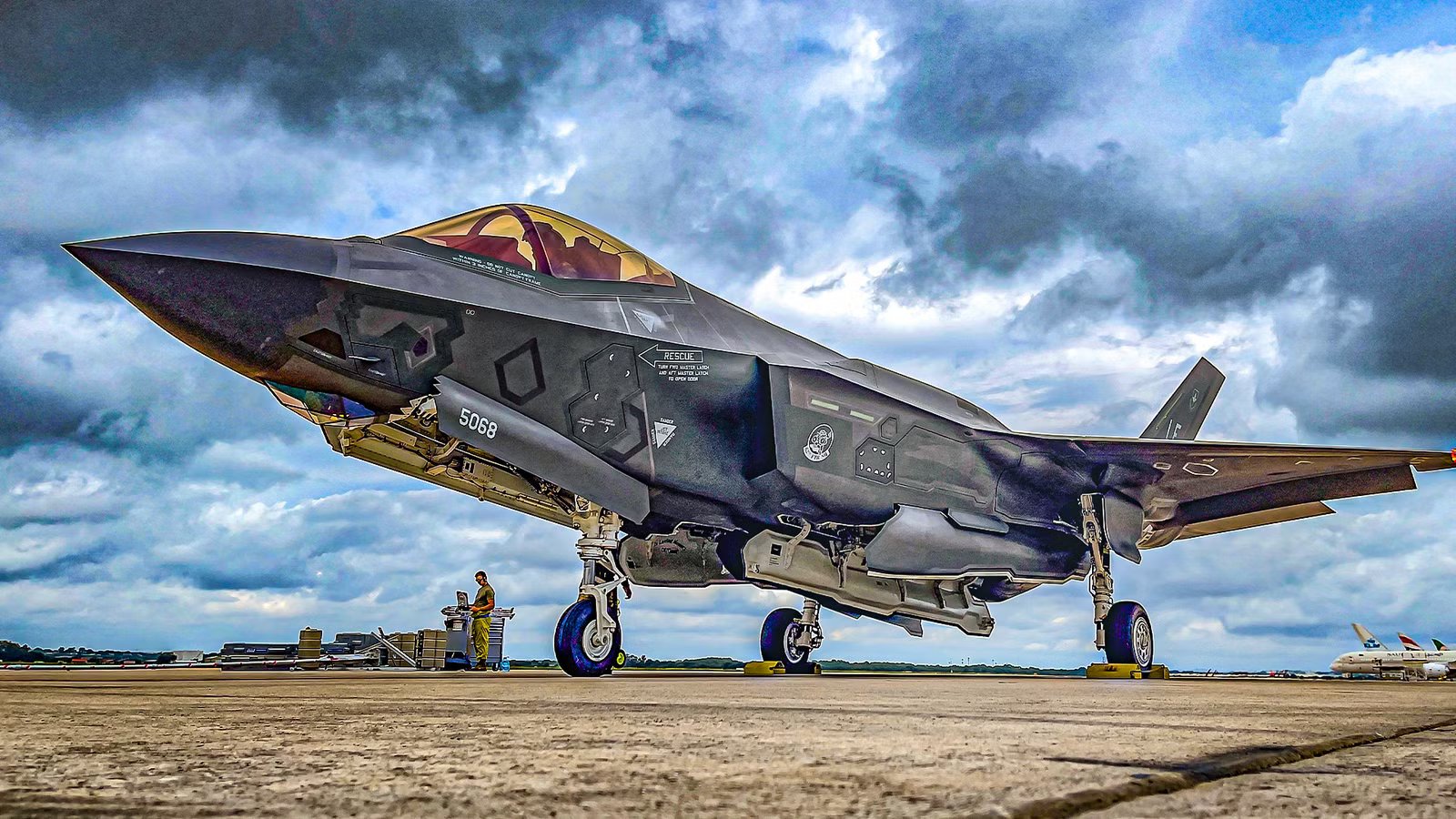
The F-35 Joint Program Office (JPO) manages an international network of industrial efforts that incorporate contributions from almost every partner nation that operates the F-35, or plans to do so in the near future. There are only three final assembly lines in the world for the F-35, covering all three variants. The largest is located at the bomber plant in Texas, while the European location is in Italy, and Japan has one as well.
European nations remain integral to the Lockheed Martin F-35 Lightning II program, contributing approximately 25% of the aircraft’s components through a network of major aerospace contractors. Of the 20 nations, and counting, that are part of the F-35 team, the level of responsibility and privilege is broken down by a tier-based partnership system that dictates financial investment and industrial workshare.
Partners Across The Pond

The F-35 Joint Strike Fighter (JSF) program was intentionally modeled after the 1970s F-16 Multinational Fighter Program, which served as the ‘blueprint’ for large-scale allied aerospace collaboration. The F-16 program began with the European Participation Group (EPG) of Belgium, Denmark, the Netherlands, and Norway, who collectively funded development in exchange for licensed production rights.
The JSF program expanded this into a three-tier system. Europe’s involvement is categorized by levels of investment in the original System Development and Demonstration (SDD) phase. The only level one partner, the United Kingdom, invested around $2 billion, or 10% of development costs, to guarantee more autonomy over its aircraft and deep industrial integration.
F-16 components were manufactured across Europe, with final assembly lines (FACOs) in Belgium and the Netherlands to ensure regional industrial benefits. The F-35 utilizes the same distributed manufacturing with an assembly plant in Cameri, Italy, as the country contributed $1 billion to development. The Netherlands was not far behind with $800 million toward development, making each a tier two partner. Denmark and Norway are tier three partners that contributed hundreds of millions of dollars to the development of the program, but limit industrial sharing to specialized industrial niches.
The European Roster

Italy’s Cameri air base is the only plant outside the US capable of assembling the complex F-35B (STOVL) variant. Prime contractor of the plant, Leonardo, also manufactures complete wing sets for the global program. Germany will become a new operator in 2026, and as such, Rheinmetall inaugurated a state-of-the-art factory in Weeze to produce hundreds of center fuselage sections.
Countries like Germany, Poland, Belgium, Finland, and Switzerland are customers under Foreign Military Sales (FMS), but some have smaller suppliers that contribute to the F-35 program in different ways. The F-35 program uses Global Support Solutions, where specific countries act as regional hubs for specific tasks. Here’s a snapshot of some of the biggest names involved in the F-35 production effort and an overview of the manufacturing contributions of each:
|
Manufacturer |
Country |
Primary Responsibilities |
|---|---|---|
|
Rolls-Royce |
United Kingdom |
Provides the unique LiftSystem technology for the F-35B variant. |
|
Martin-Baker |
United Kingdom |
Supplies the US16E ejection seats for the entire global fleet. |
|
BAE Systems |
United Kingdom |
Principal partner; responsible for the aft fuselage, fuel systems, crew life support, and the electronic warfare (EW) suite. |
|
Leonardo |
Italy |
Operates the Final Assembly and Check-Out (FACO) facility in Cameri; manufactures complete wing sets for the global fleet. |
|
Rheinmetall |
Germany |
Established a state-of-the-art factory in Weeze to produce center fuselage sections. |
|
Kongsberg |
Norway |
Developed the Joint Strike Missile (JSM) specifically for F-35 internal carriage; manufactures air-to-air missile pylons. |
|
Terma |
Denmark |
Produces over 80 composite and electronic parts, including the Multi-Mission Pod for external sensors or weapons. |
|
Fokker (GKN) |
Netherlands |
Supplies wiring systems, landing gear components, and in-flight opening doors. |
|
Patria |
Finland |
Building local industrial capabilities for regional maintenance and component assembly. |
Cameri is designated as the Euro-Mediterranean heavy airframe maintenance hub, while the Netherlands hosts the primary European logistics hub, managing the spare parts pool for over 500 aircraft operating across the continent.
This system mirrors the F-16’s goal of creating a borderless maintenance ecosystem for allied forces. By operating the same airframe, the F-16, NATO allies achieved unprecedented tactical interoperability during the Cold War. The F-35 takes this further through Sensor Fusion and the Multi-Function Advanced Datalink (MADL), expanding on joint tactics F-16 pilots pioneered decades ago.
A Paradigm Shift

By the end of the decade, there will be over 600 F-35s operational in the continent under the flags of the various members of the program and jointly serving the North Atlantic Treaty Organization (NATO). This will fundamentally alter the way that European armed forces can project air power. The 5th-Gen evolution of Europe’s Air Forces creates a ‘holistic’ air defense shield with stealth, advanced sensors, and interoperability like never before.
The widespread adoption of the F-35 in Europe is a strategic response to modern threats, particularly Russia’s Anti-Access/Area-Denial (A2AD) capabilities. The F-35 has revolutionized SEAD (Suppression/Destruction of Enemy Air Defenses) by moving beyond the traditional role of just firing anti-radiation missiles. The F-35 is specifically designed to find and destroy hostile air defenses, creating safe corridors for less survivable aircraft to operate.
NATO allies are embracing the Agile Combat Employment (ACE) concept of generating air power from geographically dispersed or austere locations. In 2025 and 2026, Dutch and Finnish F-35s successfully demonstrated the ability to conduct touch-and-go landings on public highway strips in the Nordic regions, proving they can operate from dispersed, austere locations. A major ACE breakthrough in 2026 is ‘cross-servicing,’ where Dutch maintainers can launch US F-35s and vice versa.

The World’s Largest Air Forces By F-35 Numbers
How the top F-35 flyers compare.
Allies In Peace And Conflict

Not only does having all Allied members under the F-35 umbrella contribute to the logistics and development to improve the technological and industrial base of each partner nation, but it also strengthens the resilience of each individual air force in the event that hostilities break out. Each nation can not only maintain its own individual supply of spare parts and major components, they can also cultivate domestic skill pools in the form of technicians, engineers, and air crews with expertise.
The immediate and obvious advantage to this is the independence of European operators from a burdensome tether to the United States. By eliminating the need to cross the Atlantic Ocean for major maintenance and even final assembly of new airframes, every operator in Europe enjoys a far more expedient supply chain. European F-35 fleets are also much more prepared for combat thanks to in-depth domestic and regional industrial support.
The advantage of the European F-35 Manufacturing presence is a two-way street. When the United States sends the Air Force, Navy, or Marines on deployment to Europe with F-35 squadrons, they can not only easily operate with their European allies but also count on support for their jets. Allies in Europe operate both the F-35A and F-35B variants, while the US Navy is the only operator of the F-35C today, but the enormous amount of overlap between all three airframes means that American naval aviators still have a shoulder to lean on in extreme scenarios.

The F-35’s Role In Multinational Air Defense Alliances
The F-35 is set to play a central role in air defense of both the United States and its allies for decades to come.
Peace Through Strength

The F-35 is a core pillar of NATO’s nuclear deterrence. The aircraft is the first 5th-Gen aircraft certified for the Dual-Capable Aircraft (DCA) role, carrying the B61-12 nuclear gravity bomb internally to maintain stealth. Germany and the Netherlands will use the F-35A to replace aging airframes for the NATO nuclear strike role. The F-35 has undergone extensive testing and certification to take on the Netherlands’ nuclear responsibilities.
The Netherlands fully assumed NATO nuclear responsibilities with the F-35 in 2025. Like the F-16s it replaced, the DCA F-35 squadron dedicated to the nuclear mission is now based at Volkel Air Base, according to the Aviationist. The RNLAF (Royal Netherlands Air Force) plans to acquire a total of at least 46 F-35As.
The United Kingdom announced in mid-2025 that it would purchase F-35A variants specifically to rejoin the NATO nuclear mission, in addition to the Royal Navy (RN) submarine deterrent, the Guardian reported. The F-35As will be based at RAF Marham in Norfolk. Nuclear arms vaults exist at nearby RAF Lakenheath, which is also used by the US Air Force. The B61-12 is made in four different explosive yields, of 0.3 kilotons (kt), 1.5kt, 10kt, and 50kt. For comparison, the bomb dropped in WWII on Hiroshima, Japan, had a yield of 15kt.

The 14 US Allies Participating In The F-35 Lightning II Program
Fourteen allied nations unite with the US with one purpose – the F-35 program, forging a renewed partnership.
The Kill Switch Question

The F-35 acts as a networked sensor platform, allowing a Finnish F-35 to pass targeting data to a German F-35 seamlessly. Yet, just as F-16 partners occasionally struggled with US-controlled software updates, F-35 partners have expressed frustration over closed systems, dubbed ‘black boxes,’ that prevent them from independently modifying the aircraft’s source code or integrating national weapons without US approval.
The F-16 program faced similar European concerns over sovereignty. The F-35 program uses a more comprehensive common software backbone. However, this has led to debates over technological dependency, with some European lawmakers raising concerns about a US-controlled ‘kill switch’ that could theoretically disable aircraft via software updates.
The ‘kill switch’ remains one of the most contentious debates within the F-35 program. While both the Pentagon and Lockheed Martin vehemently deny the existence of a literal, physical ‘kill switch,’ the concern persists as a political and strategic reality for European partners.
European partners often point to Israel as the only country allowed to install its own independent command-and-control software and weapons on the F-35I ‘Adir.’ The US refusal to grant similar levels of software sovereignty to NATO allies like the UK or Germany remains a major point of friction in 2026.