dailynewsnblog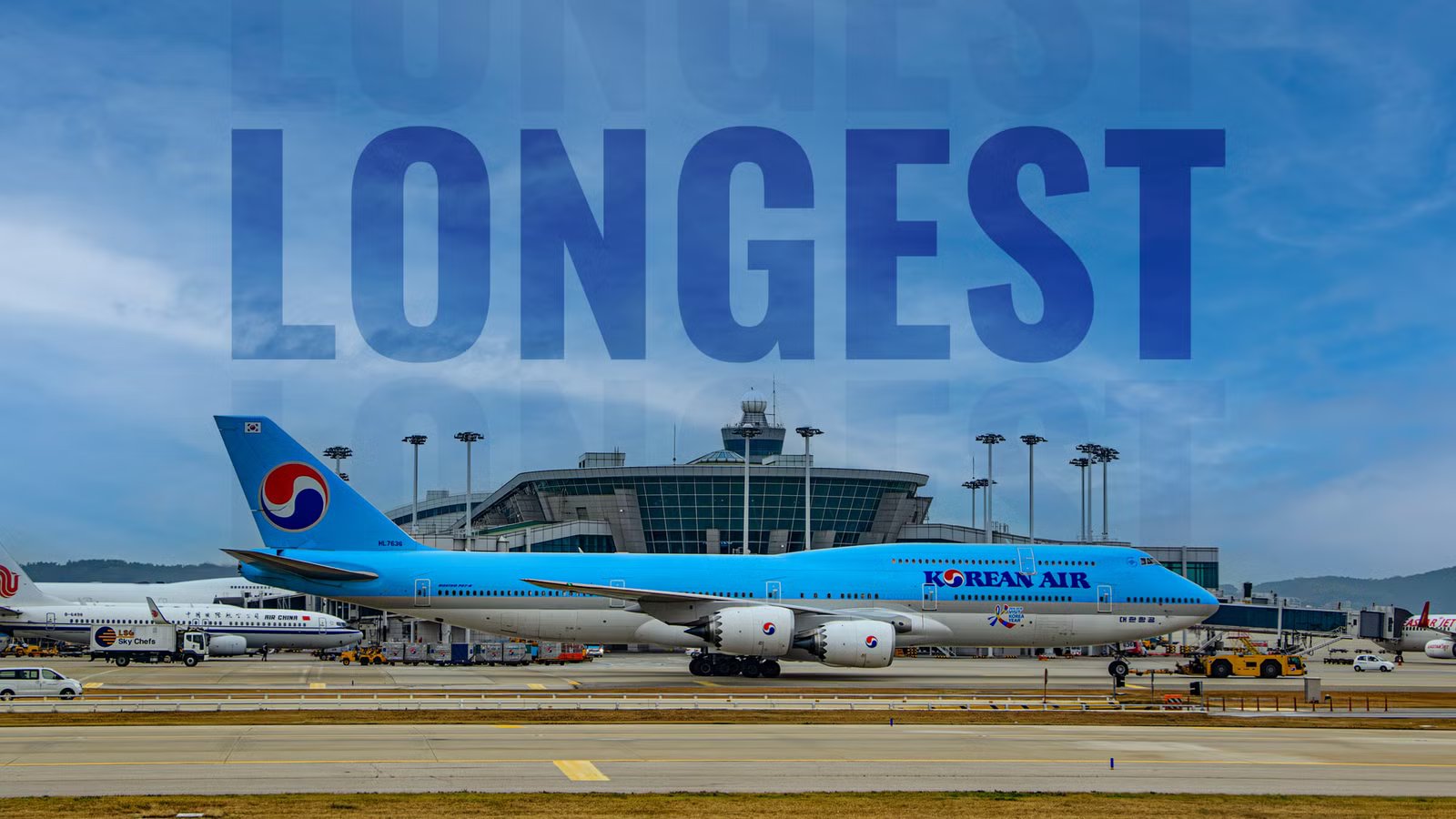
In 2026, the  Boeing 747-8 is no longer the globe-spanning default that most once knew it as. However, on the routes where it still shows up, it is there for a unique reason. This is the last, and largest, variant of the Queen of the Skies, a jet that was built to haul numerous people, specifically many premium passengers, across very long distances with the kind of range and payload flexibility that airlines still value on a handful of high-demand city pairs. The catch here is that the passenger Boeing 747-8 has become a niche aircraft, with only a small group of carriers that still fly the model, and they tend to deploy it in an extremely surgical fashion. Operators prefer to use this jet on trunk routes that combine heavy business traffic, strong connecting flows, and airport constraints that make adding more frequencies increasingly difficult.
This is what makes the longest nonstop Boeing 747-8 routes in 2026 so interesting to analyze. They are not just long for the sake of it, but they are rather an impressive snapshot of where legacy widebody economics support real deployment of this expensive aircraft in a world that is increasingly dominated by Boeing 777-300ERs, Airbus A350s, and 787 Dreamliners. These flights also help highlight the 747-8’s role as a modern flagship, albeit for relatively few carriers. This is a way for airlines to concentrate capacity, showcase a carrier’s top cabins, and move premium demand efficiently when slots are tight. We analyze the longest scheduled nonstop Boeing 747-8 services, break down which airlines still commit the type to ultra-long missions, and explain why these routes remain some of the most strategically valuable in airline networks.
A Brief Overview Of The Boeing 747-8 And The Role it Plays

The Boeing 747-8 is the final and most capable passenger variant of the legendary aircraft, a stretched, re-engined evolution of the Boeing 747 that was designed to carry a lot of people a very long distance. The jet was also designed to deliver better fuel burn and cargo capacity than earlier variants of the type. In 2026, the jet’s role will no longer be a default long-haul workhorse for airlines. Rather, twin-engine widebodies like the Boeing 777, the Airbus A350, and the 787 have mostly won order books due to their more appealing operating economics.
Instead, the Boeing 747-8 has become a specialist tool, one used exclusively by a few carriers on routes where sheer capacity, premium demand, and slot constraints matter more than having the newest and most efficient airframe. When an airline puts a passenger Boeing 747-8 on a route today, it is usually doing it for one of three reasons. For starters, it may concentrate demand on a single departure when airport slots are limited or peak-hour access is hard to get.
Second, the aircraft is a flying flagship product, primarily because the jet’s upper deck and spacious layout still lends itself to a special premium experience that airlines can and want to market. Third, an airline may choose to leverage the plane’s payload flexibility, as the jet can carry passengers, bags, and meaningful belly cargo without getting boxed in as quickly on longer sectors. The result is an aircraft that is rarer but still strategically relevant.
The Aircraft Is Extensively Used In The South Atlantic

Lufthansa’s Frankfurt Airport (FRA) to Ministro Pistarini International Airport (EZE) in Buenos Aires is a city pair that stands out as the longest served by the capable Boeing 747-8. Route data provided by aviation analytics company Cirium highlights daily service in both directions on this route, with a consistent 364-seat layout, one which turns the jet into an impressive machine for connecting Germany and Argentina. This consistency is important on ultra-long-haul routes, with each roundtrip eating heavily into block time so that cancellations can ripple across an entire schedule.
The aircraft also offers impressive capacity, with around 948 million available seat miles (ASMs) per direction, so that even small changes in overall load factor or yield can swing profits quite quickly. South America is also where the Boeing 747-8’s belly freight shines. Exporters and freight forwarders like the volume that the aircraft can provide, and it allows Lufthansa, the operator of this specific route, to lean on cargo profits when passenger revenue softens.
The next-longest South American Boeing 747-8 route connects Frankfurt and São Paulo (GRU), also offering daily service and producing an impressive 807 million ASMs in each direction. Collectively, these routes from EZE and GRU show that  Lufthansa is using the Boeing 747-8 exactly as was intended. The seat count lowers overall unit costs when demand is thick, and the range keeps schedules intact even with headwinds over the South Atlantic for much of the year.

Why Doesn’t Lufthansa Fly The Boeing 747 On Short-Haul Flights?
The airline only deploys this aircraft on long-haul sectors.
A Look At Some Pacific Routes That Demand Scale

Outside of South America, the longest Boeing 747-8 flights have increasingly become a tug-of-war between time zones, slot constraints, and aircraft utilization. Korean Air’s route from Incheon Airport (ICN) to  Los Angeles International Airport (LAX) is the longest transpacific service the 747-8 is currently used for. There are over 400 flights in each direction on this route per year, with 268 seats per departure, producing more than 960 million ASMs in each direction.
This combination of core trunk service exists when demand is high, and cargo customers want an aircraft with strong belly cargo capabilities. Lufthansa also flies the jet on a number of ultra-long-haul routes to destinations in Asia and North America, with some good examples including Mexico City (MEX), Tokyo-Haneda (HND), Los Angeles, and San Francisco International (SFO).
These flights do exist with varying frequency, with LAX and MEX seeing daily 747-8I service, while some others see more seasonal demand. Korean Air’s 747-8 jets also serve London Heathrow Airport (LHR), but at a significantly lower frequency. As a result, the Boeing 747-8 mostly pops up in places where its operators are looking to supply a larger number of seats and cargo capacity to a market. These also need to be marquee routes with the ability to sell seats in premium cabins.
Who Are The Major Operators Of The Boeing 747-8I?

There are three airlines that operate the Boeing 747-8 today — these carriers are Lufthansa, Korean Air, and Air China. Lufthansa is the type’s flagship passenger carrier, and it built the Boeing 747-8 into the backbone of its Frankfurt long-haul connecting bank. The carrier uses the jet on high-density trunk routes to North America, Latin America, and many parts of Asia. The appeal of the type is relatively simple, with a huge premium cabin presence up front, lots of seats overall, and strong belly-cargo capacity, which helps the economics on long sectors.
Korean Air uses the Boeing 747-8 in a more selective manner, but on marquee, high-volume routes, it still makes a major impact. As discussed, this primarily means long Pacific segments and slot-constrained airports. For the airline, the jet is a capacity-and-cargo tool that also carries extensive brand value, even as the airline may shift towards flying more efficient twinjets.
|
Airline: |
Boeing 747-8 Fleet Size: |
|---|---|
|
Lufthansa |
19 |
|
Korean Air |
4 |
|
Air China |
7 |
Air China is the third major operator of the type historically, deploying the Boeing 747-8 on international routes out of Beijing and other hubs when demand justifies the plane’s size. In practice, aircraft utilization has been more variable and influenced by fleet strategy changes and geopolitical swings. Across all three types, the Boeing 747-8’s niche is concentrated demand and the ability to monetize belly freight. Both these things need to line up in order to justify the jet’s high operating costs.

Lufthansa’s 2 Different Boeing 747 Cabins: Compared
The airline will fly its 24-aircraft fleet on 40 routes this month.
How Does Air China Use The Boeing 747-8?

We note that Lufthansa and Korean Air do account for the vast majority of ultra-long-haul flights operated by the 747-8, and that Air China’s network is mostly underdiscussed. These jets are primarily used in a sparing and strategic manner for high-demand, long-haul trunk routes in and out of Beijing, where the airline wants maximum seats alongside strong belly-cargo revenue. With such a small fleet, they attempt to concentrate the aircraft’s deployment on a few city pairs rather than spreading it out.
This helps protect reliability and crew planning. The Boeing 747-8 also works well at slot-constrained airports; upgauging one flight can add capacity without needing extra slots. In practice, this means that one will see the Boeing 747-8 appear primarily on peak-season banks.
The jet can also be used very effectively during holidays and other periods of constrained widebody availability. The airline uses its Boeing 777s, 787s, and Airbus A350s to cover the majority of its standard schedule. When demand softens, the aircraft is among the first to be swapped as trip costs punish weak loads on long-haul sectors.
What Is Our Bottom Line?

At the end of the day, there are a few carriers that require the Boeing 747-8I in 2026. Nonetheless, there have been exactly three airlines that believed that the plane provided enough value for them to choose to introduce it to certain kinds of high-demand routes, especially ones where some cargo demand exists.
This jet is still one of the largest and most capable aircraft to ever take to the skies, and it can easily traverse entire oceans and complete some ultra-long-range journeys. These kinds of niche routes, such as Frankfurt to Buenos Aires, are the exact kinds of connections where this plane can offer unique value.
These routes showcase an aircraft that needs to be deployed extremely carefully. The model’s capacity and range combination is again what makes it especially valuable. However, it is still a reasonably large liability, as it comes with exceptionally high operating costs.