dailynewsnblog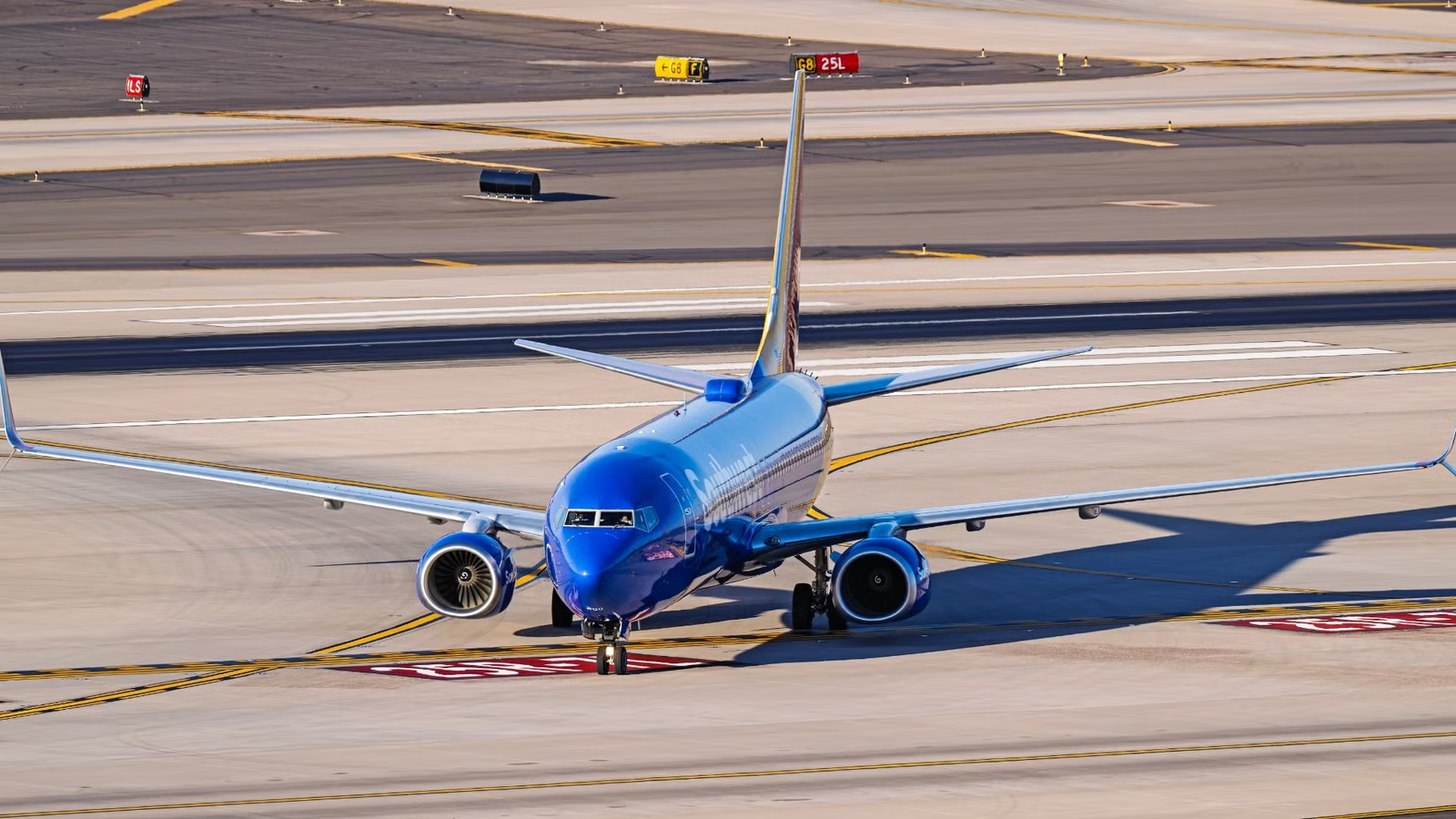
After leaving the gate of San Antonio International Airport (SAT),  Southwest Airlines flight 4996 was stopped in its tracks by a small turboprop that made a wrong turn onto the runway. According to KENS5 News, the Southwest Boeing 737 had already begun its takeoff roll when the plane was forced to abort.
the wrong way intrusion by the Pilatus PC-12, fortunately, did not result in any damage or injuries, but did cause a significant delay for the Southwest passengers. FlightAware shows that the plane did not take off until an hour after its pushback time at 1:30 PM CST and landed two hours after its originally intended arrival time.
A Harrowing Day In San Antonio

The two aircraft came within 2,000 feet of each other while the 737 was speeding up to lift off. Aside from being a violation of separation minima, this was an extremely dangerous mistake. Standard runway separation requires at least 6,000 feet of distance from another aircraft on the same runway.
If a 737 crew observes an incursion while accelerating for takeoff, they must perform a Rejected Takeoff (RTO). At high speeds, a 2000-foot gap leaves very little margin for the 737 to decelerate safely before reaching the intruding turboprop. Even for smaller aircraft, if an aircraft is departing and has not yet crossed the runway end, a following landing aircraft must maintain at least 3,000 to 6,000 feet, depending on the aircraft category.
Runway incursions are classified among the five highest-risk categories for aviation fatalities. This incident follows a close call at the end of October 2025 when another Southwest 737 had to maneuver during landing approach to avoid a collision. San Antonio Airports Director Jesus Saenz told KENS 5:
“There was 2,000 feet of separation there. I’m not gonna say that’s normal, because it’s not, but things happen. We focus on being as safe as possible in everything that we do.”
Incident Investigation Underway

Officials at the airport are working with the Federal Aviation Administration (FAA) to ensure that a full and thorough analysis of how the dangerous incident unfolded is completed. Saenz also added that the investigation team will hold those accountable if necessary after all the facts are revealed. The investigation deeply examines ‘why’ the error happened, not just ‘what’ happened.
An investigation into a high-severity runway incursion involving a 737 and a turboprop follows a rigorous, multi-layered process primarily led by the National Transportation Safety Board (NTSB), the FAA, the airport, and aircrew from each aircraft. Flight Data Recorders (FDR) and Cockpit Voice Recorders (CVR) can be pulled from both aircraft to capture exact control inputs and cockpit communications.
Recordings of controller-pilot transmissions and radar data are reviewed to determine if the incursion resulted from a pilot deviation or a controller error. A final report is issued detailing the probable cause and making safety recommendations to prevent future occurrences, such as airfield modifications or new pilot procedures.

Another Close Call: Southwest Boeing 737 Swerves To Avoid Helicopter Over Cleveland
The jet took evasive action after a TCAS warning.
The Worst Case Scenario

A collision between a Boeing 737 and a Pilatus PC-12 within 2000 feet of takeoff would likely have been catastrophic. A 737 can weigh over 150,000 lbs during takeoff, while a PC-12 weighs roughly 10,000 lbs. The 737 accelerates to as much as 185 mph (297 kmh) to achieve lift-off speed. The PC-12 would likely be shredded or flattened.
PC-12 fuel tanks would likely rupture upon impact. The resulting fireball would be fueled by both aircraft’s fuel supplies, often leading to a post-impact fire that is the primary killer in these scenarios. In a similar historical collision, a 1991 LAX crash, a 737 landed on a smaller turboprop, crushing it instantly beneath the fuselage. In the LAX incident, all occupants of the smaller turboprop were killed instantly.
Striking an object as large as a PC-12 at takeoff speeds would likely cause the 737’s nose gear to collapse. This would lead to the 737 sliding on its belly or engines, potentially veering off the runway. Debris from the PC-12 could be ingested into the 737’s engines, causing uncontained engine failure or fires. While some 737 passengers might survive the initial impact, most fatalities in these runway collisions are caused by asphyxiation from toxic smoke during a bottlenecked evacuation.
The USAir crash in 1991 resulted in a 25% fatality rate aboard the 737 after it destroyed the smaller plane on touchdown, according to Aviation Safety. Most of the deaths were due to fire and smoke as passengers attempted to escape when the jetliner came to a stop after veering off the runway and colliding with a building after striking the light plane.