dailynewsnblog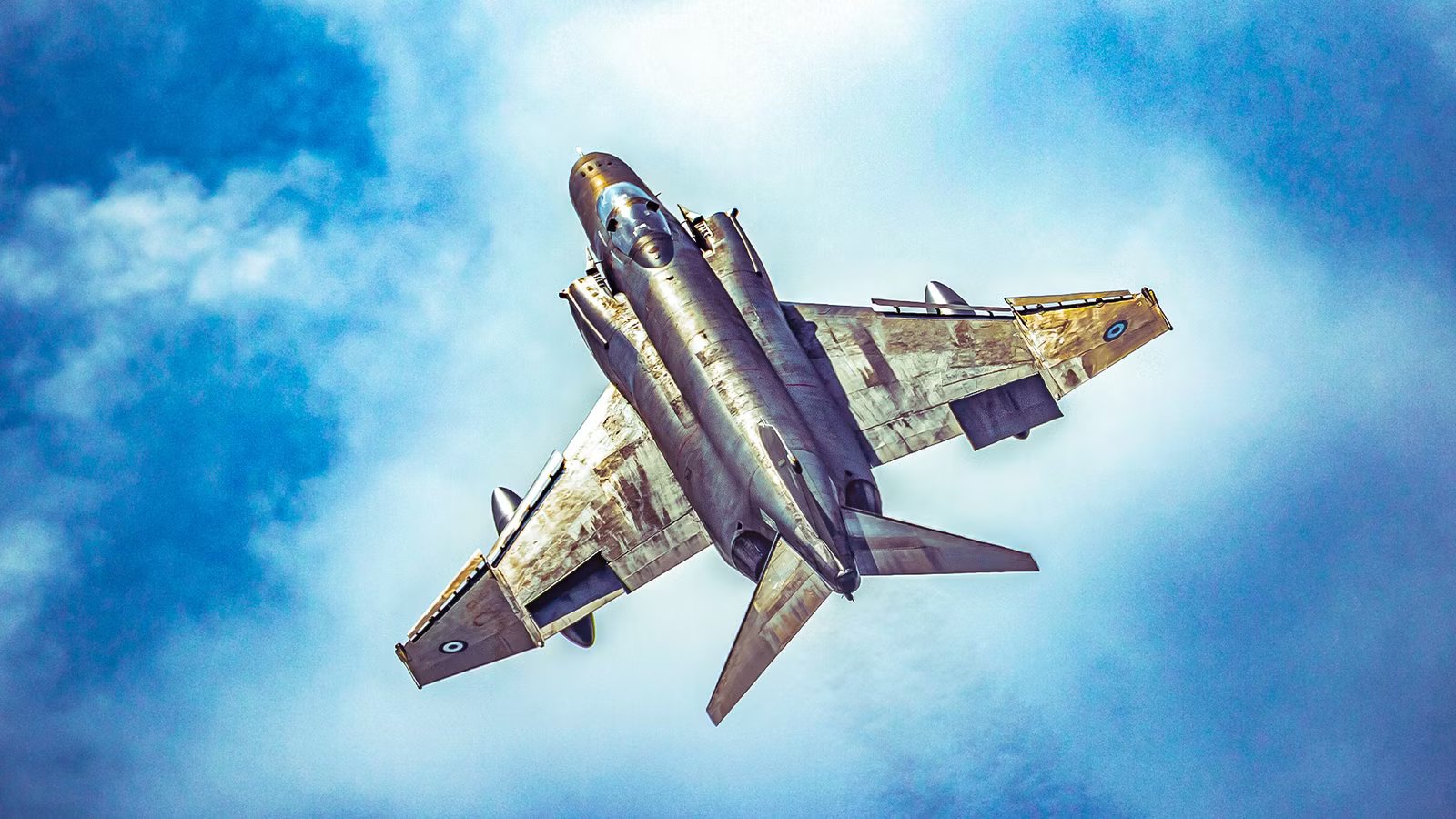
The McDonnell Douglas F-4 Phantom II was one of the most consequential fighter jets of the United States during the Cold War. Not only was it a bedrock of US Air Force air power, but also for the US Navy and Marines. The jet was one of the most capable fighter jets of its time and was as fast as modern fighter jets in the United States Air Force service today.
Over 5,000 F-4s were built for the US and export customers around the world. By the standards of the time, the F-4 was a long-range fighter jet, though it wouldn’t be considered a long-range fighter today. Here is what to know about the F-4’s range and speed, why it was revolutionary for the time, and how it has been superseded.
Development & Original Mission Set Of The Phantom

The F-4 Phantom II’s development traces back to the mid-1950s. By 1955, the US Navy had a requirement for a long-range, high-altitude interceptor that could protect carrier groups against emerging Soviet bomber threats. As a side point, the Soviet Tu-22M3 variable sweep wing bomber was later designed to attack US carrier groups. These days, the Tu-22M3, along with all other strategic bombers (except for the B-2 Spirit), is little more than a missile truck due to air defense threats.
The Phantom first flew in 1958 and was the first fighter jet to come with a tandem two-seat layout. This was a time when air-to-air missiles were seen as the new technology of the future, and so initial Phantoms were produced without an internal gun. This was soon recognized as a mistake, and guns were quickly added to Air Force versions.
The F-4 was designed as an Interceptor and fighter-bomber. The Phantom II was a versatile fighter, not a multirole fighter, as the distinction lies in its software-driven design philosophy. It was an airframe able to be rebuilt to do many missions like reconnaissance, Wild Weasel, interception, etc., but it couldn’t do all these at once, as modern multirole fighters can. It was a family of aircraft with variants for specific roles.
The US’s Long Range Fighter

For its time, the F-4 was considered a long-range fighter jet. It was able to cover hundreds of miles around a carrier, loiter, and engage targets beyond visual range. When fitted with external tanks, the F-4 had a ferry range of around 1,750 to 2,300 miles. Depending on the mission profile, its combat radius was around 340 nautical miles.
This has since increased significantly with subsequent generations, with the F-35 having a combat range of over 600 nautical miles (less for the F-35B). The F-16 has a combat range of around 300 to 400 nautical miles, the F/A-18 Super Hornet has a range of around 400 to 450 nautical miles, and the F-14 Tomcat has a range of around 450 nautical miles. Note that all of these numbers are very approximate and vary by aircraft variant, mission type, aircraft loadout, etc.
In the 1960s, the F-4’s range was considered excellent, but later its J79 engines were overtaken by more fuel-efficient modern turbofans. It should also be noted that the F-4 wasn’t constrained by stealth, so it was free to carry external tanks. Modern stealth jets, like the F-35, have to carry internal fuel to preserve stealth. The F-4 would require carrying a centerline tank and two wing tanks just to match the radius of the F-35 flying on internal fuel alone.

California Businessman Indicted For Trying To Sell F-4 Phantom Components To Iran
Iran has been sourcing parts on the black market to keep its legacy American jets flying for many years.
GE J79 Turbojets Made F-4 Fast

The F-4 Phantom II was among the fastest fighter jets ever built by the United States. It had a max speed of Mach 2.2, well above the modern F-35’s Mach 1.6. Meanwhile, the F-16 gets around Mach 2.0, the Super Hornet is officially Mach 1.6, the F-14 Tomcat was Mach 2.3, and the F-22 Raptor is classified but is over Mach 2.0, perhaps around Mach 2.2. Notably, the Raptor is designed to supercruise at Mach 1.7.
The fastest of the US fighter jets is the F-15 with a Mach of over 2.5. But while having a high Mach is cool, it comes with major issues. At that speed, its General Electric J79 turbojets would create a visible trail of black smoke, a dead giveaway in dogfights. Supersonic speeds guzzle fuel, while the aircraft becomes less maneuverable, putting it at a disadvantage in a dogfight. In practice, the jet was rarely supersonic in a fight.
|
McDonnell Douglas F-4 Phantom II (US Air Force) |
|
|---|---|
|
Number built |
5,195 |
|
Top speed |
Mach 2.2 |
|
Combat range |
370 nautical miles |
|
Ferry range |
Approx. 1,400 nautical miles |
|
Status |
In limited foreign service |
The General Electric J79 turbojets were first run in 1955, and over 17,000 were built. They were also used to power the Convair B-58 Hustler, the F-104 Starfighter, and the North American A-5 Vigilante. Israel also used the engine on its IAI Kfir fighter jets, which were based on reverse-engineered French Dassault Mirage 5s. A downgraded (unsuccessful) export variant of the F-16 was also developed using the by-then-outdated J79 turbojet.
Why The F-4 Phantoms II’s Speed Was Abandoned

The F-35 was slowed down to Mach 1.6 for a range of factors. One is that the friction of higher speeds heats its airframe and diminishes its stealth. When the F-4 was built, aircraft had gotten faster and faster, and there was the assumption that progress meant making the next-generation even faster. Lessons learned from how pilots actually flew the F-4 in Vietnam led engineers to question that assumption.
This has been repeated with bombers. The XB-70 was built for Mach 3.0, the later B-1A Lancer for Mach 2.0, the subsequent B-1B (that actually made it into service) for Mach 1.25, and the B-2 Spirit for Mach 0.9. The upcoming B-21 Raider will also be subsonic. But it’s not all a trend to slower speeds; the Air Force’s next-generation F-47 air dominance fighter will have a top speed of around Mach 2.
To characterize the development, aircraft like the XB-70 Valkyrie and the F-4 Phantom II were built with the idea, “you can’t hide, but you can run.” With an altitude of 70,000 feet, the XB-70 was also intended to fly above any threats. Modern aircraft like the B-21 and F-35 are built with the idea “you can’t run, but you can hide.” That said, while the F-47 is doubling down on hiding, it will also be able to run.

Top 5 US Military F-4 Phantom Variants By Number Built
In total, more than 5,000 units of the Phantom II were produced from 1958 to 1979.
Why The Navy Built The F-14 To Replace F-4

In the US Navy, the F-4 Phantom II was replaced by the F-14 Tomcat, made famous by the movie Top Gun. The F-14 was first deployed on the USS Enterprise and operated alongside the F-4 for another couple of decades. The F-14 was developed to solve a number of issues emerging with the F-4. One was that the F-14 was much larger and could function as a missile truck. Its AWG-9 radar and AIM-54 Phoenix missiles allowed it to track 24 targets and attack six simultaneously at a range of over 100 miles.
The F-4 could track one target at a time, and its AIM-7 Sparrow missiles had a range of up to 25 miles. The F-4 had relatively poor visibility for the pilot, so the F-14 corrected this with its bubble canopy. The variable sweep wings of the Tomcat allowed it to dramatically increase maneuverability in slow-speed dogfighting while also dashing for high-speed intercepts. The F-4 relied on speed more than maneuverability.
While Air Force F-4s had cannons, the Navy ones didn’t. The F-14 was designed with the M61 Vulcan autocannon. Another issue was the failure of the Navy’s F-111B program, imposed by the Pentagon, which sought to create a Naval version of the F-111 to replace the F-4. That program was canceled in 1968. The F-14 was born out of this failed program, using its best attributes, like its engines and long-range missile system.
Retirement Of The Phantom II

Overall, the Phantom II was one of the most versatile and capable fighter jets ever developed in the context of the jet’s era. It was so versatile that the Air Force couldn’t replace it with just one aircraft. Instead, the new F-15 Eagle took over the F-4’s role in the air superiority and long-range interception roles. The F-16 took over in the low-end roles and provided a “mass” replacement.
Other aircraft and variants took over its Wild Weasel (SEAD) and tactical reconnaissance roles. By 1986, the Phantom had been retired from the US Navy, and the Air Force had retired it from combat use by 1996. By 2004, Israel had withdrawn them, and by 2016, US stocks of retired F-4 airframes had run out, prompting a switch to retired F-16 airframes as the next-generation QF-16 target drone.
Even so, the F-4 Phantom II remains in limited service around the world. South Korea retired the last of its F-4s in 2024, while Greece is in the process of retiring theirs. This will leave only two countries operating them: Turkey and Iran. It is unclear how many Iranian F-4s are flightworthy, let alone combat-worthy. Turkey’s F-4s are the highly modernized F-4E 2020 “Terminators.” The most recent combat action was likely in June 2025 when Israel destroyed some Iranian F-4s on the ground.