dailynewsnblog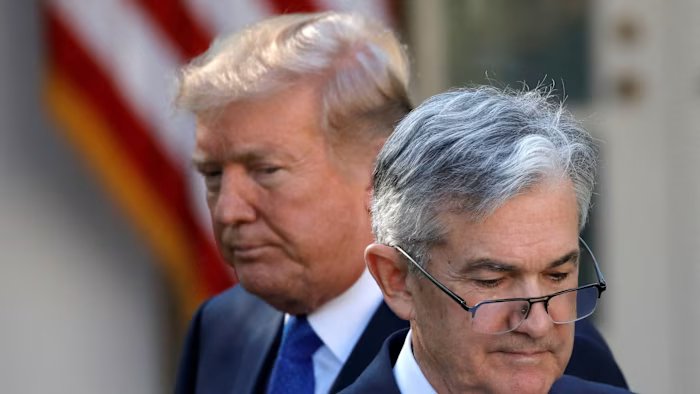
This article is an on-site version of our Chris Giles on Central Banks newsletter. Premium subscribers can sign up here to get the newsletter delivered every Tuesday. Standard subscribers can upgrade to Premium here, or explore all FT newsletters
Newton’s third law of motion loosely says that for every action there is an equal and opposite reaction. While most kept their eyes on the circus surrounding President Donald Trump’s visit to the World Economic Forum in Davos last week, I focused on reactions to him.
Whether it was the US Supreme Court, the next Federal Reserve chair, financial markets or transatlantic partners, the reactions are more interesting and important than any jamboree up the mountains in Switzerland.
The legal reaction
Last May, the US Supreme Court ruled in a case that the Fed was a “uniquely structured, quasi-private entity”, exempting it from the US president’s right to fire government officials at will. Regardless, Trump wrote to Fed governor Lisa Cook in August and fired her for the “cause” of mortgage fraud five days after calling for her resignation on Truth Social.
The administration has now softened its position a little and alleges that Cook was either fraudulent or perhaps grossly negligent. Cook’s team says her actions were, at worst, an inadvertent mistake in the past that had no consequences. But this has not been tested in court. So far, the conversation has centred around whether Trump’s actions were legal and whether the lower courts were right to allow Cook to stay in post while the main issue trundles through the US judicial process, where a final verdict could take years.
As the FT’s Monetary Policy Radar reported after the Supreme Court oral hearing last Wednesday, Cook had a good day. The three liberal justices could be counted on to react negatively to Trump’s actions, so it was the reactions of the six conservative justices that mattered. Here is a very quick summary of their concerns in the hearing:
-
Justice Samuel Alito wondered why the administration was forcing the issue up to the Supreme Court “in such a hurried manner” when the facts had not yet been heard.
-
Justice Amy Coney Barrett sounded sceptical that the administration could argue the president suffered irreparable harm by keeping Cook in post. She also suggested the court should exercise “caution”, given the potential equity-market risk of undermining Fed independence.
-
Chief Justice John Roberts worried that the administration did not have the power to fire without demonstrable “cause” and procedures that could be tested in court. “You can’t be right about the idea that courts can’t order anybody who’s been removed to be reinstated,” he told Trump’s lawyer.
-
Justice Brett Kavanaugh worried that a Truth Social post and five days’ notice before being fired was “insufficient process”.
If I had to guess, the most probable outcome will resemble Kavanaugh’s suggestion that the court would “say there was insufficient process and, therefore, we at this juncture deny the government’s application”.
Had Trump not jumped in and tried to bully Cook out of the Fed so quickly, he might well have prevailed. All he probably needed to do was to have avoided prejudging the matter and to have initiated a meeting in the Oval Office for Cook to argue her case. His actions generated a sharp oral reaction from the Supreme Court. Its ruling is expected before the summer.
The next Fed chair’s reaction
In betting markets, the latest excitement is that Rick Rieder will be Trump’s nomination to chair the Fed. I am not playing this game, because odds spike whenever the president says something nice about a potential candidate.
More important is what Trump wants from his nominee. This was relatively clear in his long and rambling speech at Davos. Referring both to Switzerland, with its zero per cent short-term interest rate, and his Treasury secretary, Scott Bessent, he said:
“We should be paying the lowest interest rate of everybody. I hope Scott’s listening to this, because we should be paying the lowest interest rate of everybody. Without us, without us, most of the countries don’t even work.”
Every action has a reaction, right? Trump’s greatest fear was also on show. In the same speech, he expressed worry that once he has ended the suspense and made his choice, his pick will ignore his monetary policy desires:
“Everyone that I interviewed is great. Everyone could do, I think, a fantastic job. Problem is they change once they get the job, they do. They said everything I want to hear and then they get the job, they’re locked in for six years, they get the job, and all of a sudden ‘let’s raise rates a little bit’. I call them, ‘Sir, we’d rather not talk about this.’ It’s amazing how people change once they have the job.”
Let’s hope his fears materialise.
The market reaction
With threats regarding Iran, Fed independence, Greenland and new tariffs all in one month, financial markets are beginning to worry about their sanguine start-of-year view that the Fed would cut interest rates further in 2026 amid disinflation, a recovering labour market and steady growth.
As the chart below shows, even with benign US inflation data, Trump’s actions have reduced bets on interest rate cuts. By attacking Fed independence, he has made traders think it is now harder for the central bank to cut interest rates and retain credibility.

The transatlantic reaction
The change in financial market expectations is shown in the chart below. The Fed is currently targeting a fed funds rate of between 3.5 and 3.75 per cent. In the Atlanta Fed analysis of options markets, the modal forecast for December is now still in that range, having been closer to 3.25 per cent when the year started.
The negative skew — which shows greater market-implied probability that interest rates will be below the mode than above it — has also decreased since the start of the year.

This prompted an interesting speech on Friday by Megan Greene, external member of the Bank of England’s Monetary Policy Committee. She asked what the UK or European response should be to a Fed that might suddenly lower interest rates, possibly inappropriately.
Her answer was that although the correlation between US, European and UK interest rates has risen significantly in recent decades thanks to more synchronous economic cycles, the BoE should err towards tighter policy if the US loosens.
Cynics among you will note that this position accords with her relatively hawkish stance, but the reasoning is sound. If lower US interest rates loosened financial conditions through higher equity prices and generated some spillover to the UK, the BoE should lean against that. European Central Bank staff made the same argument in a blog one year ago.
However, her logic depends on knowledge of the market reaction to sharp Fed interest rate cuts. If traders took fright at what they considered to be inappropriate Fed loosening and sold equities while also pushing up long-term interest rates (that is, the opposite of Greene’s assumed reaction), her thesis would fall apart. It all goes to show the importance of remembering a very sketchy version of Newton’s third law of motion.
The reactions to Trump are as important as his initial action.
What I’ve been reading and watching
-
The BoE produced an exemplary forecast evaluation report on Friday. It showed that its forecasts were bad, but not any worse than others’, and that most of the errors came from impossible-to-predict events, such as the energy price reaction to Russia’s invasion of Ukraine. The policy takeaway was hawkish. The BoE thinks it underestimated second-round effects and the persistence of inflation.
-
Continuing with the UK, the worst reason to force the BoE to stop remunerating reserves held by commercial banks is a personal grudge. Reform UK leader Nigel Farage confirmed that was exactly the motivation for his policy proposal.
-
Poland ignores its very large budget deficit and gets hubristic about its economic strength and potential membership of the euro.
-
I wrote about the economic consequences of both the US and UK possibly reaching net zero migration.
One last chart
The past year has been extraordinary for the cost of Japanese government borrowing. For maturities of 10 years and longer, the yield has risen by about 1 percentage point, as the chart below shows. A significant chunk of that happened since Sanae Takaichi became prime minister on a policy platform that promised fiscal stimulus.
Some of the explanation is related to expectations of a less sustainable fiscal position. But it also relates to raised expectations of inflation remaining around 2 per cent. Neal Shearing, chief economist at Capital Economics, pointed out this week that the 10-year market-implied inflation break-even has risen to the Bank of Japan’s 2 per cent target. That is a remarkable change, having been stuck close to zero for decades before the 2020s.

Central Banks is edited by Harvey Nriapia
Recommended newsletters for you
Free Lunch — Your guide to the global economic policy debate. Sign up here
The Lex Newsletter — Lex, our investment column, breaks down the week’s key themes, with analysis by award-winning writers. Sign up here