dailynewsnblog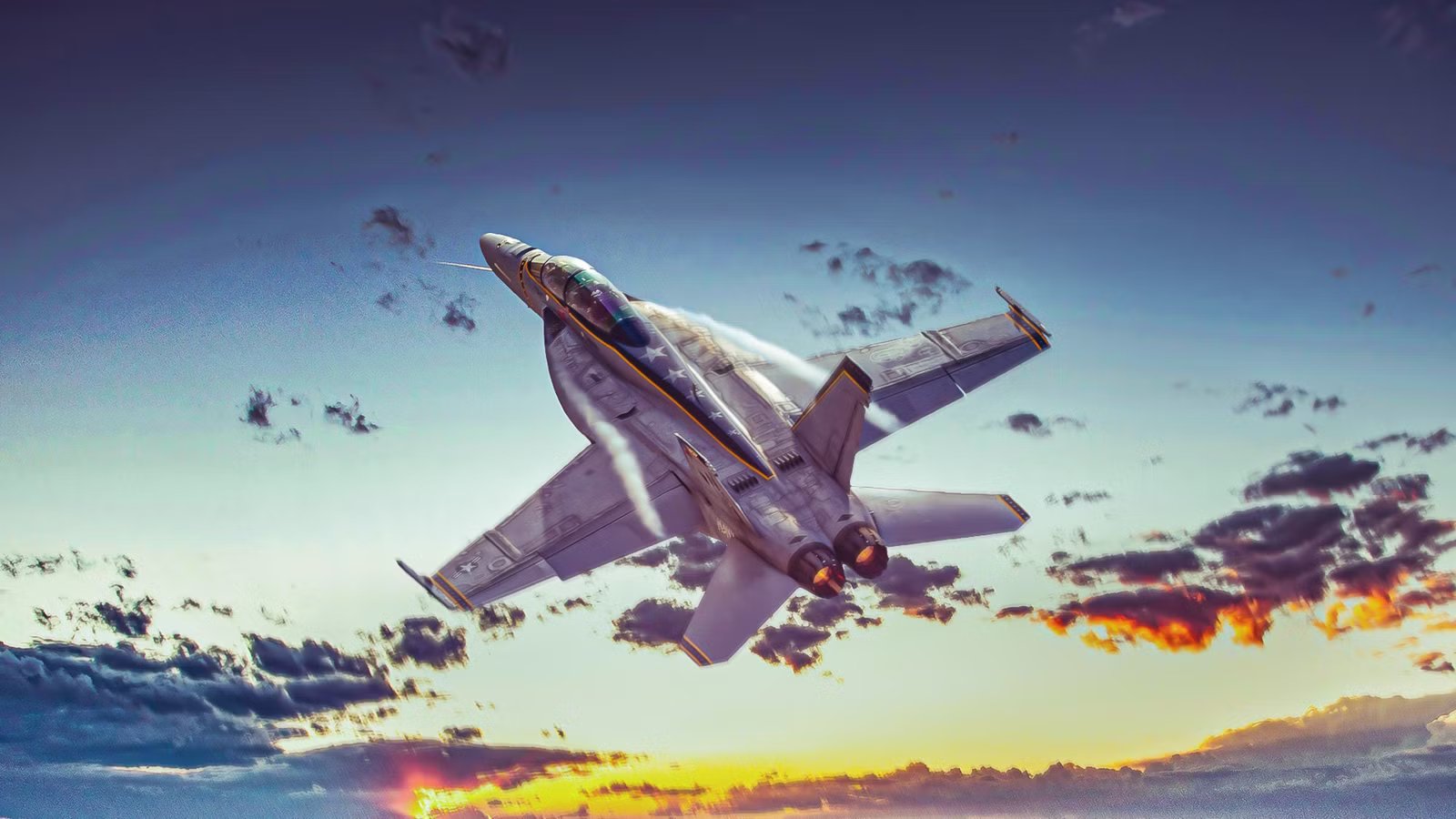
When most people think of a naval fighter jet like the McDonnell Douglas /  Boeing F/A-18, they imagine supersonic speed, tight maneuvers, and the thunderous roar of afterburners, the ones you have probably seen in the Top Gun: Maverick movie. But behind the stunts of blockbusters, and every real military sortie, there is a hidden clock — fuel. Understanding how long an F-18 can remain aloft solely on its internal fuel supply sheds light on its mission flexibility, tactical planning, and real-world employment. This is a fundamental part of how the US Navy and other foreign operators plan strikes, defensive patrols, and carrier operations.
In our article, we’ll explore how many hours the F-18 family (including the most common variants) can actually fly on internal fuel alone, compare the legacy Hornet with the newer Super Hornet, and unpack how mission profiles, payloads, and external tanks change the game. We’ll also connect performance figures to real Navy data and official sources to give aviation fans and curious readers a grounded understanding of every F-18 mission.
Internal Fuel: The Baseline Of Fighter Endurance

Before we can talk about time aloft, we need to define what “internal fuel” means for fighter jets. Internal fuel refers to the kerosene stored inside the aircraft’s wings and fuselage tanks — the fuel that is always with the jet when it takes off. It’s different from external tanks or aerial refueling, which extend endurance but aren’t part of the core aircraft design.
For the original F/A-18 Hornet (the A, B, C, and D variants), the internal fuel load is relatively modest by modern standards. According to specifications on the Hornet’s Hickory Aviation Museum page, the aircraft carries about 10,860 pounds (1,629 gallons or 4,930 kg) of fuel internally. In contrast, the evolved and more advanced F/A-18E and F Super Hornet, which Boeing and the US Navy designed in the 1990s as a more capable and larger airframe, carry about 33 percent more internal fuel than their predecessors.
This difference might sound abstract, but it’s crucial: more internal fuel means more time available for cruising, loitering, and even combat operations before needing to refuel or land, which eventually led the Navy to replace the legacy Hornet with the more capable Super Hornet.
Legacy Hornet Endurance: What Internal Fuel Really Buys You

When you ask “how many hours can an F-18 fly,” the first thing to understand is that fighter jets aren’t designed like airliners. They don’t aim for the most fuel-efficient cruise possible because their mission profiles often demand high-power settings, quick climbs, and rapid maneuvering, while carrying weapons and one or, at most, two pilots rather than cargo or passengers.
Even so, on internal fuel alone (meaning without any external tanks or tanker support), the legacy F/A-18 Hornet typically has an endurance measured in hours, not minutes. Fact sheets list a combat radius of roughly 400–460 nautical miles for typical air-to-air missions, depending on load and configuration, which corresponds to how far the jet can fly to and return from a target.
When converted to time, that combat radius translates to roughly 1.5 to 2.2 hours of flight on internal fuel alone, assuming moderately efficient cruise and no afterburner. In missions with heavy maneuvering, the usable airborne time shrinks because more fuel is burned per minute.
Pilots in demonstration teams like the Blue Angels usually fly highly energetic profiles, and they often monitor fuel levels to stay well below their theoretical maximums to ensure safety and flexibility. Even so, the “range” figures from their official guide help illustrate the core truth: the Hornet without external tanks can cover around 1,000 miles on its internal fuel (when flown conservatively), suggesting many hours of flight potential in cruise conditions.
From a practical perspective, typical flight durations on internal fuel alone put many legacy Hornet sorties at two hours or slightly less when flown at normal speeds and altitudes without afterburner.

How Many Miles Per Gallon Does An F-15 Get?
As a fighter jet, the F-15 needs to have a massive amount of fuel, especially when it is traveling at supersonic speeds.
External Fuel Tanks — Extending Time Aloft

Aircraft designers have always known that onboard fuel is only part of the endurance story. That’s why both Hornets and Super Hornets can carry external fuel tanks. They are detachable pods that significantly extend mission time.
For the legacy Hornet, these are often 330-gallon drop tanks hung on wing and centerline hardpoints. When installed, these tanks dramatically increase the fuel carried, often by more than a third. In the Blue Angels guide, it’s noted that adding external tanks can stretch the Hornet’s range to approximately 1,200 miles.
More fuel available means more time in the air. In real combat or ferry profiles, pilots often calculate fuel to account for transit, target loiter, and return, resulting in missions that can comfortably exceed three hours aloft with external tanks, especially at efficient cruise settings.
However, this extension comes with a significant trade-off: while external tanks increase flight time, they also degrade aerodynamic efficiency and reduce the number of available hardpoints for weaponry. That’s why commanders need to strike the optimal balance for each mission, and when more weapons are critical, they choose aerial refueling over extra fuel tanks wherever possible.
Super Hornet (And Growler): Bigger Body, Longer Legs, And New Roles In The Fleet

When the US Navy needed more reach and payload than the legacy Hornet could provide, Boeing responded with the F/A-18E and F/A-18F Super Hornet. This jet isn’t simply a slightly updated variant of the Hornet. According to Boeing, the new Super Hornet is a substantially larger, more capable aircraft with improved range and endurance, instantly becoming the Navy’s new favorite and standardizing the naval fleet. It also led to the creation of a highly specialized variant – the EA-18 Growler.
Internal fuel capacity soared to roughly 14,400–14,700 pounds, about one-third more than the legacy Hornet, giving the Super Hornet noticeably longer legs without external help. This increase translates into practical differences: while a legacy Hornet might manage around two hours of flight time on internal fuel alone, the Super Hornet often stays aloft for 2.5 to 3 hours in typical cruise and patrol profiles before needing tanker support, recovery, or landing. This greater endurance has been especially valuable for operations over vast expanses like the Pacific, where distances between carriers, shore bases, and targets can be immense.
The Super Hornet also forms the basis of another mission-specialized variant: the EA-18G Growler. Designed as the US Navy’s premier airborne electronic attack (AEA) platform, the Growler uses the same basic bodies and engines as the Super Hornet but trades some internal space for sophisticated jamming gear and electronic warfare systems. Despite this equipment loadout, the Growler still carries a very similar fuel load and performance profile. According to available specifications, the EA-18G carries about 13,940 lb (6,323 kg) of internal fuel and retains external tank capacity, giving it ferry ranges comparable to Super Hornets while supporting its unique role.
In terms of operational employment, the Growler, in addition to being a flying jammer platform, is a vital force multiplier. Growlers accompany strike packages or patrol missions to suppress, deceive, or deny enemy radars, communications, and air defenses before or during an engagement. With their electronic attack suite, they protect friendly forces and enhance situational awareness across the battlefield, all while operating from the same carrier air wings as strike Super Hornets. The aircraft has seen real combat use in operations since its introduction in 2009 and regularly flies alongside Super Hornets in global deployments.
Viewed together, the Super Hornet and Growler highlight how endurance and range, derived from fuel capacity, mission configuration, and tactical planning, shape not just flight time but also the strategic roles naval aviators can execute. From long-range strike and air superiority to cutting-edge electronic warfare, these jets embody a balanced design philosophy that marries hours aloft with mission effectiveness.

Why The F-35 Is The US Air Force’s Most Important Fighter Jet
Discover why the F-35 is the US Air Force’s most critical fighter — from stealth and sensors to strategy, readiness, and future upgrades
Super Hornets With External Tanks And Tanker Support

One of the defining strengths of the F/A-18E and F Super Hornet is its effective integration of external fuel tanks and aerial refueling into routine operations. Although the aircraft already carries significantly more internal fuel than the legacy Hornet, the Navy designed the Super Hornet to treat tanker support as a standard force multiplier anyway. This reflects modern carrier aviation realities, where strike fighters must operate across vast distances and remain flexible in fast-changing mission environments while fully loaded.
Super Hornets commonly fly with 480-gallon external fuel tanks, which provide a substantial endurance boost with a smaller performance penalty than earlier Hornet designs. With one or more tanks installed, airborne time can comfortably exceed three hours in ferry or patrol profiles, even before considering tanker support. The aircraft’s improved aerodynamics and powerful engines allow it to retain useful performance despite carrying extra fuel, making extended-range missions far more practical than for earlier variants.
F/A-18 Family Fuel & Range Comparison
|
Aircraft |
Internal Fuel Capacity |
Range (Internal Fuel Only) |
Range (With External Tanks) |
|---|---|---|---|
|
F/A-18A–D Hornet (Legacy) |
~10,860 lb (4,930 kg) |
~1,000 miles (≈1.5–2.2 hrs typical flight time) |
~1,200–1,800 miles (ferry profile) |
|
F/A-18E/F Super Hornet |
~14,400–14,700 lb (≈6,500 kg) |
~1,300–1,500 miles (≈2.5–3 hrs) |
2,000+ miles (ferry with tanks & refueling) |
|
EA-18G Growler |
~13,900–14,000 lb (≈6,300 kg) |
~1,300 miles (≈2.5–3 hrs) |
Comparable to Super Hornet; mission-dependent |
Source: Simple Flying
Aerial refueling further reshapes the Super Hornet’s endurance envelope. In addition to compatibility with dedicated tankers, the aircraft can refuel from other Super Hornets equipped with “buddy store” refueling pods, reducing reliance on land-based support. This system allows carrier air wings to remain self-contained, enabling longer sorties, safer recoveries, and deeper strike penetration without adding more aircraft to the mission.
This approach is even more evident in the EA-18G Growler. Although the Growler carries nearly 14,000 pounds of internal fuel and can fly for roughly 2.5 to 3 hours on internal fuel alone, its mission emphasizes sustained presence instead of rapid transit. Growlers often refuel multiple times during a single sortie to maintain continuous electronic warfare coverage for strike packages, illustrating how external tanks and tanker support transform fuel endurance from a fixed limit into a flexible operational tool for the US Navy.
Endurance As A Window Into Operational Reality

So when we ask again, “How many hours can the F-18 fly on internal fuel?” the answer is a range shaped by variant, mission profile, and configuration:
- Legacy F/A-18 Hornets generally fly around 1.5 to 2.2 hours on internal fuel alone in typical mission profiles, with actual range translating to approximately 1,000 miles when carefully paired with an efficient cruise.
- Larger F/A-18E/F Super Hornets carry roughly one-third more internal fuel, often achieving 2.5 to 3 hours in similar conditions, giving them noticeably longer legs.
- Add external tanks, and both variants can exceed three to four hours or more in long-range ferry or patrol flights.
- Bring in aerial refueling, and endurance becomes less about the onboard belly tanks and more about the coordination between fighters and tankers.
These figures reflect how the US Navy plans and executes operations worldwide — from carrier launches in the Pacific to rapid responses in the Middle East.
In many ways, endurance is a mirror of design philosophy: the legacy Hornet opted for strike flexibility and carrier suitability, while the Super Hornet expanded that baseline with more fuel, more systems, and more operational reach. Looking ahead, future platforms like the F-35C continue this trend, trading larger internal fuel loads and stealth for longer legs and more stealthy persistence.