dailynewsnblog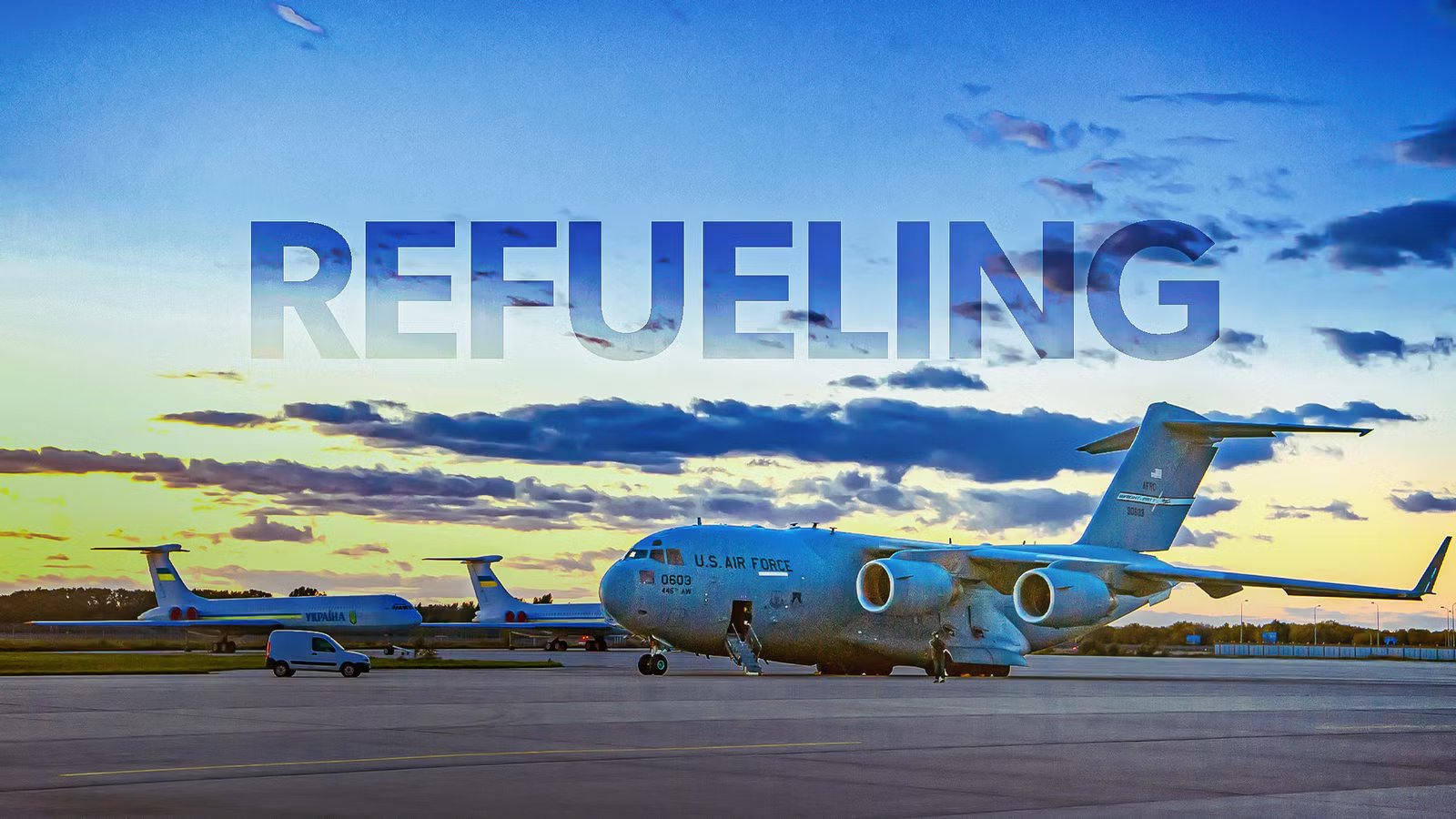
The most advanced tactical airlift platform in the United States military, and arguably the world, the  Boeing C-17 Globemaster III has an impressive range. This is the case even without the aerial refueling that allows it to fly an almost unlimited distance, only stopping for maintenance and crew needs. The C-17’s unrefueled range is 2,400 to 2,800 nautical miles, depending on the payload and mission profile.
Depending on the cargo that it is carrying and the flight profile that is chosen by the aircrew, it gives it between five and 14 hours in the air before it needs to get gas. At its standard cruising speed of 450 knots (Mach 0.74) with an average payload, for example, this equates to roughly five to six hours of flight time.
Power And Versatility

The C-17 is powered by Pratt & Whitney engines that are very similar to those equipped on the Boeing 757 long-haul single-aisle jetliner. The key difference is that these are specially modified to perform high-performance deceleration and descents with Advanced reverse thrusting technology. They are relatively fuel-efficient as they are still high-bypass turbofans, especially when compared to fighter jets or other combat aircraft.
The C-17 is one of the key airlift platforms that connects the global network of the United States Air Force and other Armed Forces bases around the world. Other aircraft like the Lockheed C-5 Galaxy may be larger, and the C-130 Hercules may be more rugged and versatile, but each lacks the unique performance and utility features that make the C-17 the workhorse of the global airlift fleet.
As with the vast majority of USAF aircraft, the C-17 often uses aerial refueling to extend its range for demanding missions. Aside from simply flying longer distances, when the C-17 is fully loaded, it relies on tankers to help make up for the extra fuel burn. The big jet often carries major outsized equipment that it was designed to haul to the front lines, like the Abrams M1 main battle tank of the US Army.
No Mission Is Too Tough

The C-17’s unrefueled range gives it the tactical value of allowing for direct delivery to the front line in unprepared fields under austere conditions to deliver supplies and equipment to troops under fire. On a single tank, it can reach distant drop zones to deliver 102 paratroopers or heavy equipment like M1 Abrams tanks. It can deliver up to 170,900 pounds of cargo directly to runways as short as 3,500 feet and as narrow as 90 feet.
The C-17’s performance allows for the rapid reinforcement of forward bases that larger strategic lifters like the C-5 cannot access. Once on the ground, its ability to perform a three-point star turn in less than 80 feet and back up under its own power allows it to operate in confined spaces where other large aircraft would be trapped.
The C-17 uses its unique in-flight thrust reversers to execute steep tactical descents that are four to five times more regressive than what a standard commercial aircraft would ever be able to perform. This allows the plane to transit from a high altitude cruise profile to a landing and a contested environment with minimal exposure to ground threats.
Scott Formiller, from the 18th Operations Support Squadron Air Traffic Control, was the non-commissioned officer in charge of a recent Agile Combat Employment at Kadena Air Force Base in Japan. The course trains Air Force personnel, Marines, and more to help aircraft like the C-17 fulfill their mission in the toughest drop zones. He described the joint training with the following remarks:
“One of the hardest parts about setting up a landing zone is adapting to the realities of the situation once you actually arrive on the ground. [Landing Zone Safety Officer course] is really the embodiment of [Agile Combat Employment], being able to pick up a couple people with just the bare essentials, and go out and still get the mission done.”
The C-17 can also perform a combat offload, where it essentially flies just about the ground and ‘kicks’ pallets and equipment off the ramp as it is still moving. This allows for vehicles, equipment, cargo, and troops to be dropped into high-threat zones with the shortest exposure time possible to the aircraft from air defense threats on the ground.

The Striking Differences Between The C-17 Globemaster & The C-5 Galaxy
From strategic airlift to tactical flexibility, delve into the unique roles of the C-5 Galaxy and C-17 Globemaster III.
Flying The Distance

The impressive range of the C-17, without the added benefit of aerial refueling, compounds the advantage that both provide to the tactical airlift mission. Air-to-air refueling is indeed a more decisive factor, as it essentially gives the plane unlimited range, with the ‘long legs’ that the C-17 has having reduced the frequency of refueling required. This makes mission planning less complex and more flexible at both the tactical and strategic levels.
On a historic mission in 1998, aircrews flying C-17 transports completed the longest airdrop mission in recorded history. The formation of eight jet transports flew over 19 hours to complete a transit of 8,000 nautical miles from the United States to Central Asia. The aircraft completed multiple aerial refuelings before finally airdropping paratroopers and their equipment over the target area. Then they did it again in the year 2000.
Elsewhere, the Indian Air Force flew an 11-hour non-stop flight from Chennai, India, to Townsville, on the East Coast of Australia. This Mission marked the longest continuous flight by an IAF C-17 in the history of the nation’s Air Force. They have also deployed aircraft to transport humanitarian aid to Turkey and Syria, involving long detours to avoid restricted airspace. A recent anti-piracy operation in March 2024 involved a 10-hour round-trip mission into the Indian Ocean to airdrop commandos.

How Many C-17 Globemasters Are Left?
Only one C-17 Globemaster has been written off due to a crash, and none have been retired and scrapped.
International Globemaster Exploits

The Royal Air Force has utilized its C-17s for numerous long-range strategic airlift and humanitarian operations since 2001. They have maintained a critical ‘air bridge’ to resupply forces in conflict zones like Afghanistan and Iraq and have conducted long-distance medical evacuations. An RAF C-17 was also notably used to transport the coffin of Queen Elizabeth II from Edinburgh to London in 2022, in what became the most tracked flight in history.
Royal Australian Air Force C-17s, based in Queensland, have supported Australian Defense Force operations overseas, including in the Middle East and East Timor. They fly regular missions to Antarctica to support the Australian Antarctic Division’s research stations, a task that involves flying to remote ice/gravel runways.
Royal Canadian Air Force C-17s, designated as the CC-177, provide an independent strategic airlift capability, allowing them to rapidly deploy personnel and equipment worldwide. They fly annual ‘Operation Boxtop’ missions to resupply CFS Alert, the world’s northernmost permanently inhabited post, often landing on snow-and-gravel runways in the Arctic.
The multi-national NATO Strategic Airlift Capability in Hungary operates three C-17s, which support the strategic airlift requirements of member nations. They have been deployed for missions in Mali, and were also used to transport victims’ bodies after the MH17 incident in Ukraine. Nations such as Qatar, the United Arab Emirates, and Kuwait use their C-17s for both military transport and extensive humanitarian aid missions around the world.

The 9 Countries That Operate The C-17 Globemaster III
The United States operates the largest C-17 Globemaster III fleet.
The C-17 By The Numbers

Another unique capability of the C-17 can be seen on the ground, as it is one of the few large aircraft capable of taxiing in reverse under its own power. It can even back up a two-degree slope, allowing it to maneuver into tight parking spots without a ground tug. Its landing gear is designed to absorb the force of ‘assault landings,’ where the aircraft essentially drops onto the runway rather than flaring. This allows it to land safely on unpaved or semi-prepared surfaces like dirt, gravel, or sand.
The C-17’s flaps are designed to stay directly in the path of the engine exhaust. This externally blown system redirects the engine thrust downward to create massive amounts of lift, enabling steep, slow approaches and short takeoffs from runways as short as 3,500 feet. Combined with the in-flight thrust reverser deployment that allows it to descend at rates up to 20,000 feet per minute, or roughly 10 times faster than a standard airliner, are features that no other airlifter possesses.
The C-17 can even act as a mobile gas station. Using ‘wet-wing’ refueling, it can land at a forward base and use its own internal pumps to transfer fuel directly into a B-2 bomber, M1 Abrams, or fighter aircraft. The aircraft can also be configured to transport up to 36 litter patients and 54 ambulatory patients, providing a long-range ‘hospital in the sky’ for rapid evacuation from combat zones.
As of 2026, there has yet to be any challenger arise that offers a threat to dethrone the C-17 as the most well-rounded and high-performance tactical airlift platform in the world. Boeing is even reportedly considering retooling a new assembly line to begin further production.