dailynewsnblog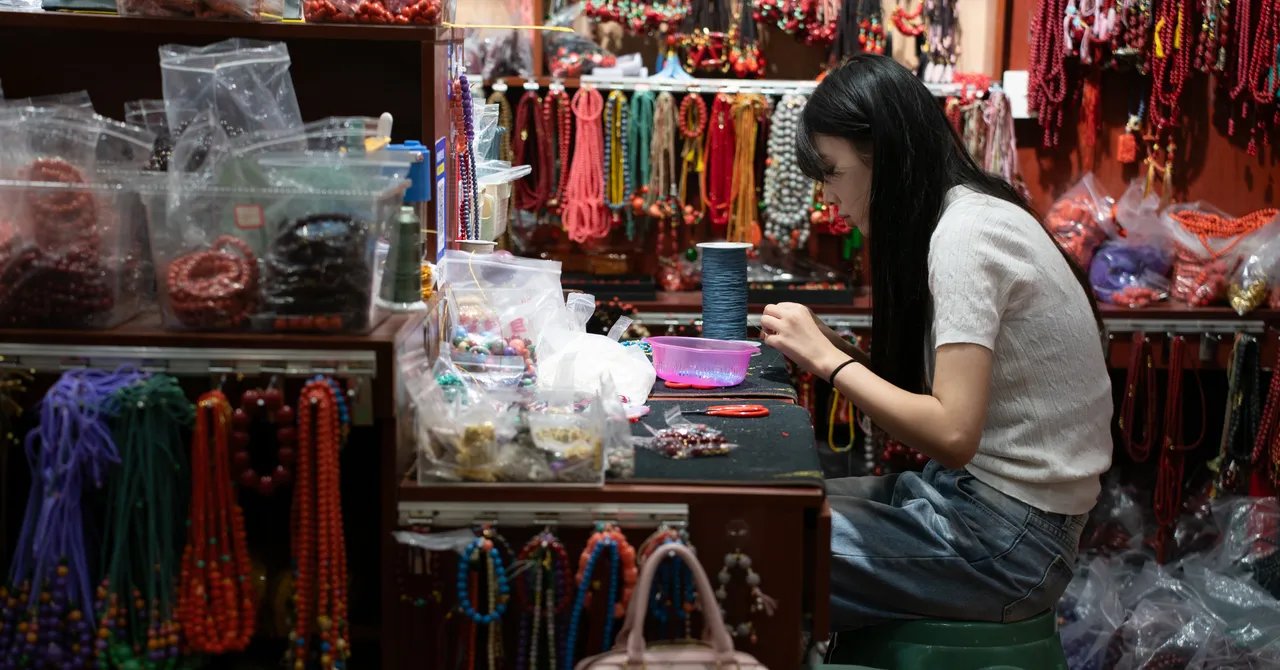
Villages looked for niches they could fill in the global market. The town of Xuchang, for instance, capitalized on its legacy of making hairpieces for opera performers—and on the willingness of rural women to sell their black ponytails—and turned itself into a hub for wigs. Zhuangzhai became the largest supplier of caskets to Japan, in part through its proximity to groves of paulownia, a lightweight, slow-burning wood favored in Japanese cremation ceremonies. The town of Qiaotou became the world’s button-making capital after three brothers found a handful of discarded buttons in a gutter and decided to resell them, or so the story goes.
Donghai already had plenty of quartz and skilled labor, as well as entrepreneurs who were willing to experiment. Wu Qingfeng, a former editor at the Crystal Museum who now leads boot camps for wannabe crystal entrepreneurs, says that in the late 1980s, artisans learned to modify washing machine motors so they could polish crystal necklaces, previously a manual job. When there wasn’t enough raw crystal to keep up with demand, manufacturers resorted to glass from beer bottles to make beads. People in Donghai told us they recall the shortage becoming so dire at one point that restaurants and bars ran out of beer.
Around the same time, illegal mining was spiraling out of control. All the digging was causing roads to collapse and houses to sink, sometimes leading to injuries and deaths, according to Chinese media. In late 2001, Donghai County authorities warned of an impending crackdown on unauthorized mining. With the domestic crystal supply tightening up, local entrepreneurs were increasingly traveling all over the world to find new sources of raw material. As one executive from a crystal industry group told a newspaper, “Wherever there are raw stones, there are people from Donghai.”
Venturing to far-flung locales was seen not as daring but simply as the default mode of doing business, says Kyle Chan, a fellow at the Brookings Institution who specializes in Chinese industrial policy. In China, there’s “this idea, almost like overconfidence, that you can just go wherever in the world and outwork and outmaneuver whoever,” Chan says. People tend not to “see the cultural barriers as, like, real barriers.”
Wu Qingfeng says that Donghai traders were astonished by the riches to be found abroad. They learned about enormous deposits in Africa, he says, after people in a neighboring province traveled there to participate in a humanitarian project. Some countries had so much quartz that they were paving roads with it. In Donghai, the crystal deposits are scattered, Wu says, “but when you go to Madagascar, Zambia, the Congo, and other countries, you find that the local rose quartz is like coal—an entire mountain is rose quartz.”
Liu, the owner of Big Purple Crystal, says he began traveling abroad to look for amethyst about a decade ago. His first stop was Brazil. “I got a cheap plane ticket and brought along a translator,” he says. “The next day, I bought my first shipping container—about 20 tons of goods.” But Liu struggled to make money, so he searched for opportunities elsewhere. At the Tucson Gem and Mineral Show in Arizona, a sprawling annual gathering, he came across impressive amethyst pieces from Uruguay, and he decided to go there.