dailynewsnblog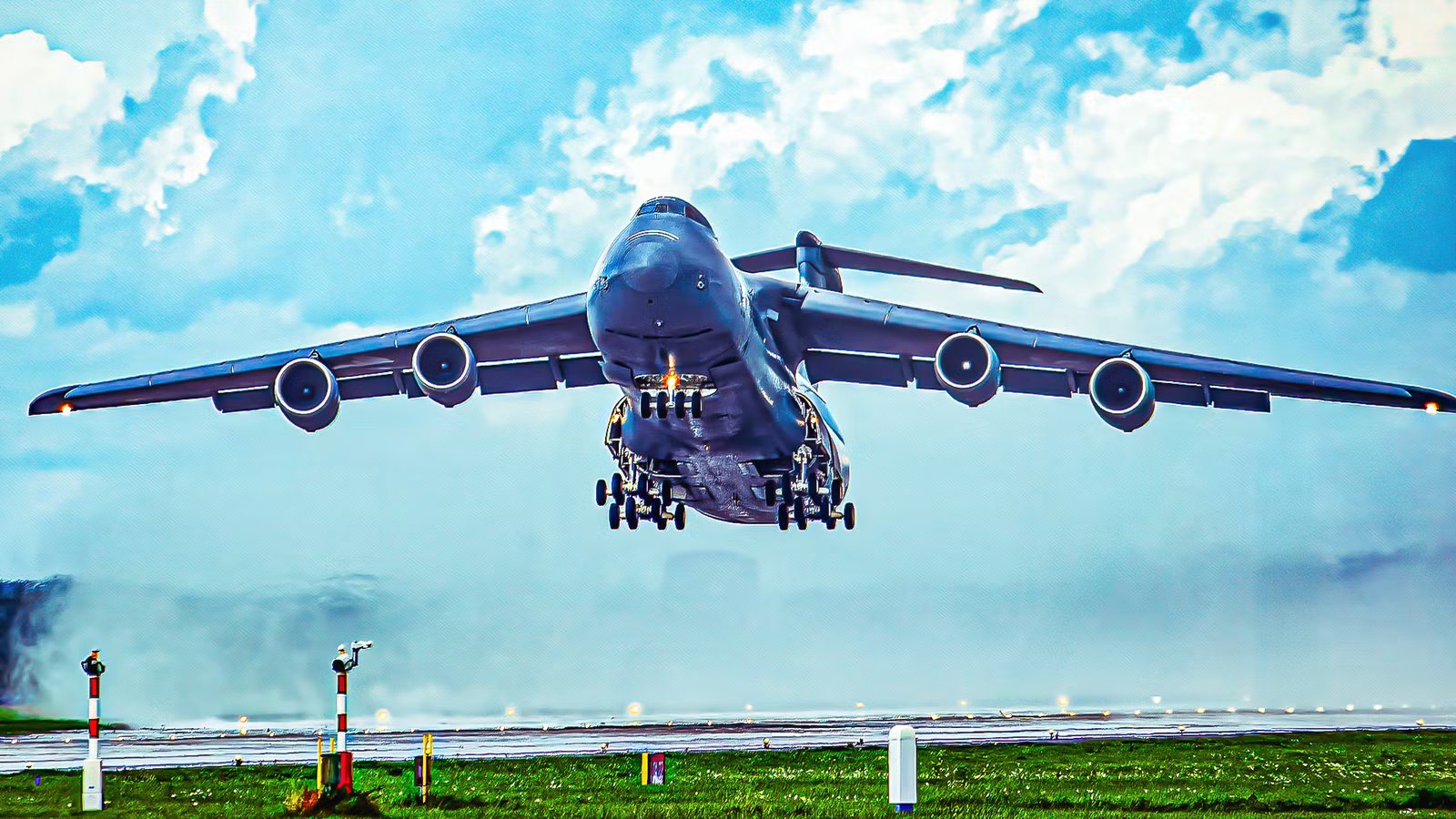
The LockheedC-5 Galaxy, one of the largest military transport aircraft ever built, is known not only for its sheer size and incredible cargo capacity, but also for a sound that is instantly recognizable. Long before the aircraft comes into view, its presence is announced by a haunting, rising whine that builds into a powerful, almost unsettling howl. For aviation enthusiasts, that sound is iconic. For casual observers, it is often confusing, even alarming, as it bears little resemblance to the noise produced by modern commercial planes.
Understanding the C-5’s sound also provides insight into how military aviation balances performance, efficiency, and environmental considerations. Noise has become an increasingly important factor in aircraft design, influencing everything from base-community relations to survivability and operational flexibility. The C-5, particularly in its earlier variants, stands as a reminder of an era when power and reach mattered more than discretion.
This article explores why the C-5 Galaxy sounds the way it does. The aircraft’s distinctive acoustic signature reflects a specific moment in aviation history, shaped by Cold War requirements, early high-bypass turbofan technology, and a mission that placed raw capability far above refinement. From the original TF39-powered variants to the modernized C-5M Super Galaxy, the evolution of the Galaxy’s sound tells a broader story about how aircraft design priorities have changed over time.
The Legacy Of The Lockheed C-5 Galaxy

The C-5 Galaxy was developed by Lockheed in the 1960s to meet a requirement unlike anything that came before it. The US Air Force needed an aircraft capable of transporting extremely large and heavy cargo across intercontinental distances, without relying on intermediate stops or specialized infrastructure. First flying in 1968, the Galaxy represented a dramatic leap in strategic airlift capability, replacing aircraft such as the Douglas C-133 Cargomaster.
From a physical standpoint, the C-5 is difficult to overstate. It features a wingspan of more than 222 feet (67.9 meters), a length of 247 feet (75.3 meters), and a maximum takeoff weight of approximately 840,000 lb (381,000 kg). Its cargo bay alone is large enough to accommodate main battle tanks, helicopters, and other outsized equipment that simply cannot be transported by most other aircraft. Yet for many people, it is not the aircraft’s size that leaves the strongest impression—it is the sound it produces during takeoff and climb.
The Galaxy’s operational impact has been equally significant. During Operation Desert Storm, C-5 aircraft carried roughly 44% of all airlifted cargo, despite accounting for only about 12% of the US Air Force’s airlift fleet at the time. Over decades of service, the aircraft has supported nearly every major US military operation, quietly (or not so quietly) becoming a backbone of global mobility.
Over time, the fleet evolved through several variants. The original C-5A was followed by the C-5B, which featured structural improvements and updated avionics. The C-5C was modified specifically to transport large spacecraft components. Eventually, the fleet underwent a comprehensive modernization program, resulting in the C-5M Super Galaxy. By 2018, all remaining operational USAF C‑5s had been upgraded to the M standard, a change that also altered how the aircraft sounds—though not enough to erase its reputation.
Unpacking The Original TF39 Engines

At the heart of the C-5 Galaxy’s unmistakable sound lies its original powerplant: the General Electric TF39 turbofan engine. Each C-5A, B, and C variant was powered by four TF39-GE-1C engines, each producing approximately 41,000 lbf (183 kN) of thrust. When the engine entered service in the late 1960s, it was among the most advanced turbofans in the world.
The TF39 was one of the first high-bypass turbofan engines ever developed. With a bypass ratio of roughly 6:1, it moved a tremendous volume of air around the engine core rather than relying solely on high-velocity exhaust gases. This design dramatically improved fuel efficiency and made it possible for the C-5 to lift extraordinary payloads.
However, it also introduced a sound profile that differed sharply from both earlier turbojets and modern turbofans. Early high-bypass engines like the TF39 lacked many of the noise-reduction features that are now standard. Acoustic liners, advanced fan blade shaping, and exhaust mixing technologies were either primitive or nonexistent.
As a result, the TF39 produced a distinctive combination of fan noise and compressor whine, particularly noticeable during engine spool-up. As power increased toward takeoff settings, often approaching 97% N1, the sound evolved into the piercing, rising howl that has become synonymous with the C-5.
|
Specification |
C-5A |
C-5B |
C-5C |
C-5M Super Galaxy |
|---|---|---|---|---|
|
First flight |
1968 |
1985 |
1986 |
2006 (first flight as C-5M prototype) |
|
Length |
247 feet, 1 inch (75.3 meters) |
Same |
Same |
Same |
|
Wingspan |
222 feet, 9 inches (67.9 meters) |
Same |
Same |
Same |
|
Empty weight |
~380,000 lb (172,365 kg) |
~380,000 lb (172,365 kg) |
~380,000 lb (172,365 kg) |
~380,000 lb (172,365 kg) |
|
Maximum takeoff weight (MTOW) |
840,000 lb (381,000 kg) |
840,000 lb (381,000 kg) |
840,000 lb (381,000 kg) |
840,000 lb (381,000 kg) |
|
Maximum payload |
281,000 lb (127,460 kg) |
281,000 lb (127,460 kg) |
281,000 lb (127,460 kg) |
281,000 lb (127,460 kg) |
|
Range (with 120,000 lb payload) |
~4,400 Nautical Miles (8,150 kilometers) |
~4,400 Nautical Miles (8,150 kilometers) |
~4,400 Nautical Miles (8,150 kilometers) |
4,800 Nautical Miles (8,900 kilometers) |
|
Range (max payload) |
~2,150 Nautical Miles (3,980 kilometers) |
~2,150 Nautical Miles (3,980 kilometers) |
~2,150 Nautical Miles (3,980 kilometers) |
2,300 Nautical Miles (4,260 kilometers) |
|
Maximum speed |
462 knots (856 km/h) |
Same |
Same |
Same |
|
Takeoff distance |
~6,000 feet (1,830 meters) |
~6,000 feet (1,830 meters) |
~6,000 feet (1,830 meters) |
5,400 feet (1,646 meters) |
|
Powerplant |
4× GE TF39-GE-1C |
4× GE TF39-GE-1C |
4× GE TF39-GE-1C |
4× GE F138-100 (CF6-80C2) |
|
Thrust per engine |
41,000 lbf (183 kN) |
41,000 lbf (183 kN) |
41,000 lbf (183 kN) |
51,000 lbf (230 kN) |
|
Noise profile |
Extremely loud, high-pitched whine |
Same |
Same |
Quieter, smoother, still low-frequency dominant |
The sound also varied depending on aircraft loading. A heavily loaded C-5 departing at maximum gross weight produced a deeper, more strained growl beneath the whine, while a lightly loaded aircraft sounded noticeably cleaner and sharper. Ground crew and pilots have often described the noise as a “sustained power chord,” a fitting analogy for an engine that prioritized brute force over refinement.

C-5M Super Galaxy: 5 Big Facts About The US Air Force’s Most Massive Aircraft
Discusses the facts, features, and accomplishments of the iconic Lockheed-Martin C-5M Super Galaxy
The Science Behind The Unique Sound

From an acoustic standpoint, the C-5’s sound is the result of several interacting phenomena. The most prominent contributors are fan noise and airflow turbulence, both of which are amplified by the sheer scale of the engines and the operating conditions under which they are used.
Fan noise is generated as the large fan blades slice through incoming air, creating pressure fluctuations that radiate outward as sound waves. In TF39 engines, these fluctuations were particularly strong, producing a high-frequency whine that was clearly audible even at significant distances. At the same time, turbulent airflow within the engine and around the nacelle added mid-range and low-frequency components, giving the sound its layered character.
Measurements and anecdotal reports suggest that noise levels near a C-5 at full power can approach or exceed 120 dB, well into the range where hearing protection is required. Unlike modern engines, which are designed to smooth and diffuse these sound sources, the TF39 allowed much of this raw acoustic energy to escape unfiltered.
Another factor was the limited mixing of hot core exhaust and bypass air. Modern engines use carefully engineered mixing and serrated nozzles to reduce noise, but the TF39’s simpler exhaust geometry tended to amplify tonal noise instead. The result was a sound that was not just loud, but emotionally striking—often described as eerie, intimidating, or awe-inspiring.
The Evolution To CF6 Engines In The C-5M

Linking to the overall guide, the transition from TF39 to CF6 engines in the C-5M Super Galaxy marks a significant shift in both performance and sound profile. This upgrade, part of the Reliability Enhancement and Re-engining Program (RERP), aimed to extend the aircraft’s life while addressing noise and efficiency issues. Understanding this evolution explains why the classic C-5 sound is becoming a relic of the past.
Through analysis, the CF6-80C2 (military designation F138) provides 51,250 pounds of thrust each—a 22% increase, allowing for shorter takeoffs and faster climbs. Comparisons show improved fuel efficiency and lower maintenance costs, and crucially, far better noise performance. The C‑5M’s noise footprint is closer to that of commercial widebodies like older Boeing 747s, even if it still falls short of meeting the strictest FAA Stage 3/Stage 4 standards. This results in a sound more akin to commercial jets, with substantially reduced perceived loudness, often reported as on the order of tens of decibels lower than TF39‑powered C‑5s, depending on distance and conditions.
Continuing the discussion, the first C-5M flight in 2006 highlighted these benefits, with GE delivering engines certified for the program. Additional information from press releases notes the FADEC system for better control, indirectly contributing to smoother, quieter operation. This upgrade not only boosts capability but also reduces environmental impact near bases. In the words of USAF Lt. Col. Mike Semo, a 709th Airlift Squadron pilot,
“The new engines are like a whisper compared to the whine of the [older, non-upgraded C-5] legacy aircraft”

How The C-17 Globemaster Stacks Up Against The C-5 Galaxy In 2025
In 2025, the C-5 still leads in raw payload and range, while the C-17 dominates in flexibility and access, two giants that shape modern air mobility.
Comparing The C-5’s Sound To Other Aircraft

A common question among aviation fans is how the C-5 Galaxy’s sound stacks up against other large aircraft, such as the C-17 Globemaster III or commercial giants like the Antonov An-124. This comparison reveals the uniqueness rooted in engine design and era-specific technology.
The C-17, powered by Pratt & Whitney F117 engines, produces a deeper but far more controlled sound, reflecting its newer design and emphasis on short-field performance with reduced noise. The An-124’s Progress D-18T engines generate a heavy rumble, but lack the high-pitched whine associated with the C-5’s TF39.
The An-124’s Progress D-18T engines offer a deeper rumble, but lack the high-pitched scream of the C-5. Aviation-specific insights from forums like PPRuNe note that the C-5M’s CF6 sound resembles the 747’s, blending familiarity with military power.
Commercial aircraft, particularly those designed in the last few decades, sound smoother and more subdued by comparison. Their engines are optimized to meet strict noise regulations, and their operating profiles avoid the sustained maximum-thrust departures that characterize heavy military airlift. Frequency analysis further highlights these differences. The C-5’s sound features pronounced peaks in the 1–2 kHz range, creating the unsettling howl that many find so distinctive. Newer aircraft exhibit flatter, more uniform acoustic signatures, trading character for compliance and efficiency.
The Fading Echo: Future Of The C-5’s Sound

As the C-5 fleet has fully transitioned to the C-5M standard, the classic TF39-powered sound is becoming increasingly rare. For many enthusiasts, this represents the gradual fading of one of aviation’s most distinctive auditory experiences. The C-5M is objectively better in nearly every measurable way, but something intangible has been softened in the process.
For those hoping to experience the original sound, archived videos and museum visits may be the only options. Institutions such as the Air Mobility Command Museum preserve both the aircraft and the memory of an era when aviation sounded different.
Looking ahead, continued advancements in propulsion technology suggest that such sounds may never return. Future airlifters will likely be quieter, cleaner, and more efficient, but also more restrained. In that sense, the C-5 Galaxy’s sound, past and present, stands as a reminder that engineering priorities leave audible fingerprints, and that sometimes, noise tells a story all its own.