dailynewsnblog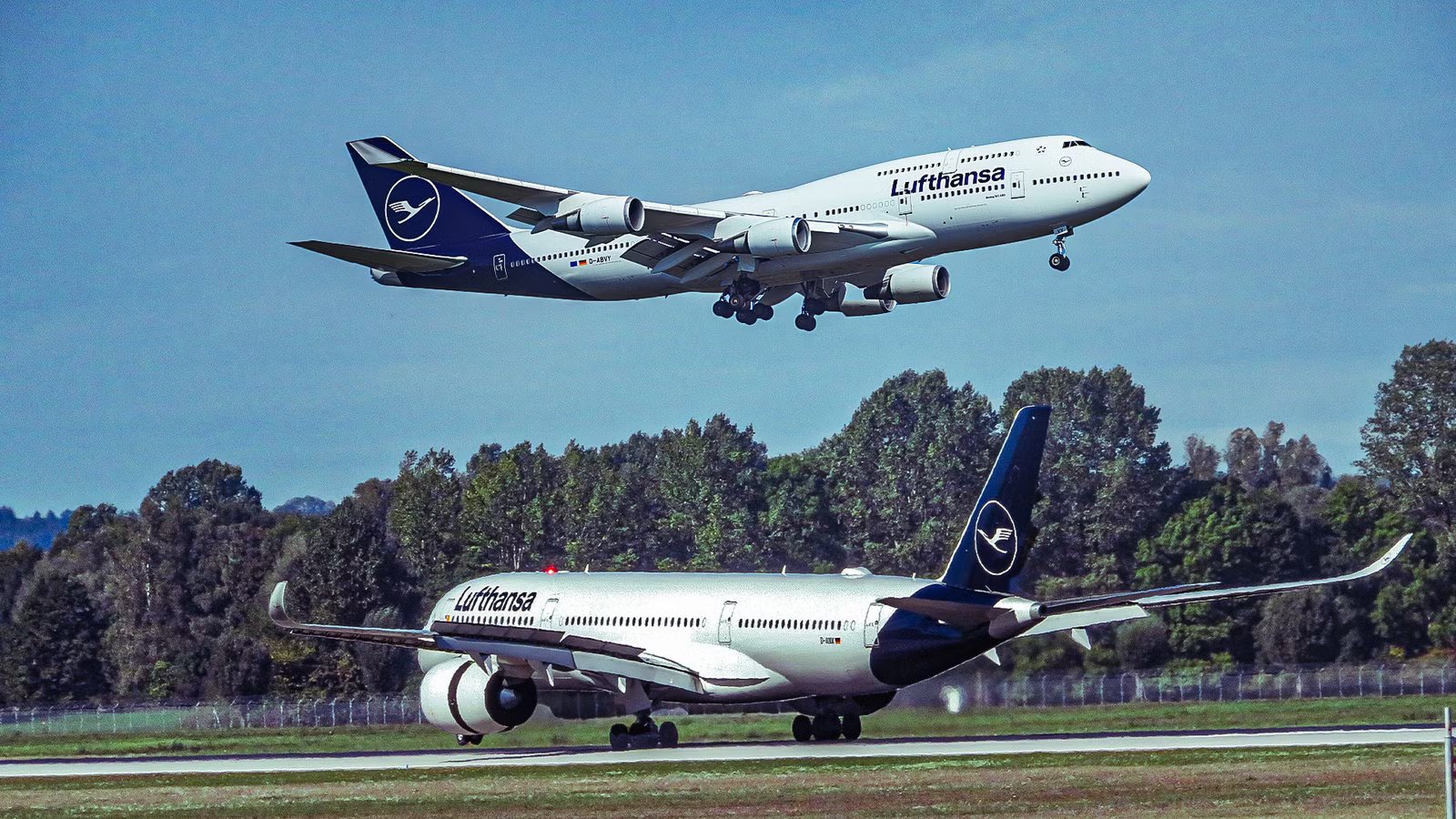
The Boeing 747-400 and the Airbus A350 represent two very different eras of long-haul commercial aviation. The 747-400, often referred to as the “Queen of the Skies,” was designed as a high-capacity, four-engine aircraft built to transport large numbers of passengers across continents, at a time when engine reliability and airport limitations favored size and redundancy. For decades, it was one of the most recognizable and influential aircraft in the world, shaping global air travel and airline networks.
The Airbus A350, by contrast, reflects the modern aviation industry’s shift toward efficiency, technology, and sustainability. Built with advanced composite materials and powered by two highly efficient engines, the A350 prioritizes lower fuel burn, longer range, and improved passenger comfort over sheer size. While the 747-400 is physically larger in several key dimensions, comparing it with the A350 highlights how aircraft design has evolved from maximizing capacity to optimizing performance and economics.
Overall Size: Length, Height, And Visual Presence

The Boeing 747-400 immediately commands attention thanks to its sheer size and unmistakable shape. Measuring approximately 232 feet (70.7 meters) in length, it is roughly 13 feet longer than the Airbus A350-900, which measures around 219 feet (66.8 meters). That extra length gives the 747 a larger ground footprint, contributing to its reputation as a true jumbo jet.
In terms of height, the difference is even more visually striking. The 747-400 stands approximately 63 feet 8 inches (19.4 meters) tall, compared to the A350-900’s height of about 55 feet 11 inches (17.1 meters). Much of this additional height comes from the 747’s raised cockpit and iconic upper-deck hump, which also allows for extra internal space. The tall vertical stabilizer further enhances the aircraft’s imposing silhouette, making it instantly recognizable even from a distance.
The Airbus A350-900, while smaller overall, reflects a modern design philosophy centered on efficiency rather than scale. Its slightly shorter length and lower height result in a cleaner, more streamlined profile that reduces aerodynamic drag. Instead of prioritizing visual dominance, the A350’s proportions are carefully optimized for performance, illustrating how contemporary widebody aircraft achieve long-range capability and comfort without the massive physical presence that defined earlier generations like the 747.
Wingspan And Airport Compatibility

The Airbus A350 actually edges out the Boeing 747-400 when it comes to wingspan. The A350 stretches to about 212 feet (64.8 meters) from wingtip to wingtip, slightly wider than the 747-400’s wingspan of approximately 211 feet (64.4 meters). While the difference is minimal and barely noticeable visually, it highlights how modern aircraft achieve performance gains through advanced wing design rather than overall aircraft size.
Despite their similar wingspans, both aircraft are generally classified within the same airport infrastructure category, meaning most major international airports built to handle large widebodies can accommodate either type. However, the 747-400’s greater height and longer fuselage often require additional consideration for gate spacing, taxiway clearances, and hangar access. Airports that were originally designed around the 747 frequently became global hubs, shaping infrastructure standards for decades.
The A350 benefits from a newer wing design optimized for efficiency and flexibility. Its long, slender wings with advanced aerodynamics generate high lift while reducing drag, improving fuel efficiency without dramatically increasing airport compatibility challenges. As a result, many airports can integrate the A350 more easily into existing operations, reflecting how modern widebody aircraft are designed to maximize performance while minimizing infrastructure demands.

Is The Airbus A350 Bigger Than The A340?
Airbus A350 vs A340: Which one is truly bigger? Discover how range, capacity & efficiency redefine “size” beyond fuselage length.
Passenger Capacity And Cabin Volume

The Boeing 747-400 was designed to move large numbers of passengers efficiently, and its size reflects that goal. In typical airline configurations, the 747-400 can carry around 400 to 420 passengers, with high-density layouts exceeding 500 seats. The aircraft’s long fuselage and additional upper deck give it a clear advantage in total cabin volume, allowing airlines to prioritize capacity on heavily traveled long-haul routes.
One of the 747’s defining features is its upper deck, which adds usable cabin space not found on the A350-900. Airlines historically used this area for premium seating, lounges, or business-class cabins, enhancing both capacity and onboard service offerings. This extra deck also contributes to the aircraft’s taller profile and allows for greater internal flexibility compared to single-deck widebodies.
The Airbus A350-900 takes a different approach, focusing more on comfort and efficiency than maximum seat count. It typically seats around 300 to 325 passengers, depending on configuration, but offers a wider cabin at shoulder level, larger windows, and a quieter interior. Higher humidity levels and a lower cabin altitude further improve passenger comfort, showing how modern widebody design emphasizes quality of experience over sheer passenger numbers.
Design Philosophy: Four Engines Vs Two Engines

The Boeing 747‑400 was designed with four engines to provide redundancy and long-range reliability. Its engines produce a combined thrust of about 253,200 lb (1,125 kN), allowing it to carry heavy loads over oceans and remote areas safely. At the time of its design, four engines were essential for long-haul flights, ensuring that a single engine failure would not compromise safety.
The Airbus A350‑900, by contrast, uses just two high-efficiency engines producing roughly 168,400 lbₑ (749 kN) in total. Thanks to advances in engine reliability and performance, twin-engine aircraft like the A350 can safely fly ultra-long-haul routes under ETOPS (Extended-range Twin-engine Operational Performance Standards) regulations, even thousands of miles from the nearest airport.
This difference also affects operating efficiency. Four engines on the 747 mean higher fuel consumption and more maintenance, while the A350’s twin engines reduce fuel burn, lower costs, and produce fewer emissions. The comparison highlights the shift from raw engine power and redundancy toward optimized design and efficiency in modern aviation.

The Top 10 Boeing 747 Airline Customers In History
Only a few of the greatest purchasers of the Boeing 747 were US airlines, and some still have them in service.
Range, Efficiency, And Operating Economics

The Airbus A350 is designed with a significantly longer nonstop range than the Boeing 747-400, reflecting the shift toward ultra-long-haul, point-to-point flying. While the 747-400 was optimized in the 1980s and 1990s for long intercontinental routes, in general, the A350 can fly farther on a single fuelling, allowing airlines to operate routes that were previously impractical or required payload limits. This gives the A350 more flexibility on very long sectors, making it better suited to today’s network strategies, which favor direct flights over hub-and-spoke operations.
In terms of efficiency, the A350 is vastly superior. As a modern twin-engine aircraft built with advanced aerodynamics, composite materials, and new-generation engines, it burns far less fuel per seat than the four-engine 747-400. The 747-400 was efficient for its time, but its older engine technology and heavier aluminum structure resulted in significantly higher fuel consumption. The A350 also benefits from lower emissions and reduced noise, which are increasingly important for airline operations and airport regulations.
|
Specification (AviatorJoe) |
Boeing 747‑400 |
Airbus A350‑900 |
|---|---|---|
|
Length |
231 feet 11 inches (70.7 m) |
219 feet 2 inches (66.8 m) |
|
Wingspan |
211 feet 5 inches (64.4 m) |
212 feet 5 inches (64.8 m) |
|
Wing Area |
5,825 feet² (541.5 m²) |
4,768 feet² (443.1 m²) |
|
Height |
63 feet 8 inches (19.4 m) |
55 feet 11 inches (17.1 m) |
|
Engines |
4 |
2 |
|
Total Thrust |
253,200 lbₑ (1,125 kN) |
168,400 lbₑ (749 kN) |
|
Max Takeoff Weight (MTOW) |
875,000 lb (397,000 kg) |
617,000 lb (280,000 kg) |
|
Range |
7,236 nm (13,400 km) |
7,749 nm (14,350 km) |
|
Cruise Speed |
M0.85 |
M0.85 |
|
Typical Passenger Capacity |
416 |
315 |
Operating economics strongly favor the A350. With only two engines, lower fuel burn, and reduced maintenance requirements, the A350 costs much less to operate on a per-trip and per-seat basis. The 747-400, while capable of carrying more passengers, requires higher load factors to be economically viable and incurs greater maintenance, fuel, and crew costs. As a result, most airlines have retired the 747-400 in favor of aircraft like the A350, which offer better profitability, lower risk, and greater route flexibility in today’s airline market.
Legacy Of The 747 Vs The Future-Focused A350

The Boeing 747 is one of the most iconic aircraft in aviation history, earning its nickname as the “Queen of the Skies.” It revolutionized long-haul air travel by making international flying more accessible and affordable, dramatically increasing passenger capacity and shaping the global hub-and-spoke airline network. For decades, the 747 symbolized prestige, technological ambition, and airline flag-carrier pride, serving as the backbone of intercontinental travel and even as Air Force One. Its distinctive hump and four-engine design left a lasting cultural and operational legacy that few aircraft can match.
The Airbus A350 represents a very different philosophy, centered on efficiency, sustainability, and flexibility rather than sheer size. Designed for modern airline economics, it emphasizes long range with lower fuel burn, advanced materials, and quieter, cleaner operations. Instead of carrying the maximum number of passengers between major hubs, the A350 enables airlines to fly long distances more efficiently on thinner routes, supporting today’s demand for nonstop, point-to-point travel. It reflects how aviation has evolved to prioritize cost control, environmental performance, and passenger comfort.
Together, the 747 and A350 illustrate a clear shift in commercial aviation priorities. The 747 represents an era of growth driven by scale, spectacle, and central hubs, while the A350 embodies a future shaped by efficiency, sustainability, and adaptability. Rather than replacing the 747’s legacy, the A350 builds on it by using modern technology to meet modern challenges. The transition from the 747 to aircraft like the A350 marks not a decline, but an evolution in how airlines connect the world.