dailynewsnblog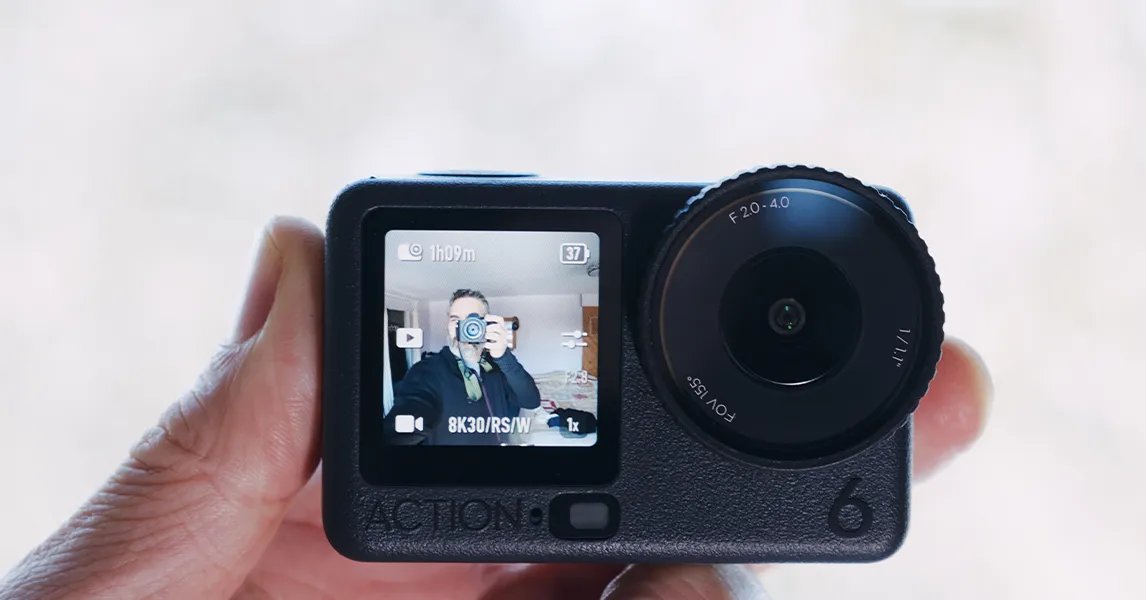
It’s worth noting that some of what you’re going to read here won’t be found in other reviews because the 8K 30 fps video capabilities were not added until near the end of 2025, when DJI delivered a firmware update which enabled 8K video. So if you see those initial, rushed reviews going for that Google juice, saying that the Action 5 tops out at 4K—well, they’re wrong now.
The new sensor is a 1/1.1-inch chip and it’s square, which means you can shoot once and crop to various formats, including the evil that is vertical video. One caveat there is that shooting in custom mode for the largest possible use of the sensor and then cropping to 16:9 does not produce as good of footage as shooting in 16:9 mode. I can’t figure out why this would be, but I’ve done multiple tests, and it is. Possibly the same is true for vertical video, but no one cares because all vertical video is crap.
The other, better benefit of the larger sensor is that the stabilization feature doesn’t crop as much so you get a wider field of view with stabilization enabled than you do with the Action 5. This is also true of horizon leveling, which can now be set to either 45 degrees in either direction, or 360 degrees.
Variable Aperture
Probably the most exciting feature in the Action 6 though is not the new sensor, but the variable aperture lens. Yes, DJI put teeny tiny aperture blades in there to allow the lens to shoot at f/2 to f/4. The idea is to improve the low light capability of the camera without sacrificing too much depth of field. So you can use the f/2 to shoot while surfing at sunset and then stop down to f/4 when vlogging back at the hotel, or something like that.
Low light performance is better, as you would expect with a wider aperture lens. The video is cleaner and sharper than either the Action 5 Pro or the Ace Pro 2. And that’s true whether you use SuperNight mode or not. You can really see this shooting D-Log—the ungraded footage is much brighter and sharper. I would say it’s a full stop brighter.
Alas, there is a good bit of noise still and the codec does show its limitations at times. The only way I know around this is to increase the bitrate, which unfortunately isn’t possible in the Action 6 (the only camera I’m aware of that lets you shoot in high bitrates is the GoPro and that requires using the GoPro Labs software). Overall though, for most people, the Osmo Action 6 is going to give you the best low light performance of any action camera currently on the market.
I think it’s also worth noting that there is a potential danger here. DJI has put a mechanical piece inside a camera that often gets put through the ringer—will the aperture end up failing on people two years down the road? DJI has probably done a good bit of testing, but the real world is different than lab tests. I would be particularly worried about high vibration environments like mounted on the handlebars of a bike, which happens to be my main use for an action camera. I know far to many people who have destroyed cameras just from keeping them in a handlebar bag, let alone mounted to the actual bike. Unfortunately, only time will tell.