dailynewsnblog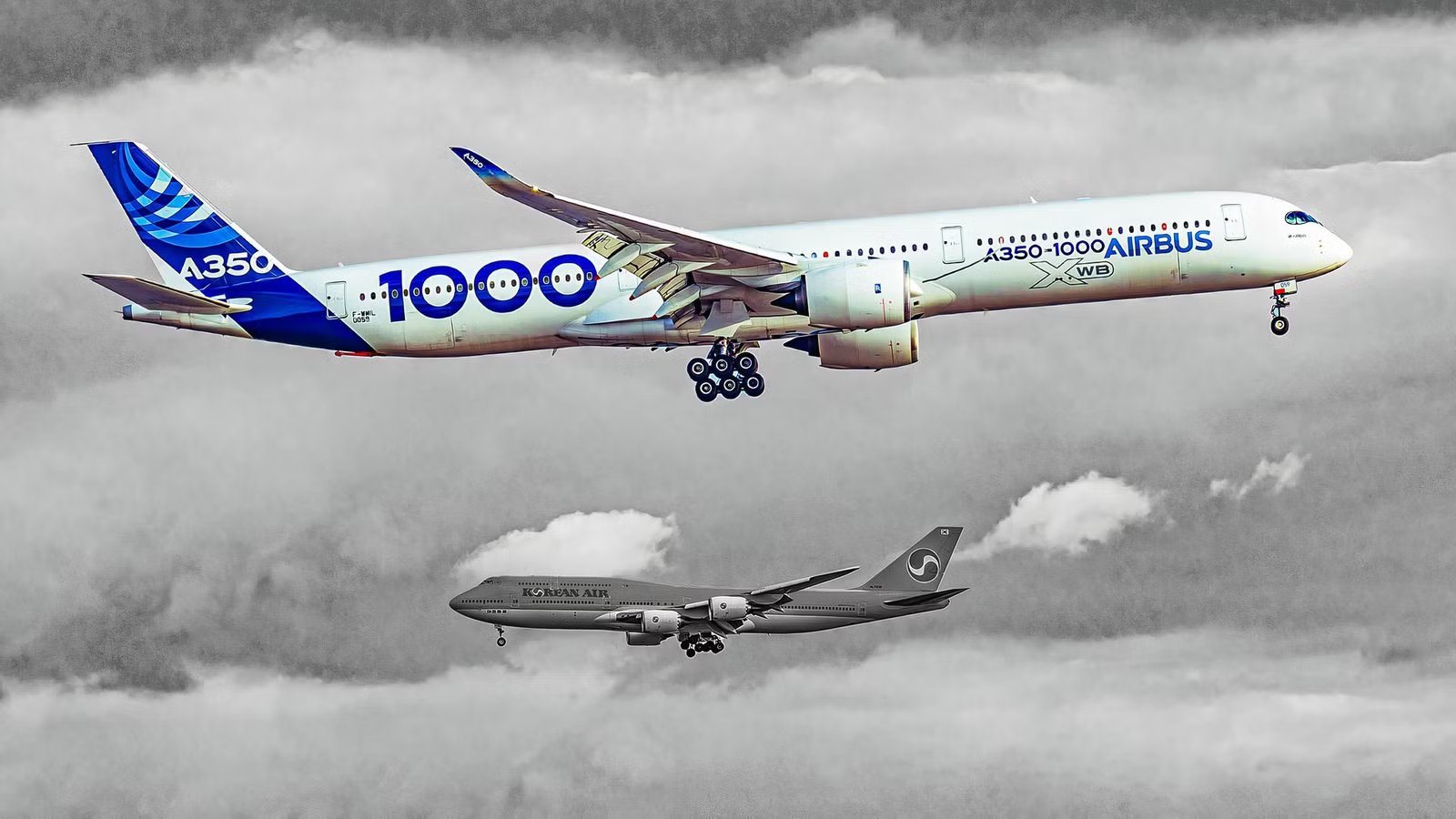
The Airbus A350-1000 is the largest Airbus currently in production. It is, of course, the largest variant of the Airbus A350 XWB family, an aircraft viewed as a smaller, long-range aircraft that makes long-haul flying more economical. However, this belief about the A350 and 787 being small widebodies isn’t necessarily true, because compared to other widebodies from the past, both aircraft are huge. The Airbus A350-1000, meanwhile, is the largest of them all.
The Boeing 747 was, for decades, the ubiquitous long-range airliner. This huge double-decker has sold over 1,500 units across 55 years of production, and at one point, every large international airline operated it. Today, the 747 is gone precisely because of smaller, more efficient twinjets like the Airbus A350 and Boeing 787. But in reality, these small planes are anything but, so how does the largest of the new breed, the Airbus A350-1000, compare to the legendary Boeing 747?
Examining The Variants Of The Boeing 747

It’s essential to note that, just as the Airbus A350-1000 is a variant of the A350 XWB family, the Boeing 747 has several variants that differ in size. The newest model of the 747 is the 747-8, which features a fuselage stretch, reprofiled wing with increased span, new engines, and a stretched upper deck on the 747-8i passenger model. At 250 feet, 2 inches (76.25 meters), 224 feet, 7 inches (68.5 meters) wide, and rated for a Maximum Takeoff Weight (MTOW) of 447.7T, this variant dwarves the A350-1000.
The Boeing 747-8 is the first (and only) stretch of the 747’s fuselage; however, Boeing did shrink the 747 in the 1970s. The 747SP was developed to better compete with smaller trijets while also improving range over existing 747 variants. The 747SP featured a fuselage shrink of 47 feet (14 meters), making it around the same length as the Boeing 787-8. Its wingspan is also similar to that of the Boeing 787. In other words, the 747SP is significantly smaller than the A350-1000.
The Boeing 747-100/200/300/400 all share the same fuselage length at 231 feet, 10 inches (70.7 meters). The 747-100 and 747-200 share the same size hump, while the 747-300 and 747-400 have a stretched upper deck. The first three variants of the 747, as well as the 747SP, have a wingspan of 195 feet, 8 inches (59.6 meters), while the 747-400 incorporates winglets that increase the wingspan.
Comparing The 747 To The A350-1000

The Airbus A350-1000 is the largest aircraft currently produced by Airbus. It is smaller than the Boeing 747-8, and definitively larger than the Boeing 747SP. The rest of the 747 lineup is very close in size to the A350-1000, and determining which is bigger is a relatively ambiguous question. This is because the answer largely depends on which metric you choose to focus on.
In terms of length, the A350-1000 is 242 feet (73.78 meters) long, while its wingspan is 212 feet, 5 inches (64.75 meters). In other words, it’s longer than most 747 variants, while its wingspan is comparable to the 747-400, and wider than earlier 747 variants. The A350 is lower than the 747, largely on account of its much smaller tail, and its MTOW is far lower at 319T, whereas even older 747s can be rated for upwards of 340T (except for the 747SP).
A higher weight doesn’t necessarily indicate that an aircraft is overall larger, just that it’s heavier. The A350 is primarily constructed from carbon-composite materials, which greatly lowers its empty weight. The A350’s fuselage is, however, narrower than the 747’s. This allows the 747 to accommodate ten-abreast economy as standard, whereas the A350 usually only features nine seats across.

Airbus A380 Vs. Boeing 747: Which Aircraft Gets More Miles Per Gallon?
While the A380 and 747 remain marvels of aviation, their fuel efficiency is no longer at the cutting edge.
Looking Deeper At The Aircraft

When looking at length, the A350-1000 trumps all variants of the 747 except for the 747-8. However, the A350-1000 is also longer than the Airbus A380, yet the A380’s fuselage is overall bigger because it spans two decks. Similarly, the Boeing 747’s fuselage is overall larger than that of the Airbus A350-1000. The 747 famously has a partial upper deck that visually appears like a hump, along with a large nose that contains a passenger cabin.
Not only does the 747 have a partial upper deck, but its main deck is also wider than the A350-1000’s. This allows the 747 to accommodate more economy seats per row, resulting in an overall larger fuselage. This does, however, make for a plane that’s inherently heavier than the A350, not even taking into account the difference in materials.
While the 747-400 and A350-1000 share similar wingspans, the 747’s wing is overall larger as it has a higher wing area. This is because the 747 was designed in the 1960s and has largely kept the same wing design from its first flight to today. It has a high 37.5° wingsweep, which makes it faster, but is less fuel efficient. In contrast, the A350’s wing has a lower sweep angle, and is skinnier, while maintaining the same span.
Over Half A Century Of Innovation

The Boeing 747 was once the pinnacle of commercial aviation. Today, however, the Airbus A350-1000 is nearly the same size while consuming a fraction of the fuel. Not only that, but the A350-1000 is the longest-range airliner currently in production, capable of connecting virtually any two points on Earth. Qantas has selected a higher gross weight variant of the A350-1000 to operate its “Project Sunrise” flights, traveling nonstop from Australia’s East Coast to London and New York.
The A350-1000 can achieve this while only relying on two engines. The Rolls-Royce Trent XWB-97s are the most powerful ever fitted to an Airbus. While it’s similar in size to the quadjet 747, the Trent XWB-97s are twice as powerful as the engines on the original 747s, and far more efficient. While its fuselage is too narrow for most airlines to fit ten-abreast economy seating, airlines that do will find a plane with similar capacity to the original 747s.
|
Specification |
Rolls-Royce Trent XWB-97 |
Pratt & Whitney JT9D-7 |
|---|---|---|
|
Application |
Airbus A350-1000 |
Boeing 747-200B |
|
Thrust |
97,000 lbs of thrust |
45,500 lbs of thrust |
|
Bypass ratio |
9.6:1 |
4.8:1 |
|
Pressure ratio |
50:1 |
26.7:1 |
|
Fan size |
118″ |
93.4″ |
|
Compressor |
Eight-stage intermediate pressure, six-stage high pressure |
Three-stage low pressure, 11-stage high pressure |
The Boeing 747-400 has a higher maximum capacity mainly owing to its stretched upper deck. The A350 also cannot legally carry as many passengers as the 747 because it only has eight exit doors, whereas the 747 has ten doors on the main deck and two more on the upper deck. In practice, the capacity difference between the aircraft is not as significant as you’d expect.

Is An Airbus A350 Bigger Than A Boeing 777?
While the 777-300ER is a physically bigger aircraft, the A350-1000 feels more spacious onboard.
Comparing Both Planes To The Boeing 777-300ER

The Boeing 777-300ER is the plane that essentially killed the Boeing 747. Similar to the A350-1000, the 777-300ER was nearly the same size as the 747, had nearly the same range, but had two fewer engines and a more modern design that made it far more efficient. After the 777-300ER debuted in 2004, 747 sales dried up while the 777-300ER became by far the best-selling version of the Boeing 777.
The Airbus A350-1000 and Boeing 777-300ER are nearly identical in size. The 777’s fuselage is slightly wider, allowing it to regularly accommodate ten-abreast in economy; however, its wing is smaller. The 777’s GE90 engines are larger than the Trent XWBs on the Airbus A350, and the 777 is rated for a higher MTOW, largely on account of its higher empty weight.
The Airbus A350 was essentially developed as a replacement for older Boeing 777s. The 777 is the most successful widebody aircraft family of all time, so focusing on this market instead of competing directly with the 787 has proven to be a winning strategy so far. The A350-900, slightly larger than the 777-200ER, has received more than double the orders, while over 350 orders have been received for the A350-1000, which is essentially a one-for-one replacement for the 777-300ER.
The A350-1000 Vs. The Boeing 777X

The A350-1000’s closest competitor is the Boeing 777-9. But whereas the A350-1000 is sized the same as the 777-300ER, the 777-9 has a new, larger wing and a stretched fuselage. The 777-9 will be the longest passenger aircraft to have ever been produced at 251 ft 9 in (76.72 m), while its wingspan will be wider than the Boeing 747-8. Because the 777-9’s wingspan has been widened, it features folding wingtips that reduce the span to that of current 777s; that way, the 777X can use existing 777 gates.
The 777X is one of the most thorough overhauls of any airliner in recent history. Because it retains the same metal fuselage, Boeing had to stretch the plane to make it competitive on a per-seat basis. Both aircraft have been moderately successful, with 362 orders for the A350-1000 and over 400 orders for the 777-9. Ultimately, the two aircraft take different approaches on how to address the top end of the widebody market, with Boeing deciding to make their plane larger than the A350-1000.