dailynewsnblog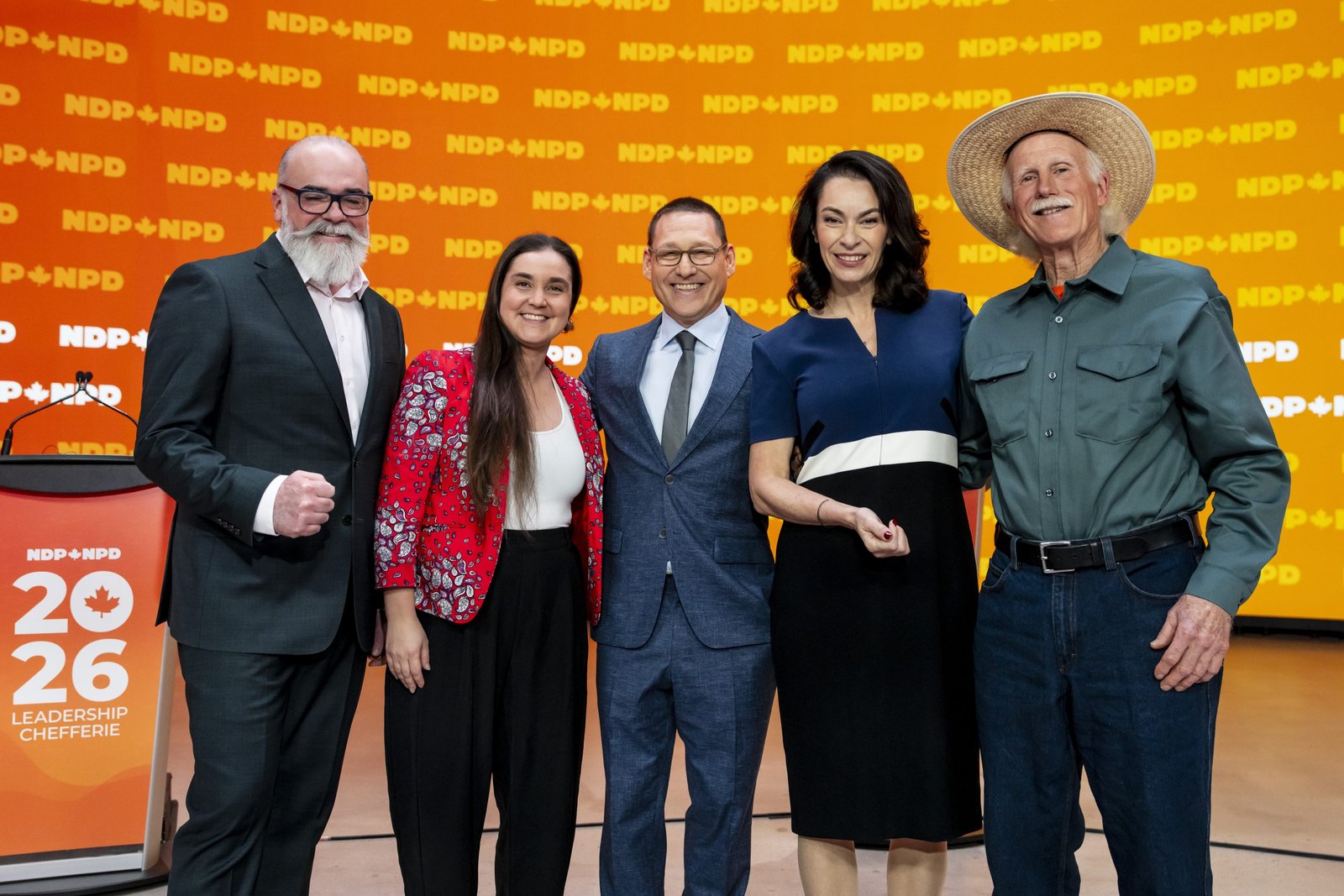
Erin Morrison, who served as deputy chief of staff to former NDP leader Jagmeet Singh, said Avi Lewis, Rob Ashton and Heather McPherson are the only credible contenders, with each of them drawing support from different factions of the party.
The NDP leadership race is entering the final stretch but observers say it’s unclear which of the three major candidates has the inside track and who’s best suited to resurrect the party that suffered its worst-ever showing in last spring’s election.
Each of the top candidates — Avi Lewis, Rob Ashton and Heather McPherson — are putting forward differing views on the best path forward for the party, and are drawing support from different factions, said Erin Morrison, who served as deputy chief of staff to former NDP leader Jagmeet Singh.
She said Lewis, a filmmaker whose grandfather formerly led the federal NDP, draws support from the party’s traditional socialist base. Ashton, the leader of the B.C. longshore workers’ union, is the favourite of the labour cohort, and McPherson, the only sitting MP in the race, is the top choice of the more pragmatic crowd and Prairie NDPers, according to Morrison, now a vice-president and partner at Texture Communications.
She said it’s not clear right now if there’s a favourite among the three and the race will “come down to which group of voters is most motivated to turn up — the labour group or the centrists.”
And that decision for voters will ultimately come down to “feeling seen, heard and represented by a candidate,” Morrison said, though they will also put some stock into electability.
NDP members will elect their new leader at the end of the party’s upcoming convention in Winnipeg on March 29. The party uses a ranked ballot and the successful candidate must win 50 plus 1 per cent of the vote.
The membership cut-off date to be eligible to vote in the race is Jan. 28.
Vancouver Island municipal politician Tanille Johnson and Tony McQuail, a perennial party candidate in Ontario, are also running for the leadership.
The race has been tough to gauge because of the lack of polling and fundraising data, though it’s expected Elections Canada will publish that financial information in mid-February. Lewis’ campaign is the only one that has announced fundraising numbers, claiming to have drummed up $783,000 in donations at the end of December.
The leadership vote comes at a precarious time for the NDP. The party won only seven seats and just over 6 per cent of the vote in the 2025 election, where it was largely relegated to the sidelines in a campaign dominated by Canada-U.S. relations.
Singh, who was defeated in his own riding, resigned on election night after leading the party since 2017, with Vancouver MP Don Davies picked soon after to serve as interim leader.
Since becoming the official opposition and winning 103 seats in 2011, the NDP has been on a steep decline, falling behind the Liberals as the biggest party on the left and watching the Conservatives cannibalize its working-class base.

For Ashton, the solution is clear. The NDP, he said, needs to focus on representing Canada’s “working class” and taking back power from out-of-touch elites.
“We’re the campaign that knows the damage that’s being done by Liberals and Conservatives all across this country,” he told iPolitics in an interview.
“I’ve lived it. I represent workers that live it, and I know what it feels like on the ground, and that’s the message we’ve been sending out. That’s the message that people are identifying with … They’re tired of housing prices being through the roof, grocery prices being through the roof, and the whole time, jobs are being lost and jobs are being offshored. And we’re going to change that.”
He also argued the NDP needs to get back to proudly and loudly championing its ideas, saying the party wasn’t vocal enough in taking crediting for pushing the Liberals to pass dentalcare, pharmacare and anti-scab legislation in the last Parliament.
“I think we forgot how to talk to people. If you look at universities and colleges, for example, our people used to thrive in those areas. We used to be able to throw our soap-box down, get up there and talk to people, and then we stopped doing it. And so who moved into that space? The ruling class, the Conservatives. And it tells in the polls,” he said.
Lewis doesn’t disagree but said voters want solutions above anything else, and that’s why his proposals, like creating a network of publicly-funded grocery stores, have been able to grab attention from beyond the party’s core.
“What we did when we when we launched was we made a very intentional decision not to do a traditional leadership campaign, where you spend the first phase introducing the candidate to Canadians and telling a personal story. We came out with big swing solutions that were directly laser-focused on the cost of living emergency, or what we call… the everyday emergency of just trying to get by in an impossible economy,” he told iPolitics.
“Because we believe that that is the experience of the 99 per cent of Canadians. It is the overwhelming daily emergency that they’re facing, and we believe that Canada is best served with at least one party that is prepared to marshal the resources and capacity of the federal government to directly solve those problems, instead of giving fountains of public money to corporations and hoping that the market will start to solve those problems.”
Lewis said there’s an appetite for a truly progressive party as Mark Carney has moved the Liberals to the centre, but believes the NDP can’t opt for half-measures, and needs to offer up bold solutions for the challenges facing Canadians.
“We are pitching solutions that are an order of magnitude more ambitious than the NDP has traditionally done, and I think that’s one of the secrets to our success right now. I also think that there’s a communication style that is different. We think that the one of the reasons why we lost touch with our base of support, working class and otherwise, was that people weren’t always clear on what the NDP stood for.”
McPherson, the only one of the major three candidates that has held public office, said her campaign has focused on housing, healthcare and affordability because it echoes concerns she’s heard from voters, and thinks the party needs to focus “unabashedly” on growing its popularity and winning more seats.
“I do not want to see our party yelling into the abyss and not being electorally successful, not being able to put more people in Ottawa fighting for Canadians,” she said, adding that as leader she would work closely with provincial NDP wings, which have been much more electorally successful than the federal party.
The NDP is currently in government in B.C. and Manitoba, and the official opposition in Ontario, Nova Scotia, Saskatchewan and McPherson’s home province of Alberta. But some of these provincial parties have been at loggerheads with their federal chapter in recent times over issues like resource development, especially in the oil-rich Prairie provinces.
“We should be working together. We should be working to support each other. We should be working to open up those lines of communication even more,” said McPherson, who has represented an Edmonton seat in the House since 2019.
“I’ll be honest, I do worry that that some of the candidates are would make life very, very difficult for the provincial parties, and would make it much harder for the federal party to be successful.”
Asked about being framed as the centrist in the race, McPherson said her policies are “extraordinarily progressive” and the label isn’t about what she’s proposing but instead her track record of broadening the party’s appeal outside its traditional territory, including in Alberta, where the main competition is the Conservatives.
“I think what people are trying to say when they talk about that is the idea that I know how to do this work. I’ve been rebuilding this party and trying to build out this party for a very long time, well before I was going to put my name forward as leader,” she said.
“We have door knocked in almost every province in this country, well before the leadership race began, because I want to rebuild our party, because I can do that work. The other piece is, frankly, I can win, and I can win against Conservatives, and that’s a proven track record that I have.”
The road back
Whoever wins the leadership race will face the daunting task of bringing the NDP back into contention for government.
While a decade earlier the party seemed poised to displace the Liberals as the main progressive party in Canada, it has struggled to gain traction since the passing of Jack Layton, a few months after he led the party to its breakthrough election in 2011.
Thomas Mulcair succeeded Layton as leader and was able to stay competitive with the Liberals and Conservatives until about half-way through the marathon 2015 campaign. Justin Trudeau led the Liberals from third-place to majority government in that vote, while the NDP caucus shrank by more than half.
Mulcair was turfed as leader when he lost his review in 2016, and Singh took the reins a year later.
Under his watch, the party lost more ground in 2019, dropping another 19 seats and falling further behind the other parties in the popular vote.
But that election reduced the Liberals to a minority, opening up opportunities for the NDP to act as a kingmaker in the House of Commons.
Ultimately, the session was derailed by the COVID-19 pandemic, and when voters headed to the polls again in 2021, Singh was able to lead the NDP to a 2-point hike in the popular vote and an additional seat in Alberta.

Since the vote, the NDP’s polling has had a slight rebound but it’s still far behind its big adversaries, and the party is facing questions about what direction it should map out. Will it be one that prioritizes progressive values or will it more aggressively appeal to working-class voters, who once formed the core of its base?
Morrison said the NDP doesn’t need to choose between its values or electability, but the new leader needs to broaden the party’s appeal by putting forward “credible, realistic [and] doable ideas.”
“It would be a huge mistake to not consider future electability. In order for the party to rebuild, it needs donations. It needs credibility. It needs attention and members, and that means someone… able to hold their own in Ottawa and present a clear alternate vision for how the country should be run,” she said.
“It has to be a credible vision. The pie in the sky or sort of burn it all down ideas are not going to fly with the general electorate.”
Karl Bélanger, a former top aide to Layton and Mulcair, said the next party leader has to be realistic about what they can achieve, acknowledging that they won’t be in shape to challenge for government in time for the election.
He said that means the new leader should focus on bringing the NDP back into the political conversation.
“It is still by and large a two-way race,” said Bélanger, now the president of public affairs and communications firm Traxxion Stratégies, referring to the Liberals and Conservatives, who are running neck-and-neck in most polls.
“You need to break the lock. But it’s not going to be easy.”
Quito Maggi, president of polling firm Mainstreet Research, said the numbers show just that.
The party, he said, remains far behind the Liberals and Conservatives in the single-digits in his polling, though a small swing in support for the NDP could have a huge impact on the tight national race.
“The NDP is like a bit of an afterthought, but I pointed out to a few people that potential tiebreaker in this stalemate is the NDP,” he said, calling the Liberal-NDP switchers the “swing vote that would impact the next election the most.”
“They don’t have to increase a lot to be impactful in the next election. At 12 per cent, their seat count doubles directly whatever votes they take away from the Liberals.”
For Maggi, the federal NDP might be wise to use the same playbook from the Ontario wing and hyper-focus on a few ridings where they can be competitive. Despite falling to third place in the popular vote, the Ontario NDP finished second in seat count and retained official opposition status in the 2025 provincial election.
What’s next?
Ashton said the party’s polling wouldn’t change his approach but admitted the NDP was likely not going to be in a position to challenge for government in the next election.
“I’m an eternal optimist. I wouldn’t be running for leadership of the NDP if I didn’t believe this party could do great things. But I’m also a realist, and with seven seats, it would be an amazing feat for us to take government,” he explained.
“We’re going to rebuild. We’re going to take back our space and expand our space, but then the next election, I’m running [to be] the new prime minister.”

Lewis said while his approach wouldn’t change based on the party’s polling, he would be realistic with voters on his chances of becoming prime minister heading into the next election.
During the last campaign, he said voters in his riding of Vancouver Centre told him they found it “jarring” that Singh was insisting he was running for prime minister despite the NDP’s poor polling.
“It seemed to be one of the things that sound that seemed out of touch,” he said.
“I think people want you to be real. So, if we’re at 9 per cent at the beginning of election campaign, and I’m the leader, I’m not going to be saying when I’m prime minister. But the point of electoral politics is to win government. I’m not doing this because I need a soapbox. I’m doing this because I want these ideas to be actually enacted in Canada [and] because I believe it will make everybody’s life better.”
McPherson said it’s clear the party is in a “rebuilding phase” and she would put forward a “realistic” proposition to Canada if she led the NDP into the next election.
“What we are doing right now is rebuilding a party that suffered its worst election loss in [its] history in April,” she said.
“We’re gonna have to roll up our sleeves. We are going to have to convince Canadians that we are the party that will fight for them, and we do that through conversations in church basements, union halls, in lines in restaurants and coffee shops.”
Morrison said even if it’s a steep challenge, the new leader needs to make winning office their goal as it’s the only way to broaden the party’s support.
“I think that any candidate who stands for prime minister and says, ‘well, hey, I’m not here to win.’ I think you’re sunk before you are started,” she said.
“I think it’s important that somebody is able to present a credible alternative, and that Canadians can picture that person as prime minister of this country. It doesn’t necessarily mean, in my mind, that as Liberals did years ago, [going] from the wilderness to government in one election. But it does mean that the goal of a comeback, whether it occurs over three years or a longer timeframe, is to go from where we are today into the prime minister’s office.”
This has been 2026’s first edition of Adjournment Proceedings, our weekly long read. We typically publish a new edition every Friday morning, though decided to release this week’s story a day earlier.
Missed a week? Take a look through our archives here.