dailynewsnblog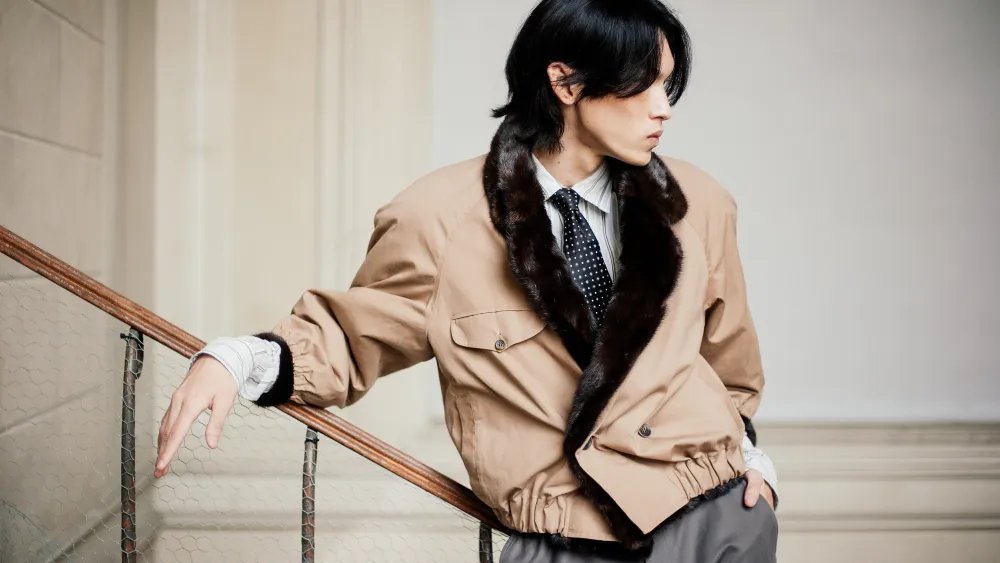
Let’s get this out of the way early on: Soshi Otsuki’s fall show didn’t disappoint all the anticipation surrounding his runway debut in Europe, as guest designer of Pitti Uomo.
The global spotlight has been on the Japanese talent since last September when he beat more than 2,300 competitors to nab the top award at the 2025 LVMH Prize for Young Designers.
His languid tailoring owes a lot to the fluid and deconstructed sartorial wear championed by the late Giorgio Armani, who Otuski has often described as a personal hero — his references often landing on the influx of Made in Italy garb in Japan during the island country’s years of economic boom in the ‘80s and ’90s.
A whiff of nostalgia ran through his fall effort, paraded inside the arched Santa Maria Novella Refectory on Thursday, yet always imbued with an electrifying sense of modernity and novelty.
Take, for example, the gray double-breasted suits with elongated blazers and multipleated pants and the square-shouldered beige and brown iterations cut in boxy fits — they looked both out of an ‘80s C-suite businessman’s closet and entirely contemporary in their almost caricatural proportions, which seemingly riffed on the archetype of retro power-dressing as a byword for strength.
Here fragility was celebrated instead, lending unique personality to each look, sometimes punctuated by off-kilter and playful touches, as in the meaty leather blouson cropped at the waist and nipped with a narrow belt so that its bottom two inches jutted out in a corolla or the chopped peacoat lined in faux fur.
Oxford shirts were cut on the bias, intentionally emphasizing the drapes that appear when tucked into pants, sometimes worn with neck scarves, instead of ties, peeking between the top two buttons. A tuxedo ensemble whose wide lapels’ tips were folded into a curl was accessorized with a vintage cigarette holder ring. Chic!
“Up until now I have been telling the story of the era when Italian suits flowed into Japan,” Otuski said in a preview with WWD a few weeks ahead of the show. “This time, I am approaching the collection with the intention of re-exporting that story back in the opposite direction.”
“Japanese tailoring tends to be extremely precise, and at times I feel it can lack a sense of playfulness. Italian tailoring, by contrast, has a kind of sensuality — almost as if it might fall apart if you pulled a single thread,” Otsuki said. “It’s not about which one is better; I value holding both of these perspectives at the same time.”
The designer was cheered loudly by the audience as he took his final bow, confirming his Florence show was a solid debut on the international stage — filled with wondrous clothes.