dailynewsnblog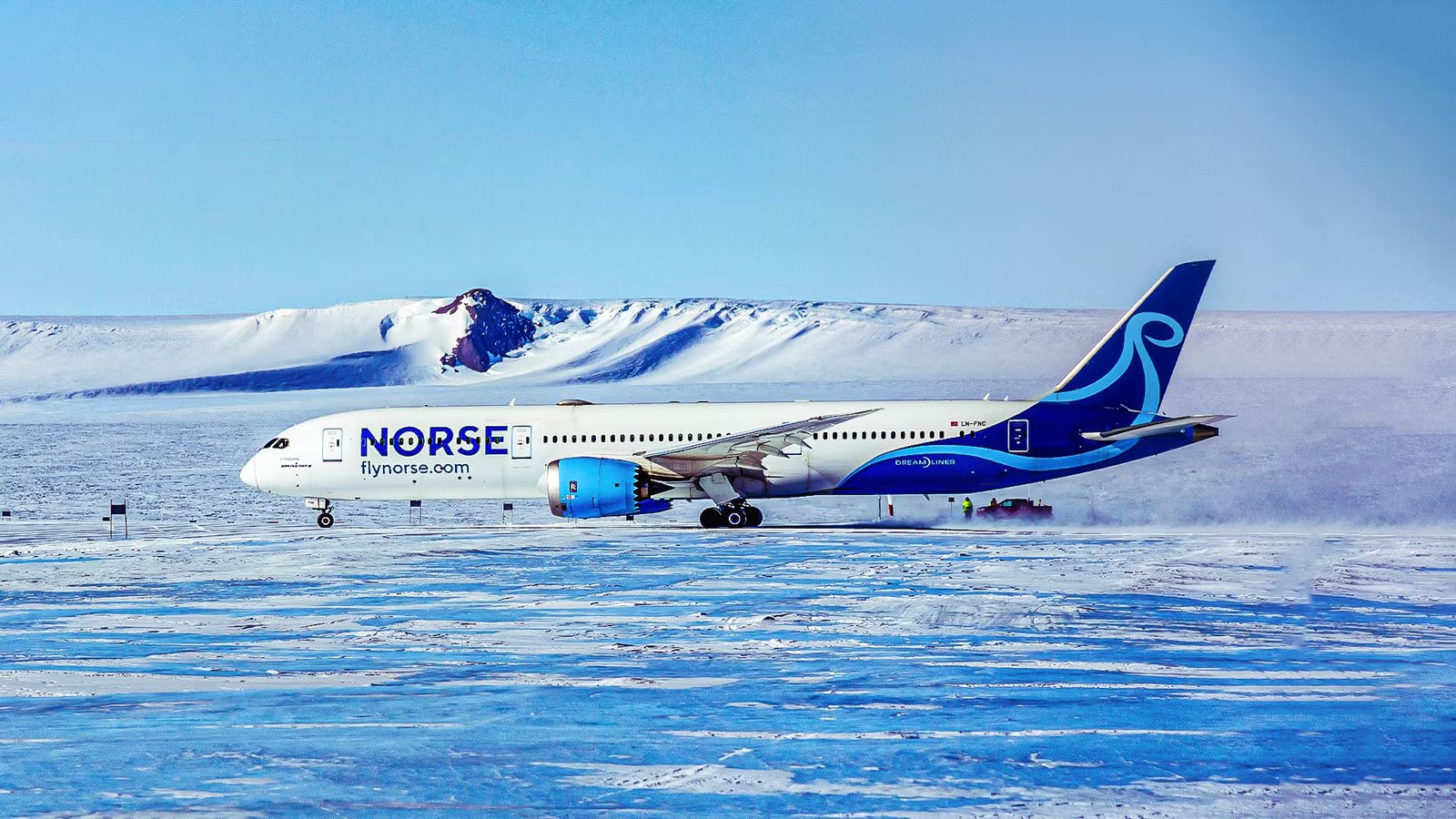
Antarctica is one of the most remote regions in the world and relies heavily on aviation to support scientific research, logistics, and its small but growing tourism sector. With no permanent commercial airports and harsh weather conditions, flying to the continent requires highly specialized, well-planned operations. Historically, access to Antarctica has been dominated by military airlift and ski-equipped aircraft, designed to operate on snow and ice rather than paved runways.
In recent years, however, modern commercial widebody aircraft have begun to play a larger role, challenging long-held assumptions about what types of planes can safely operate in polar environments. Advances in aircraft performance, navigation, and the use of new types of runways are gradually expanding the range of viable landing options across the continent. These developments are reshaping how people and cargo reach Antarctica, offering faster, more efficient connections while maintaining the safety and environmental standards required for operations at the bottom of the world.
Who Flies To Antarctica?

The largest reason for flights to Antarctica is to support the large number of ongoing research programs. These flights typically transport relevant cargo such as research equipment and supplies, along with scientists and support personnel. In most cases, these flights are operated by the Air Forces of countries with large-scale research programs or specialist charter airlines. However, in recent years, commercial charter airlines have entered the Antarctic aviation landscape, using regular commercial widebody aircraft to conduct these highly planned and non-scheduled flights.
Commercial airlines that operated to Antarctica include Norse Atlantic Airways on its Boeing 787 aircraft, and Hi Fly on its Airbus A340 and, more recently, its Airbus A330 aircraft. Below is an overview of the five largest aircraft to ever land in Antarctica by wingspan and length:
|
Rank |
Operator |
Payload |
Wingspan/Length |
|
|---|---|---|---|---|
|
1. |
Lockheed C-5 Galaxy |
U.S. Air Force |
281,001 lbs (127,460 kg) |
222 ft 9 in(67.89 m) / 247 ft 10 in (75.3 m) |
|
2. |
Airbus A340-300 |
Hi Fly |
115,000 lbs (52,150 kg) |
198 ft (60.3 m) /208 ft 11 in (63.69 m) |
|
3. |
Airbus A330-300 |
Hi Fly |
100,500 lb (45,600 kg) |
197 feet 9 in (60.3 m) / 209 ft (63.66 m) |
|
4. |
Boeing 787-9 Dreamliner |
Norse Atlantic Airways |
116,000 lbs (53,000 kg) |
197 ft 3 in (60.12 m) / 206 ft 1 in (62.81 m) |
|
5. |
Boeing C-17 Globemaster III |
U.S. Air Force |
170,900 lbs (77,518 kg) |
169 ft 10 in (51.77 m) / 174 ft (53.04 m) |
Where Do You Even Land An Airplane In Antarctica?

Antarctica has several airfields and airstrips, which are primarily operational during the austral summer season from December to February. The primary purpose of these airfields is to support scientific research, logistics, and limited tourism in Antarctica. It is no surprise that these airfields are nothing like the airport we are used to. They do not have permanent terminal buildings, and runways are not paved with asphalt or concrete. Instead, most runways are made of compacted snow or are so-called “blue ice runways”. These “blue ice runways” are naturally occurring areas of dense ice where no snow accumulation occurs due to constant wind, creating a smooth surface that can support an aircraft.
Some of these airfields are, as shown by the examples above, even able to accommodate large widebody aircraft. However, this is definitely not the case for all, with many runways only supporting special or ski-equipped planes. Most airfields in Antarctica are operated by national research programs, with flight scheduling often aligned with scientific and logistical needs. And even though there are no large-scale commercial operations in Antarctica, a few airfields serve as entry points for tourists. Weather, ice conditions, and seasonal melting can temporarily close runways, making Antarctic landings highly dependent on environmental factors.
One of the most important airfields in Antarctica is the McMurdo Station Complex (QAI, QAW, QAX), maintained by the US Antarctic Program. This aviation complex is the continent’s largest, comprising three airfields working together and frequently welcoming aircraft as big as the C-17 Globemaster. Due to the runways’ varied surface areas and advanced technological systems, the airfield can stay operational even in severe weather conditions. The primary reason for the relatively large complex is to support McMurdo Station, which is the largest settlement in Antarctica with around 1,000 people in summer and even 150 in winter.
Some other important airfields in Antarctica include Wolf’s Fang Runway (WFR), a private facility with a blue-ice runway that is frequently used by large widebody aircraft. The facility’s main purpose is to support scientific research, but it is also a gateway for high-end tourists who are increasingly visiting Antarctica. Another airfield is King George Island (TNM), which is the continent’s most accessible airfield due to its proximity to South America and year-round operations. As a result, it is an important access point for tourism, particularly cruise tourism. Lastly, there is also Troll Airfield (QAT), which is operated by the Norwegian Antarctic Program and has a runway long enough to welcome aircraft as large as the Boeing 787. The airport has a regular connection to Cape Town (CPT), making it an important international access point often described as one of the closest things Antarctica has to a centralized aviation hub. Even though the airfield primarily supports scientific research, the airfield also occasionally handles some tourist expeditions.

Why In The World Does The Boeing 787 Fly To Antarctica?
A look at what makes the 787 suitable to fly to the icy continent.
What Did Hi Fly’s Antarctica Operations Look Like?

The Portuguese charter airline Hi Fly has become one of the world’s first and most prominent commercial operators to and from Antarctica. As of writing, the airline has been operating to and from the continent for five years in partnership with various expedition and logistics providers. Hi Fly’s Antarctic flights are operated as highly controlled charter operations, typically supporting tourism, scientific personnel, and essential logistics rather than scheduled commercial services.
In December 2025, the airline made history by operating the first-ever Airbus A330 flight to Antarctica. This flight departed Cape Town and touched down on the Wolf’s Fang airfield, demonstrating that commercial widebody aircraft can safely land on blue-ice runways, expanding the possibilities for connecting to Antarctica beyond military and ski-equipped aircraft. Hi Fly’s Antarctic flights are highly planned, time-limited operations, with aircraft typically remaining on the ground for only a few hours due to environmental and logistical constraints. These include cold-related technical risks and the lack of diversion or maintenance options. Carlos Mirpuri, the airline’s Vice Chairman and captain of the flight, said the following at the time of the flight:
“Landing in Antarctica is never routine; every flight demands careful planning. (…) Introducing the A330 to this remote runway highlights our commitment to innovation, operational excellence, and the ongoing evolution of polar aviation.”
Prior to introducing the A330, Hi Fly used its Airbus A340 aircraft for flights to Antarctica. The aircraft’s long range and quad engines provided additional margins for safe operations in the absence of diversion airports and ground infrastructure. The successful transition from the A340 to the A330 reflects improvements in Antarctic ground handling, navigation procedures, and runway maintenance, particularly at blue-ice airfields like Wolf’s Fang

A Frigid First: Hi Fly Makes A Historic Landing In Antarctica
The European charter specialist has been flying to Antarctica for five straight years.
What Did Norse Atlantic’s Antarctica Operations Look Like?

In November of 2023, Norse Atlantic Airways joined Hi Fly in the list of commercial airlines operating regular widebody airplanes to Antarctica, as one of its Boeing 787 Dreamliners touched down on the continent for the first time. The flight operated from Oslo (OSL) via Cape Town to Troll Airfield. Norse’s 787-9 Dreamliner carried scientists from the Norwegian Polar Institute and more than ten tons of research equipment. An important additional achievement beyond the first Boeing 787 landing itself is, that Norse Atlantic operated the entire Cape Town–Antarctica round trip without refueling.
A year later, in November 2024, Norse Atlantic returned to Antarctica, proving that the 787 flight a year earlier was not only a one-off publicity event. According to Norse Atlantic, the Dreamliner’s fuel efficiency, range, and advanced avionics make it particularly well-suited for polar missions, reducing operational risk while increasing payload capacity compared with other widebody aircraft. At the time of Norse’s second flight to Antarctica, Mette Birkedahl, the airline’s Director of Charter and ACMI, said the following:
“Returning to Antarctica with our Dreamliner reaffirms Norse Atlantic’s ability to handle complex logistical operations. We’re proud to demonstrate the capabilities and efficiency of our aircraft and operational excellence of the Norse Atlantic charter team, from meticulous planning to precise execution, demonstrating our role as a trusted partner for missions to even the most remote destinations.”
Together, Norse Atlantic and Hi Fly are demonstrating the evolving possibilities of polar aviation, showing how modern, fuel-efficient widebody airliners and specialist charter operators can increasingly bridge the gap between military aircraft and traditional scientific logistics. By doing so, they enable faster, higher-capacity access to Antarctica for research missions and limited tourism. Their operations also reflect a broader shift toward the use of large, wheeled aircraft on blue-ice runways, complementing ski-equipped fleets and expanding the range, efficiency, and reliability of future polar flights.