By Rodrigo Campos and Libby George
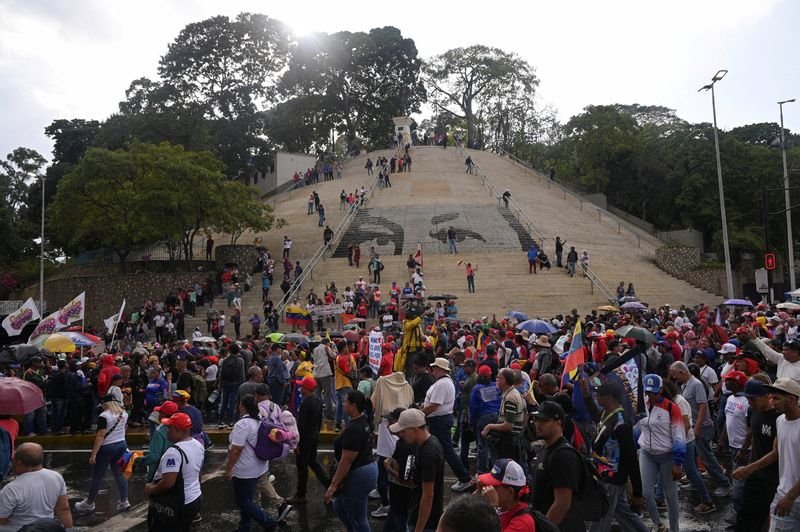
NEW YORK/LONDON, Jan 8 (Reuters) – U.S. President Donald Trump’s muscular moves in Venezuela and Argentina are adding to a rightward shift across Latin America in a pivotal election year, making foreign cash more likely to flow to the region as investors anticipate market-friendly reforms.
The U.S. removal of President Nicolas Maduro over the weekend sent Venezuela’s defaulted debt soaring, while Trump’s gamble last year to bolster Argentina’s Javier Milei – an ideological ally – with a financial backstop of up to $40 billion paid off when Milei’s party did well in crucial midterm elections.
In a different era, Trump’s interventions may have sparked more of a backlash against brazen foreign meddling. And while not everyone in Latin America has welcomed his moves, reaction has been relatively muted at a time of a broader rightward political shift that investors say will boost the region’s financial assets as they anticipate market-friendly changes.
“What we’ve found historically in Latin America is that things tend to go in waves and trends together,” said Robert Koenigsberger, chief investment officer and managing partner at Gramercy. “It clearly seems that the current trend in Latin America is from left to right.”
That perception, he said, has made investors more comfortable adding exposure as they focus on expected fiscal consolidation and regulatory reforms across the region.
A REGIONAL SHIFT
The willingness to add exposure reflects a view that Latin America has moved as a block in regional cycles, with political shifts often reinforcing one another rather than playing out country by country.
Recent election wins in Ecuador, Argentina and Chile have seen a shift towards right-wing parties, underpinning rallies in regional equities, currencies and bonds over the past year.
Markets have also been buoyed by a general trend towards orthodox monetary policies and fiscal discipline, even in those countries led by leftist leaders like Brazil and Mexico.
Brazil’s real and Mexico’s peso were among the best performing emerging market currencies in 2025, while stocks in Colombia, Peru and Chile crowded the leaderboard for equity gains.
The ousting of Maduro was being taken positively by markets, said Graham Stock, an emerging markets strategist at RBC BlueBay.
“If anything, it reinforces our expectation that you’re going to see a shift to more market-friendly governments in Latin America,” he said.
ELECTIONS IN VIEW
After Latin America outperformed many emerging market peers last year, investors are watching a packed electoral calendar in 2026, which will include elections in Colombia, Peru and later in the year, Brazil.
Eileen Gavin, head of sovereign analysis at Verisk Maplecroft, said Colombia was particularly exposed to potential fallout from neighboring Venezuela as it heads to congressional elections in March and a presidential race in May.
Leftist Colombian President Gustavo Petro, who has clashed with Trump and was hit with U.S. sanctions back in October, cannot run for reelection.
“The pressure on the elections will be to tilt towards the right, and for bondholders, that’s a risk upside,” Gavin said, adding that Venezuela’s turmoil could also weigh on Peru, Panama and Cuba through changes to migration and trade.
Peru’s April 12 presidential election seems open, with at least 34 hopefuls registered to compete, and nearly half of voters without a preferred candidate, according to a poll late last year.
In Brazil, meanwhile, President Luiz Inacio Lula da Silva currently leads most polls as he seeks a fourth term in office in a vote set for October.
Whoever wins, they will need to deal with Trump, set to be in office until January 2029.
“The more the U.S. puts pressure on these countries, the more they’re likely to bend to American will, which, in the case of Latin America, means more pro-market policies,” said Marko Papic, chief strategist at BCA Research.
Investors at Citi noted that the negative response to Trump’s Venezuelan operation had been limited.
“In the short term, the action has not generated a rally around the ‘Latin American flag’, with many voices welcoming the move,” Citi’s Donato Guarino said in a note, adding that the bank remained long on Venezuelan credit.
RESOURCE EXTRACTION COMPANIES COULD BENEFIT
Indeed, even some leftist presidents have sought to cut deals or appease Trump. Colombia’s government has emphasized in recent days it would cooperate with Washington to fight drug trafficking.
“Leftist leaders are probably constantly looking over their shoulders,” said Brian Jacobsen, chief economic strategist at Annex Wealth Management.
As regional governments seek investment that fits U.S. strategic priorities, multinational companies involved in infrastructure development and resource extraction were likely to be among the main beneficiaries, Jacobsen said.
BCA’s Papic also predicted natural resources-linked assets should outperform, as well as banks.
“The Latin American private sector has deleveraged, and there is potential for financial institutions to benefit as well,” he added.
Broadly constructive on Latin American assets, he warned that investor enthusiasm hinged on Washington avoiding an overly aggressive posture, however.
“It would be a mistake for the U.S. to rely purely on the heavy-handed approach,” he said, arguing that it could yet trigger a backlash rooted in sovereignty concerns. “Hopefully the (Trump) administration can find some middle ground.”
(Reporting by Rodrigo Campos in New York and Libby George in London; editing by Karin Strohecker and Rosalba O’Brien)


 dailynewsnblog