dailynewsnblog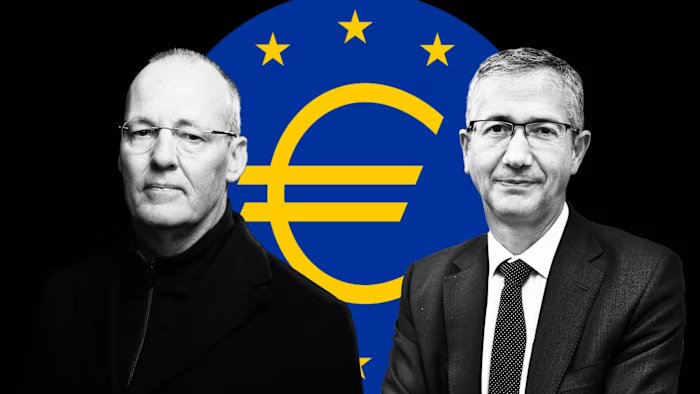
Unlock the Editor’s Digest for free
Roula Khalaf, Editor of the FT, selects her favourite stories in this weekly newsletter.
Spain’s former central bank governor Pablo Hernández de Cos and his Dutch counterpart Klaas Knot are European economists’ preferred picks to become the next president of the European Central Bank, according to a Financial Times poll.
The top job at the Frankfurt-based institution will become available in November 2027 when Christine Lagarde’s non-renewable eight-year term expires. But several contenders are already starting to position themselves for the role amid a major reshuffle of the ECB’s top ranks within the next two years.
Both Bundesbank president Joachim Nagel and ECB executive board member Isabel Schnabel have openly expressed interest in succeeding Lagarde, who is the best-paid official in the EU with an estimated annual salary of €726,000.
Europe’s most powerful central banker is appointed by the European Council, and the position was historically subject to last-minute behind-the-scenes horse-trading among capitals.
Of the 70 economists who responded to a question about the ECB presidency in the FT survey, 26 per cent would choose Hernández de Cos to succeed Lagarde.

Knot, whose second seven-year term as Dutch central bank governor ended in June, was endorsed by 24 per cent of the respondents, who came from the private sector, think-tanks and universities.
“Hernández de Cos is the candidate with the strongest technical understanding of monetary policy and central banking in my view,” said Christian Kopf, head of fixed income at German asset manager Union Investment.
Appointing a “career technocrat” such as Hernández de Cos would send “a strong signal that Europe will not waver and that the euro will remain a hard currency” in an era where central banks’ independence has come under pressure in countries including the US, Kopf added.
Francesco Papadia, an economist at think-tank Bruegel, described Knot as a policymaker with a “sound, stability-oriented approach to monetary policy” as well as “the flexibility needed to adapt to changing circumstances”.
The two known German contenders — Schnabel and Nagel — received the support of 14 and 7 per cent of respondents respectively.
Four economists picked other possible candidates. French central bank governor François Villeroy de Galhau was the only one who was suggested twice. Another 23 per cent of the respondents said they did not have a preference at this stage.

A further 18 economists in the survey, which polled 88 in total, skipped the question about the ECB presidency altogether, with some pointing to the delicate nature of any such endorsement.
Some economists pointed out they did not pick Schnabel as they thought she would be barred by EU law from taking another role on the ECB’s executive board.
“Isabel Schnabel is probably the best qualified person, but it looks like she cannot jump from executive board member to president,” said Lorenzo Codogno, founder of his own macro advisory firm, who instead supported Knot.
Some of the polled economists had conflicting views over the ideal nationality of the next ECB president. Jesper Rangvid, a professor at Copenhagen Business School, argued that 29 years after the creation of the ECB, it was “arguably time for a German to assume the role”. The bloc’s largest economy has never held the ECB top job.
Spyros Andreopoulos, founder of Thin Ice Macroeconomics consultancy, argued that a German ECB boss would be of “symbolic importance” for a country in which the Euro-sceptic far-right Alternative for Germany party was supported by a growing number of voters. German leadership of the ECB could “help to counter fears” that the single currency was “just a project to rip off Germany,” Andreopoulos said.

Others argued that a German ECB president at a time when the European Commission was also run by a German — Ursula von der Leyen — was not a realistic scenario.
With almost two more years left of Lagarde’s term, Martin Moryson, global head of economics at Germany’s largest asset manager DWS, pointed to the unpredictable nature of the process and the longtime horizon. “Individuals from the financial world who have not yet been mentioned” might stand a chance, he said.
In the past, frontrunners have not always been successful, and compromise candidates emerged late in the process. “Who had predicted in advance that Lagarde would become ECB president?” said Commerzbank’s chief economist Jörg Krämer.
The high and rising level of European government debt will create a big challenge for the next ECB leader, many of the economists warned. Léa Dauphas, chief economist at consultancy TAC Economics, said the next ECB president would have to “operate in a regime where the key challenge is credibility” in the face of such issues.
Excessive government borrowing could limit the central bank’s room for interest rate rises as it may make government debt too expensive to service, some of the economists surveyed warned.
José Manuel González-Páramo, a former member of the ECB’s executive board, said that the central bank’s next president would have to work hard to “stay aside from political pressure” as they would face calls to “embrace more tasks” than just keeping inflation in check and safeguarding financial stability.