By Florence Tan
SINGAPORE, Jan 4 (Reuters) – Oil prices are likely to move higher when benchmark futures resume trading later on Sunday on concern that supply may be disrupted after the United States snatched Venezuelan President Nicolas Maduro from Caracas at the weekend and President Donald Trump said Washington would take control of the oil-producing nation.
There is plentiful oil supply in global markets, meaning any further disruption to Venezuela’s exports would have little immediate impact on prices, analysts said.
The U.S. strike on Venezuela to extract the country’s president inflicted no damage on the country’s oil production and refining industry, two sources with knowledge of operations at state oil company PDVSA said at the weekend.
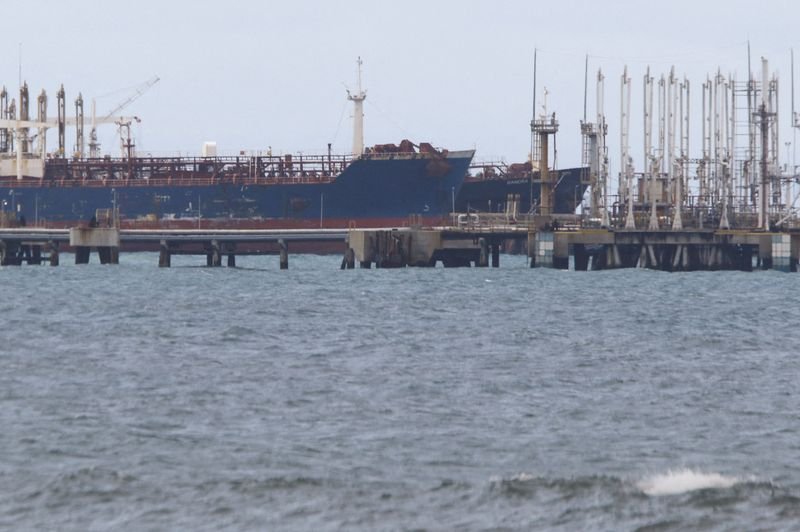
Since Trump imposed a blockade of sanctioned oil tankers entering or leaving Venezuelan waters and seized two cargoes last month, exports have fallen and have been completely paralysed since January 1.
That has left millions of barrels stuck on loaded tankers in Venezuelan waters and led to millions more barrels going into Venezuelan oil storage.
The OPEC member’s exports fell to around 500,000 barrels per day in December, around half of what they were in November. Most of the December exports took place before the embargo. Since then, only exports from Chevron of around 100,000 bpd have continued to leave Venezuela. The global oil major has U.S. authorisation to produce and export from Venezuela despite sanctions.
The embargo prompted PDVSA to begin cutting oil output, three sources close to the decision said on Sunday, because Venezuela is running out of storage capacity for the oil that it cannot export. PDVSA has asked some of the joint ventures that are operating in the country to cut back production, the sources said. They would need to shut down oilfields or well clusters.
Trump said on Saturday that the oil embargo on Venezuelan exports remained in full effect. If the U.S. government loosens the embargo and allows more Venezuelan crude exports to the U.S. Gulf, there are refiners there that previously processed the country’s oil.
The weekend’s events were unlikely to materially alter global oil markets or the global economy given the U.S. strikes avoided Venezuela’s oil infrastructure, said Neil Shearing, group chief economist at Capital Economics.
“In any case, any short-term disruption to Venezuelan output can easily be offset by increased production elsewhere. And any medium-term recovery in Venezuelan supply would be dwarfed by shifts among the major producers,” he said in a note.
Trump also threatened on Friday to intervene in a crackdown on protests in Iran, another OPEC producer, ratcheting up geopolitical tensions. Trump on Friday said “we are locked and loaded and ready to go”, without specifying what actions he was considering against Tehran, which has seen a week of unrest as protests over soaring inflation spread across the country.
“Prices may see modest upside on heightened geopolitical tensions and disruption risks linked to Venezuela and Iran, but ample global supply should continue to cap those risks for now,” said Ole Hansen, head of commodities research at Saxo Bank.
On Sunday, the Organization of the Petroleum Exporting Countries and their allies agreed to maintain steady oil output in the first quarter, OPEC+ said in a statement. Both Venezuela and Iran are members of OPEC. Several other members of OPEC+ are also embroiled in conflict and political crises.
The producer group has put increases in production on pause for the first quarter after raising output targets by around 2.9 million barrels per day from April to December 2025, equal to almost 3% of world oil demand.
Brent and U.S. crude futures settled lower on Friday, the first day of trading of 2026, as investors weighed oversupply concerns against geopolitical risks. Both contracts closed 2025 with their biggest annual loss since 2020 marked by wars, higher tariffs, increased OPEC+ output and sanctions on Russia, Iran and Venezuela. [O/R]
VENEZUELA
“The political transition in Venezuela adds another major layer of uncertainty, with elevated risks of civil unrest and near-term supply disruptions,” said Jorge Leon, head of geopolitical analysis at consultancy Rystad Energy and a former OPEC official.
“In an environment this fragile, OPEC+ is choosing caution, preserving flexibility rather than introducing new uncertainty into an already volatile market.”
Trump said on Saturday that the U.S. would control the country until it could make an orderly transition, but an interim government led by vice president and oil minister Delcy Rodriguez remains in control of the country’s institutions, including state energy company PDVSA, with the blessing of Venezuela’s top court.
A top Venezuelan official said on Sunday that the country’s government would stay unified behind Maduro amid deep uncertainty about what is next for the Latin American country.
Trump said that American oil companies were prepared to reenter Venezuela and invest billions of dollars to restore production there.
Venezuela is unlikely to see any meaningful boost to crude output for years even if U.S. oil majors do invest the billions of dollars in the country that Trump has promised, analysts said.
“We continue to caution market observers that it will be a long road back for the country, given its decades-long decline under the Chávez and Maduro regimes, as well as the fact that the U.S. regime change track record is not one of unambiguous success,” Helima Croft, RBC Capital’s head of commodities research, said in a note.
(Reporting by Florence Tan in Singapore, Ahmad Ghaddar and Alex Lawler in London, Marianna Parraga in Houston; Editing by Simon Webb and Chizu Nomiyama )


 dailynewsnblog