dailynewsnblog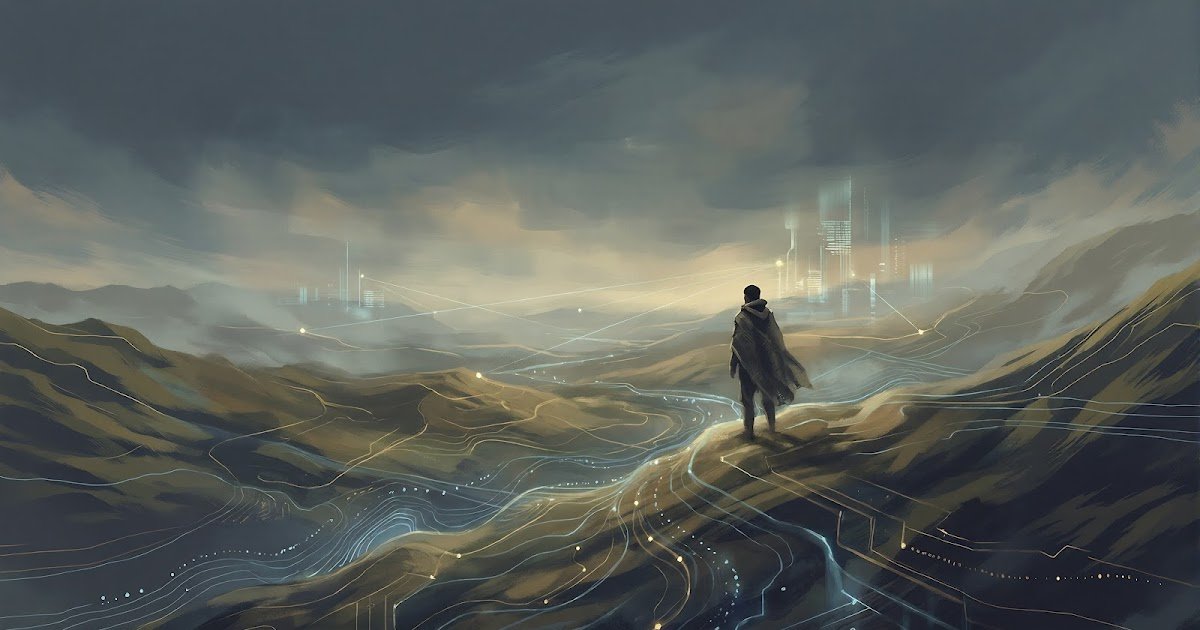
Creativity, Selfhood, and Agency in the Age of Extended AI.

We are living through a period of change that is not merely
technological but topological. The ground beneath our habits,
identities, and expectations is shifting—not once, but continuously. Tools no
longer arrive as discrete instruments to be mastered and set aside; they arrive
as living systems that reshape the conditions of action themselves. In this
context, many of our inherited metaphors—career ladders, skill acquisition,
tool mastery, productivity—begin to fail us. They assume a stable terrain. We
no longer inhabit one.
A more fitting metaphor for this moment is that of an affordance
landscape: a dynamic field of possibilities shaped by the interaction
between agents, environments, and technologies. What matters in such a
landscape is not control, nor even expertise in the traditional sense, but attunement—the
capacity to perceive emerging possibilities and move with them.
Nowhere is this more apparent than in the experience of
working with extended AI systems.
From Tools to Terrain
In the analog and early digital worlds, creativity was
inseparable from friction. Progress required time, repetition, apprenticeship,
and the slow accumulation of procedural knowledge. Mastery conferred authority
precisely because it was difficult to obtain. Effort functioned as both a
gatekeeper and a moral signal: if something took a long time to learn, it
deserved respect.
AI-mediated systems disrupt this logic at a foundational
level.
When an image can be improved, a design refined, or a
complex workflow executed in minutes—often with results that exceed prior
efforts—the relationship between effort and outcome is severed. This is deeply
unsettling for those whose sense of self and value is anchored in procedural
mastery. But it is also revelatory. It exposes something that was always true
but easy to ignore: much of what we called “skill” was not essence, but
interface negotiation.
The shift from tools to terrain matters. Tools are things we
use. Terrain is something we move within. AI no longer behaves like a
passive instrument; it reshapes the space of possible actions. The relevant
question is no longer “How do I master this tool?” but “What does this
landscape now make possible for someone like me?”
That question is inherently relational.
The End of the Autonomous Self (Quietly)
Modernity trained us to imagine the self as autonomous,
bounded, and self-sufficient. Intelligence was presumed to reside inside the
individual, with tools acting as external amplifiers. This model worked—up to a
point. But it came with hidden costs: exhaustion, identity rigidity, and the
constant pressure to keep up as complexity increased.
Extended AI systems expose the limits of this model.
When intelligence becomes distributed across humans,
machines, datasets, and infrastructures, agency is no longer localized. It is orchestrated.
Creativity becomes less about execution and more about orientation, judgment,
and sense-making. The self shifts from operator to navigator.
This is not a loss of agency. It is a reconfiguration of it.
Those who cling to the autonomous self model often
experience AI as threatening or dehumanizing. But for those already
experimenting with relational or distributed models of selfhood, AI feels less
like replacement and more like resonance. It does not diminish authorship; it
relocates it. The human contribution moves upstream—from manipulating pixels
and menus to shaping intention, meaning, and coherence.
What becomes scarce is no longer skill, but discernment.
Friction, Time, and Meaning
One of the most profound effects of AI-mediated creativity
is the collapse of friction at the operational layer. Tasks that once required
hours now take minutes. For some, this feels like a violation of an unspoken
ethical contract: meaning was supposed to be earned through effort.
But effort is not meaning. It is merely one historical path
to it.
When friction is removed, time does not disappear; it is
redistributed. Depth does not vanish; it migrates. The question becomes where
that liberated time and energy are reinvested. If speed is used only to produce
more, faster, exhaustion returns under a different name. But if speed creates
space for reflection, experimentation, and conceptual play, something else
becomes possible.
In this sense, AI does not trivialize creativity—it raises
the bar. When execution is cheap, coherence matters more. When iteration is
instant, direction matters more. When outcomes arrive quickly, the capacity to
recognize what is alive, aligned, and worth pursuing becomes decisive.
The affordance landscape rewards those who can sense
gradients rather than defend positions.
Winners, Losers, and Misalignment
It is true—and unavoidable—that periods of rapid landscape
change produce uneven outcomes. Some people will experience loss: of status, of
identity, of hard-won expertise. This is not because they lack talent, but
because their talents were cultivated under a different regime of constraints.
Framed through the affordance landscape metaphor, this is
not a moral failure but a mismatch. Landscapes do not reward virtue;
they reward fit. Anxiety, resentment, and resistance often signal a gap between
how one has learned to move and how the terrain now behaves.
Conversely, those who thrive are not necessarily the most
technically adept. They are those willing to relinquish procedural sovereignty
in exchange for expanded reach. They can tolerate surprise. They can
collaborate with systems whose inner workings they do not fully control. They
understand that authorship today is less about command and more about curation,
steering, and resonance.
In short, they are adaptable selves rather than defended
ones.
Aging, Experience, and a Quiet Advantage
There is an irony here worth noting. Those who grew up in
analog worlds—who remember the slowness, the labor, the materiality of
creation—often feel the rupture most acutely. But that very contrast can become
an advantage. Having lived through multiple regimes of friction, they can
recognize what has genuinely changed and what has not.
They know that judgment, taste, and meaning were never
located in the tools themselves.
For such individuals, AI’s acceleration is not disorienting
but exhilarating. It feels like time returned rather than stolen. Energy once
spent wrestling interfaces can now be invested in thinking, composing, and
world-building. The fascination is not with the machine, but with the newly
expanded space of possibility for creative life—especially later in life, when
energy is precious and curiosity remains abundant.
This is not nostalgia. It is perspective.
Toward New Metaphors of Agency
The affordance landscape metaphor does important cultural
work because it avoids false binaries. It does not ask us to choose between
human and machine, mastery and surrender, speed and depth. Instead, it invites
us to think in terms of navigation, attunement, and relational agency.
It reminds us that:
- intelligence
is not a possession but a field - creativity
is not an act but a process of alignment - agency
is not control but participation
Most importantly, it gives us a way to stay oriented without
pretending the ground will stop moving.
In an era where change outpaces adaptation, metaphors
matter. They shape what we notice, what we fear, and what we believe is
possible. The affordance landscape does not promise stability. It promises legibility.
And in a world of extended intelligence, legibility may be the most valuable
affordance of all.
The question before us, then, is not whether AI will change
the landscape—it already has. The question is whether we will cling to old
maps, or learn to sense new contours.
Some will defend the hills they know. Others will begin to explore.
And a few—quietly, experimentally—will start making worlds
in the middle of the shift.