dailynewsnblog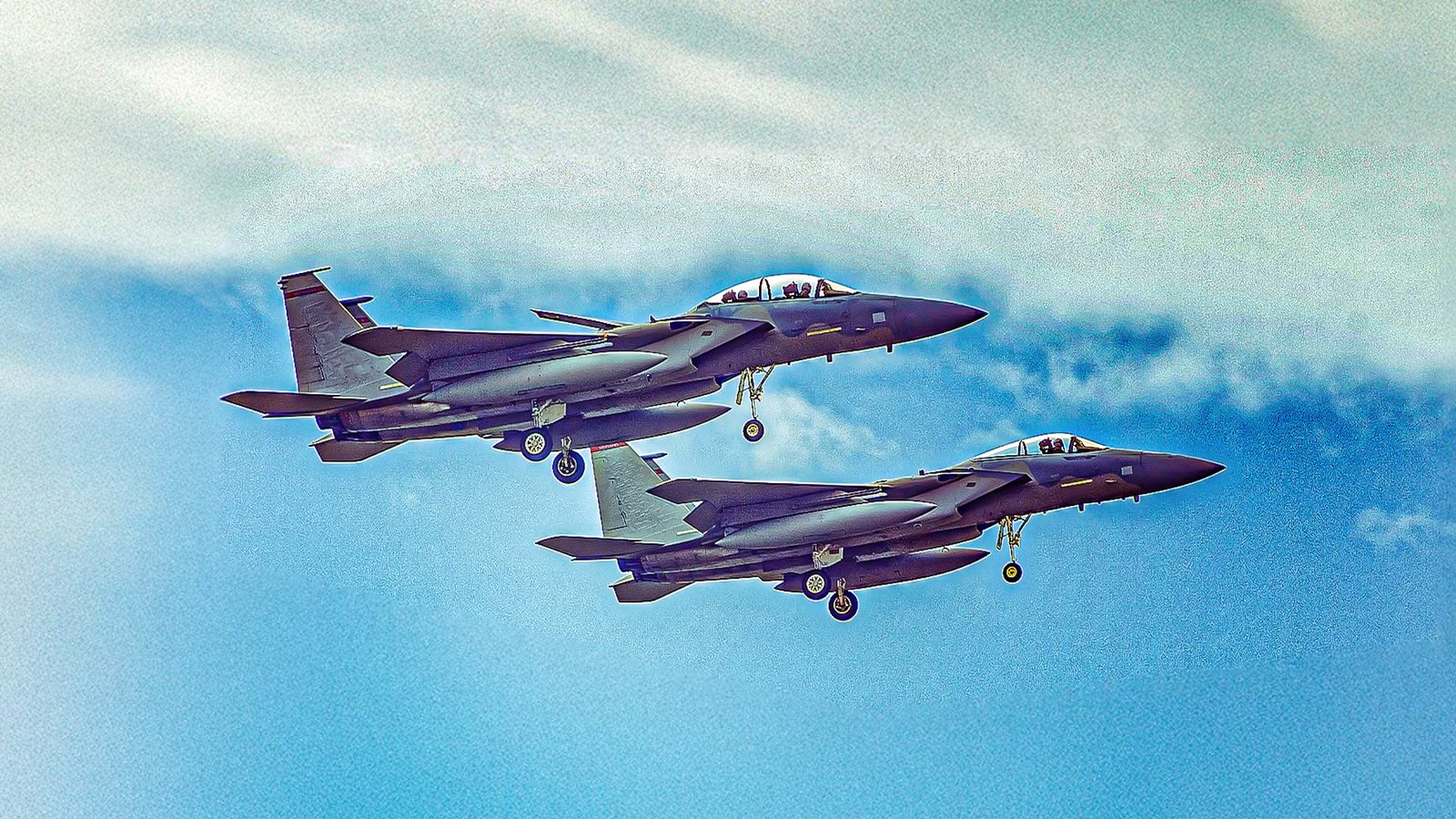
Fighter aircraft rarely spend all that much time operating at their top speeds. However, analyzing the top speeds of different fighter aircraft can still tell you quite a lot about an aircraft’s design priorities. On paper, the F-15 Eagle family is clearly quicker than the F-35 Lightning II, both of which are fighter programs originally developed for the United States Air Force by McDonnell Douglas and Lockheed Martin, respectively. The USAF lists the maximum operational speed for the F-15 Eagle at around 1,875 miles per hour (3,017 km per hour), which accounts for a speed of roughly Mach 2.5 at altitude. The F-35 Lightning II is capped at a top speed of around Mach 1.6 at altitude, which computes to around 1,200 miles per hour (1,931 km per hour).
Both jets offer impressive maneuverability, as they can each pull 9 g turns and operate at incredibly high altitudes. However, it is important to note that these jets were built for entirely different eras and missions. The F-15 Eagle was designed as a 1970s-era air superiority fighter, while the F-35 Lightning II was designed instead as a stealthy, networked multirole striker. In terms of raw dash speed, the F-15 is the unquestionable winner. However, the Air Force is more interested in the dynamic capabilities of both aircraft, meaning that the actual value of a jet exceeds the simple comparison between how fast each jet can fly. Here, we analyze not just the impressive speeds of these two models, but also the dynamic long-haul capabilities each brings to the table.
The F-15 Eagle Holds A Clear Edge In Terms of Raw Speed

The easiest, and consequently, most obvious place to start this comparison is with top-line aircraft speed. The F-15 Eagle, as well as its derivative, the F-15E Strike Eagle, are both quoted by the United States Air Force to be able to operate at speeds of around 1,875 miles per hour (3,017 km per hour).
This makes the F-15 Falcon one of the fastest fighters in frontline service, even exceeding the operational speeds of many newer-generation fighters, including both the Lockheed Martin F-22 Raptor and the Lockheed Martin F-35 Lightning II. The F-35, which is increasingly becoming the most critical element of allied air power, has a quoted top speed of around Mach 1.6, with that figure given by the manufacturer at a full internal weapons load. This could mean that the aircraft is capable of exceeding this top speed with lighter payloads. However, it is still unlikely that the model could fly just as fast as the much more capable F-15 Eagle.
This roughly 50% advantage in maximum speed reflects the design choices made for the models. With a twin-engine layout, large inlets, and a relatively clean 4th-generation construction, the F-15 is optimized to sprint at altitude and chase high-flying bombers, all while out-running or out-climbing any potential threats. In terms of pure numbers, there is simply no doubt as to which of these aircraft can fly faster.
The F-35 Was Not Designed With Stealth As A Principal Priority

The F-35 was never designed to be a record-setting aircraft in terms of pure speed. Official descriptions of the aircraft emphasize stealth, sensor fusion, and overall situational awareness, as opposed to pure dash speed. The aircraft’s shaping, internal weapons bays, and fuselage blending are tuned in order to minimize radar and infrared sensor signatures. Minimizing drag at speeds exceeding Mach 2 was simply never a priority the Air Force or Lockheed Martin had in mind when this aircraft was designed.
Lockheed Martin’s official top speed of Mach 1.6 with a full internal payload makes sense, and it is enough for a strong supersonic dash but well below the expected ceiling for the McDonnell Douglas F-15 Eagle. Those who designed the aircraft were essential in the business of trading top-end speed for the uninterrupted ability to approach targets undetected. Here are some specifications for the two models, according to figures from the United States Air Force:
|
Category |
F-15 Eagle Specification |
F-35 Lightning II Specification |
|---|---|---|
|
Maximum speed at altitude |
1,875 miles per hour (3,017 km per hour) |
1,200 miles per hour (1,931 km per hour) |
|
Service ceiling |
65,000 feet (19,812 meters) |
50,000 feet (15,230 meters) |
|
Engines |
2x Pratt & Whitney F100 |
1x Pratt & Whitner F135 |
|
Primary role |
Air-superiority fighter |
Stealth multirole strike fighter |
These fighter aircraft share data with other assets and fight beyond visual range using a fused picture from advanced radar and electro-optical sensors across the board. In an environment where getting seen first often means getting shot at first, the F-35’s philosophy is that being slightly slower but far harder to detect is a better survival trade than just chasing Mach 2.5.

Is The Eurofighter Typhoon Faster Than The F-35?
A riveting race between two titans of the sky: does the Eurofighter Typhoon outrun the F-35?
A Comparison Of Other Performance Specifications

Speed, on its own, is incapable of capturing how fast a fighter aircraft performs in combat. Altitude and climb rate matter because they translate into options for pilots. Altitude can be traded for speed, for example, if a pilot is in a dive. Higher climb rates allow aircraft to get up to combat altitudes faster. The F-15’s official service ceiling is around 65,000 feet (19,812 meters), with the United States Air Force also emphasizing the role that the aircraft plays as a high-maneuverability air-superiority fighter where maneuverability is critical.
The aircraft can climb exceptionally fast, reflecting an impressive thrust-to-weight ratio for a fighter of its size. The F-15 has been consistently cited for having an exceptional combat record, and maneuverability is a key reason why the aircraft has yet to record any air-to-air losses.
The F-35A’s stated ceiling is above 50,000 feet (15,240 meters), slightly lower but still high enough for long-range missile deployments and efficient cruise performance. Both jets have impressive maneuverability ratings, but the F-15’s raw performance capabilities still make it seem like a more classic fighter, especially in regimes where stealth is not as important of a factor.
Impressive Engines Power These Two Aircraft

When one also compares acceleration and sustained supersonic dash capabilities, the gap begins to narrow slightly. The McDonnell Douglas F-15 Eagle uses a pair of Pratt & Whitney F100 afterburning turbofans, while later F-15EX Eagle II models can operate with engines that deliver more than 29,000 pounds of thrust (129 kN) each, giving a combined afterburning thrust exceeding 58,000 pounds of thrust (358 kN), an excellent thrust-to-weight ratio.
This ultimately allows the Eagle to build speed quickly on a climb or pursue targets that may try to run. The F-35 Lightning II has just one engine, but it is an exceptionally powerful powerplant. The Pratt & Whitney F135, which was built specifically for this dynamic aircraft program, is rated at about 40,000 pounds of thrust (178 kN). This makes the aircraft exceptionally capable in all kinds of combat scenarios.
Lockheed’s F-35 Lightning II offers exceptional subsonic acceleration and a helpful supersonic dash capability, even while carrying a maximum fuel load and internal weapons package. Essentially, the F-15 Eagle is the most impressive in terms of raw capabilities, but the F-35 is still a respectable supersonic fighter in its own right.

Top 5: The World’s Most Advanced Fighter Jets
The US arguably has the most capable fighter jets, with China, Europe, and Russia also boasting advanced fighters.
Neither Aircraft Is Regularly Operating At These Speeds

When it comes to actual combat operations, there are very few situations in which either aircraft would actually be operating at its maximum afterburner speed. In reality, the two jets spend most of their lives at high-subsonic speeds. Long-range air patrols, strike escorts, and counter-air missions are usually flown around Mach 0.8-0.9 (around 850-966 km per hour).
At these speeds, fuel efficiency and overall sensor employment matter far more than an aircraft’s actual top speed. The F-15’s higher-speed capabilities are most valuable when the jet is in its classic interceptor role. This specifically involves the aircraft scrambling to meet incoming bombers, executing high-speed barrier maneuvers, or chasing down fleeting aircraft in relatively permissive airspace.
The F-35 instead elects to leverage speed to reposition between threat sectors or execute short supersonic dashes into or out of a contested area, with the aircraft primarily relying on stealth and networking in order to avoid ever needing a prolonged high-Mach chase. Modern doctrine increasingly prioritizes low observability over raw speed capabilities, especially for a fighter jet designed for multirole operations.
What Are Our Key Takeaways From This Analysis?

The principal takeaway here is that the F-15 Eagle is objectively faster, but that the F-35 Lightning II is the smarter aircraft. When analyzed on paper, it is pretty clear which of the two jets has a top-speed edge, with the former reaching around 50% higher speeds than the stealth-oriented F-35.
The F-15 also has a higher service ceiling and can climb faster, as one would expect for a classic air superiority sprinter and interceptor. The F-35 trades this raw speed for stealth, sensor fusion, and networking, ultimately accepting a lower top-end speed in exchange for all kinds of advanced capabilities that allow it to more effectively perform its stated multirole function.
During real operations, the F-15 and the F-35 rarely fly anywhere near their top speeds. Nonetheless, if necessary, the F-15 could undoubtedly fly faster. However, an F-35 could be more effective if the situation required a jet optimized to find and shoot down enemies before even being detected.