dailynewsnblog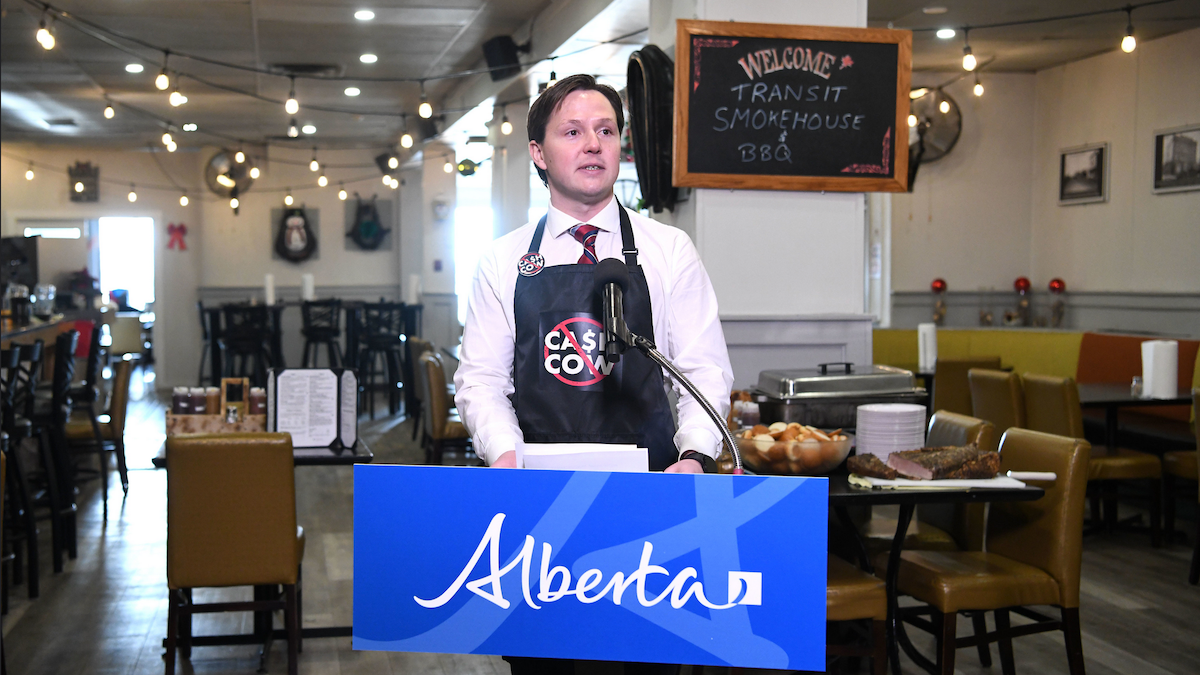
In an “update on highway speed survey results” published on the Government’s official website Tuesday, Transportation Minister Devin Dreeshen claims answers to a questionnaire that was online from Nov. 7 to Dec. 12 show “public support for raising speed limits on divided highways.”
Needless to say, that is not quite the truth, the whole truth and nothing but the truth.
“Albertans have spoken loud and clear,” the press release masquerading as a ministerial statement concluded. “We’re taking that direction seriously, and we will continue to make improvements that support safety, mobility, and economic growth across the province.”
Albertans have said no such thing, of course, and it’s doubtful Mr. Dreeshen’s plan will do much to support safety, mobility, and economic growth.
The transportation minister, who appears to be a reasonably intelligent young man, certainly understands that his statement is nothing more than misleading spin about a straw poll with no validity as a measure of public opinion.
The government survey results are based entirely on answers provided by anyone who felt like clicking a button on a web page and ticking the right boxes to agree with the Transportation Department’s questions, which leaned hard in favour of raising speed limits on some rural highways from 110 km/h to 120 km/h.
Much like the self-selecting surveys used in the United Conservative Party’s so-called “Alberta Next” engagement campaign to gin up popular support for Alberta separation and put pressure on the federal government to cave in to Alberta’s pipeline demands, this self-selecting survey has all the statistical validity of a politician asking a crowd of supporters to raise their hands if they agree.
You can draw the conclusion from such an exhibition that the room is full of supporters, but as a measure of actual public opinion, such voodoo polling is useless except as a tool for manufacturing consent. It’s possible, of course, that there is public support for higher speed limits, but there’s no way of telling from Mr. Dreeshen’s propaganda.
Whoever typed up Mr. Dreeshen’s statement was initially careful to be at least technically accurate about the questionnaire’s obvious flaws.
The “online public engagement survey … received a total of 59,400 responses,” the press release began. “The survey gave Albertans the opportunity to share their views on modernizing speed limits on rural divided highways,” it continued, echoing the biased language in Mr. Dreeshen’s original Nov. 7 release, but nevertheless half-heartedly acknowledging the self-selecting nature of the survey.
“Preliminary results show that 68 per cent of respondents who shared thoughts on the matter support increasing speed limits on these highways from 110 km/h to 120 km/h,” the release continued. Would the result have been different if respondents who just answered yes or no were included? Or is the release just ambiguously written. That much is not clear.
“It’s clear that Albertans are ready for modern, common-sense rules that better reflect how our roads are built and how people actually drive,” the statement said. So the government, in addition to reaching a highly questionable conclusion about public support, is telling us that the higher speed limits Mr. Dreeshen and his heavy-footed pals desire are modern and just common sense, an assertion for which there is no evidence.
Sad to say, at least with some unsophisticated readers, this flim-flammery seems to have worked. “Survey shows majority of Albertans back higher highway speed limits,” proclaimed the Central Alberta Online news site. The story continued in that vein.
Albertans first learned of this scheme in Mr. Dreeshen’s Nov. 7 announcement, which said the government was “investigating how to safely increase speed limits on divided highways, and if Albertans support increasing speed limits. … We want Albertans to be able to drive the speed limit that the highways are designed for. Modern vehicles combined with public awareness mean we can explore higher speed limits.”
As I observed at the time, the author of that release apparently wanted us to believe the government intended to safely increase highway speeds, knowing full well that higher speeds will make crashes deadlier.
The original news release – presumably unintentionally – also strongly suggested that Mr. Dreeshen had already made up his mind on what would happen next. The department would move ahead quickly to “conduct a mini-trial of a 120 km/h speed limit to assess the impacts of higher speed limits on divided highways.”
Tuesday’s announcement confirms that was the plan all along. It’s also likely that the decision to make the increase permanent has already been made.
As noted in my previous column, what happens next can be predicted with confidence by what happened when exactly the same thing was tried in British Columbia in 2014.
A study published by physicians and engineers from the University of British Columbia “looked at crash and insurance claim data from the 1,300-kilometre stretches of highway where the speed limit was raised to 120 kilometres per hour in 2014,” the CBC reported in the fall of 2018. The study indicated “the number of fatal crashes jumped by 118 per cent, injury claims with ICBC rose by 30 per cent and total insurance claims went up by 43 per cent.” The Insurance Corporation of British Columbia is B.C.’s public auto insurance provider.
British Columbians had to wait until 2018, when grownups were back in charge in the Legislature in Victoria, for speed limits to be brought back to a safer 110 km/h.
Mr. Dreeshen’s previous significant policy decision, celebrated in a March 27 press release headlined “Alberta is ending the photo radar cash cow,” was removing speed-camera enforcement from major provincial highways including those that run through urban areas. The policy also eliminated “speed-on-green” automatic enforcement at intersections.
All the results posted by Mr. Dreeshen on Tuesday show is who did the best job of getting supporters to fill out the government’s biased survey. It would be interesting to see what commenters actually said.
Had this kind of survey been published about a federal election campaign, the Canada Elections Act would have required anyone transmitting its results to indicate that it was not based on recognized statistical methods.
Oh well. This is Alberta. Make sure you do up your seatbelt the next time you venture out on a provincial highway.
Orders in Council
The Alberta cabinet was busy yesterday rewriting the regulations to the Citizen Initiative Act, which, it is increasingly obvious, was a hot mess when it was drafted and passed and later amended as the be all and end all in democracy. Obviously, the welter of strikeouts and substitutions in this cabinet order requires a closer look by someone with a sharp legal mind. Since there are such people among the readers of this blog, I post this link now in hope they will illuminate our fuzzification.