dailynewsnblog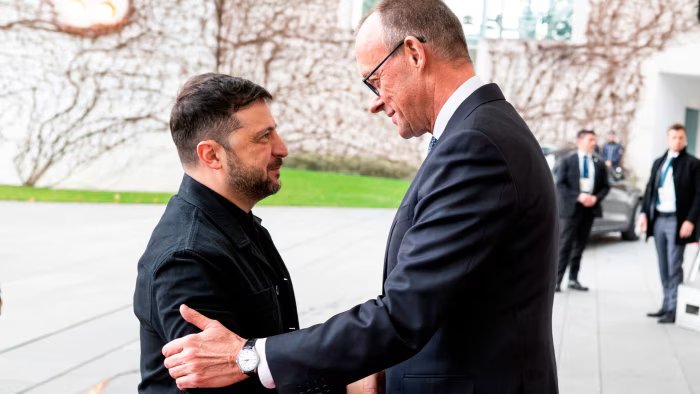
This article is an on-site version of our Europe Express newsletter. Premium subscribers can sign up here to get the newsletter delivered every weekday and fortnightly on Saturday morning. Standard subscribers can upgrade to Premium here, or explore all FT newsletters
Good morning, and welcome to a big week.
The EU’s 27 leaders will sit down for a hugely consequential summit on Thursday that could decide whether Ukraine goes bankrupt and loses the war, and whether the EU has any trade ambitions left.
Today, I explain the issues that will consume Brussels and EU capitals for the next five days, and our environment correspondent reports on tensions over methane regulations among energy ministers.
Do or die
Last week US President Donald Trump blithely dismissed Europe’s leaders as “weak”. Faced with stark choices, they now have a chance to demonstrate that’s not true, or have this week go down in infamy.
Context: Ukraine will go bankrupt without additional financial support. EU leaders are arguing over a “reparations loan” for Kyiv raised against immobilised Russian state assets. The EU also needs to finalise its Mercosur trade agreement, or accept that it cares more about French farmers than economic growth and geopolitical relevance.
Ambassadors from the EU’s 27 states were due to meet yesterday to discuss the latest draft of the loan, but their meeting was postponed until this evening, as officials fine-tuned the legal text.
Italy, Malta and Bulgaria joined Belgium on Friday in signalling queasiness about the loan. While they voted in favour of a preliminary step to potentially use the assets, all four countries urged the European Commission to “continue exploring and discussing alternative options”.
Commission officials exasperatedly stress that it’s a little late to be talking of “alternative options” when Ukraine needs tens of billions to be agreed by Friday night, or face near-certain meltdown when financial markets open on Monday.
“It’s time to stop talking and start doing,” said one senior EU diplomat. “This is Europe’s moment and we’re either going to stand up and be counted, or prove to the rest of the world that we’re only good at talking, arguing, and dividing ourselves.”
Meanwhile, peace talks continue in the background. Ukrainian President Volodymyr Zelenskyy yesterday dropped his demand to join Nato in exchange for security guarantees. Talks continue in Berlin today and European leaders meet tonight.
On the trade front, a failure to reach an agreement on the Mercosur trade deal, 25 years in the making, would mark a further nadir in EU governance, other diplomats warned.
France last night demanded a vote on the deal be delayed “to obtain legitimate protections” for farmers, fearing increased South American imports would hurt local products.
But diplomats say a delay beyond this week would kill the deal, and that further diluting the pact, which already includes safeguards requested by Paris, would cause it to unravel and make a mockery of the EU’s free trade ambitions.
“If we can’t agree on Mercosur we don’t need to talk about European sovereignty anymore,” said another senior EU diplomat. “If we cannot reach a trade deal with them, after a quarter of a century of trying, we might as well just give up.”
Chart du jour: Brussels effect

Once a model for the world, the EU’s rulemaking machine has faltered under the weight of its own ambition.
Methane monitoring
EU countries should clarify how they are going to enforce the bloc’s rules on damaging methane emissions, Brussels has said ahead of a meeting of energy ministers today, even though gas suppliers appear to be shrugging off concerns about the law, writes Alice Hancock.
Context: Methane is the second-biggest contributor to global warming after carbon dioxide and is a more potent greenhouse gas than Co2, although shorter-lived. The EU’s methane regulation requires importers to monitor for methane leaks in their supply chain, and eventually cap them.
US exporters in particular have been up in arms about the regulation, claiming that it will hit their ability to sell gas to the EU because of the complexity of supply chains on their side of the Atlantic, which is dominated by hundreds of small gasfields.
In a statement published at the weekend, 10 US and EU industry bodies called the requirements of the law “disproportionate” and asked for it to be simplified.
To quell concerns, the European Commission said in a note circulated to member states ahead of today’s meeting that in cases where information about methane levels was difficult to trace, member states could for instance require certificates.
It also said that member states should apply penalties judiciously and make sure they don’t impact security of supply.
But the concerns over the regulation may have been overblown: A new analysis by the Norwegian energy intelligence firm Rystad shows that by 2027, when the law starts to come into effect, there will be twice as much gas available that will meet the EU’s methane requirements as the bloc needs.
It noted that gas suppliers have continued to book volumes at EU terminals “suggesting their confidence to continue importing” despite their complaints.
What to watch today
-
European leaders meet to discuss Ukraine peace plans with Ukrainian and US officials in Berlin.
-
EU foreign affairs ministers meet in Brussels.
-
EU energy ministers meet.
Now read these
-
‘State within a state’: A Belgian bitcoin investor is buying up land on a Caribbean island to set up a libertarian community with its own court system.
-
‘Exporting chaos’: The threat posed by Moscow will persist until Vladimir Putin is “forced to change his calculus”, the new head of MI6 will warn.
-
FT View: The EU can make the single market work better by applying and enforcing the rules more than it is currently doing.
Recommended newsletters for you
Free Lunch — Your guide to the global economic policy debate. Sign up here
The AI Shift — John Burn-Murdoch and Sarah O’Connor dive into how AI is transforming the world of work. Sign up here
Are you enjoying Europe Express? Sign up here to have it delivered straight to your inbox every workday at 7am CET and on Saturdays at noon CET. Do tell us what you think, we love to hear from you: europe.express@ft.com. Keep up with the latest European stories @FT Europe