dailynewsnblog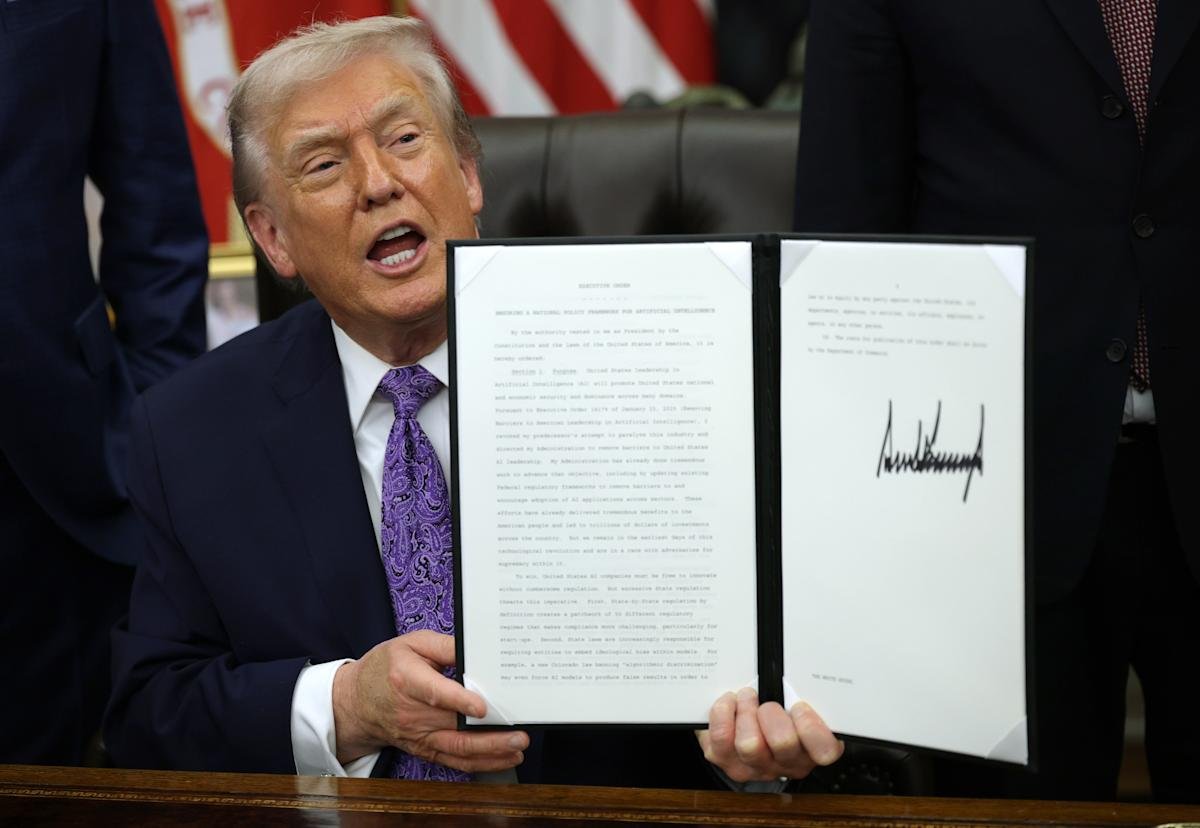
On Thursday evening, President Donald Trump signed an executive order calling for a single, nationwide regulatory framework governing artificial intelligence at the expense of the ability of different states to regulate the nascent technology. “To win, United States AI companies must be free to innovate without cumbersome regulation,” the order states. “But excessive State regulation thwarts this imperative.”
As was expected after a draft of the order leaked earlier this week, the centerpiece of the document is an “AI Litigation Task Force whose sole responsibility shall be to challenge state AI laws inconsistent” with the president’s policy vision. US Attorney General Pam Bondi has 30 days to create the task force, which shall meet regularly with the White House’s AI and crypto czar, David Sacks.
As laid out in the president’s AI Action Plan from July, the administration will also limit states with “onerous” AI laws from accessing federal funding. Specifically, the secretary of commerce will target funding available under the Broadband Equity Access and Deployment (BEAD) Program, a $42.5 billion effort to expand high-speed internet access in rural communities.
Advocacy groups were quick to criticize the president’s order. “This executive order is designed to chill state-level action to provide oversight and accountability for the developers and deployers of AI systems, while doing nothing to address the real and documented harms these systems create,” Alexandra Givens, president and CEO of the Center for Democracy and Technology, said in a statement provided to Engadget. “States that take steps to protect their residents from such harms should not be subject to threats of legal attacks; nor should the administration punish rural Americans by threatening to withhold funding for the broadband services that could connect them to AI in the first place.”
It’s worth noting President Trump’s previous attempts to curb the ability of states to regulate AI as they see fit has proven unpopular across the political spectrum. As part of his One Big Beautiful Bill, the president attempted to impose a 10-year moratorium on state-level AI regulation. That clause was eventually removed from the legislation in a decisive 99-1 vote by the Senate.