dailynewsnblog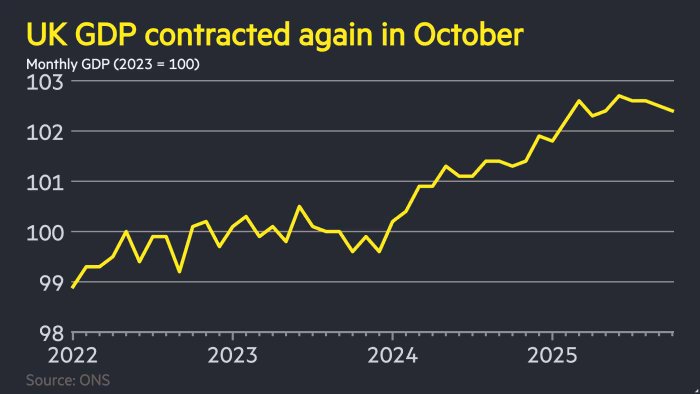
Unlock the Editor’s Digest for free
Roula Khalaf, Editor of the FT, selects her favourite stories in this weekly newsletter.
The UK economy shrank by 0.1 per cent in October, in a slowdown that both analysts and the UK statistics agency linked to concerns about Rachel Reeves’ tax-raising Budget.
The figures published on Friday compare with the 0.1 per cent expansion forecast by economists polled by Reuters, and underscore the challenges facing the country’s Labour government.
Although the government says growth is its priority, the UK economy has expanded in only one of the past seven months and is now no bigger than in May.
The Office for National Statistics, which issued the October figures, said that “businesses across the production, construction and services sectors” — ranging from computer programmers to real estate firms and employment agencies — had spent the month waiting for the outcome of the November 26 Budget.
Lindsay James, investment strategist at Quilter, added that “much” of the fall in output shown in Friday’s figures “can be put down to the Budget and the deterioration in consumer confidence, spending and business planning”.
Ultimately, Reeves announced £26bn in tax rises, which are expected to take the overall burden to a record 38 per cent of GDP by the end of the parliament in 2029.
James said that the GDP figures made a Bank of England interest rate cut next week “increasingly likely . . . but with inflation remaining persistently high, the pace at which subsequent cuts can be delivered remains questionable”.

The ONS also confirmed a 0.1 per cent GDP fall in September, when a cyber attack triggered a shutdown at Jaguar Land Rover, and said there had been no growth in August.
Suren Thiru, economics director at the Institute of Chartered Accountants in England and Wales, added that the “dismal” October GDP figures could be followed by a “similarly turbulent November”.
He said “the damage to business and consumer confidence from the frenzied speculation ahead of the Budget [was] likely to have frozen wider economic activity”. The after-effects from the Budget “may mean that the UK’s economic prospects are poorer over the near term”, he added.
For the August to October period, the economy also fell 0.1 per cent, the ONS data showed, the first fall on a three-month basis since the end of 2023.
Liz McKeown, ONS director of economic statistics, said that during that time, “production fell again and services growth stalled . . . continuing the recent trend of slowing in this sector”.
She noted that growth in rental, leasing and retail was offset by falls in the wholesale and scientific research sectors and that during October the car industry only made a “slight recovery”. Construction also shrank in the three months to October.

Overall growth has slowed steadily through the year, down from 0.7 per cent in the first quarter and 0.3 per cent in the second.
Even before Friday’s figures were released, markets attributed a high likelihood to a quarter-point interest rate cut to 3.75 per cent by the BoE next week, partly because of the country’s sluggish growth. Traders stuck to those bets after the data was published, giving a cut a 90 per cent probability.
The two-year gilt yield, which is sensitive to changes in rate expectations and moves inversely to prices, fell 0.02 percentage points to 3.76 per cent.
Philip Shaw, an economist at Investec, said it was “not totally clear” whether the recent weakness of the economy marked a fundamental downturn or just reflected a pre-Budget dip in spending.
But, he added: “Without a material upturn in momentum towards the end of the year, the economy will post a quarterly contraction in Q4 for the first time in two years.”
The Office for Budget Responsibility upgraded its UK growth forecast for 2025 to 1.5 per cent last month, compared with the 1 per cent it had expected in March.
The change was partly because of first-quarter growth that itself had been spurred by business activity ahead of US President Donald Trump’s tariffs and house purchases made before increases in stamp duty took effect.
However, the fiscal watchdog revised its 2026 growth expectations down 0.5 percentage points to 1.4 per cent.
The OBR expects quarterly growth to pick up “only gradually” in the near term because of continuing geopolitical uncertainty and subdued business and consumer confidence.
A Treasury spokesperson said the government was “determined to defy the forecasts on growth and create good jobs, so everyone is better off, while also helping us invest in better public services”, pointing to action to cut energy bills, reform the planning system and expand major airports.
Sir Mel Stride, Conservative shadow chancellor, described the fall in output as “extremely concerning” and “a direct result of Labour’s economic mismanagement”.
The OECD forecast this month that the UK economy would grow by 1.4 per cent this year, the second-fastest pace in the G7 countries after the US. But it also said growth would slow to 1.2 per cent next year, below the rates of Canada and the US.