dailynewsnblog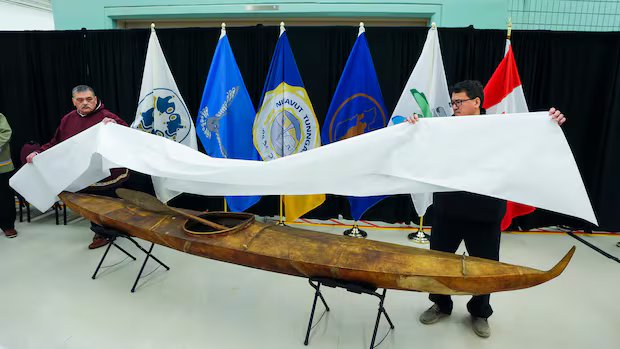

Listen to this article
Estimated 4 minutes
The audio version of this article is generated by text-to-speech, a technology based on artificial intelligence.
After their arrival on a snowy tarmac in Montreal Saturday, a number of Inuit objects among the 62 Indigenous cultural items repatriated from the Vatican were unveiled at the Canadian Museum of History on Tuesday.
For a century, the items were held in Vatican museums and vaults until efforts to return them to their original communities began in earnest following Pope Francis’s visit to Canada in 2022.
They are among thousands of objects originally sent to Rome between 1923 and 1925 for a world exhibition organized by Pope Pius XI, who called on Catholic missionaries to send materials from Indigenous people around the world.
The 1925 exhibition Vatican Missionary Exposition featured, by some accounts, 100,000 relics from Africa, the Americas, Asia and Oceania.
In a warehouse of the museum in Gatineau, Que., on Tuesday, Natan Obed, president of Inuit Tapiriit Kanatami, stood before an Inuvialuit kayak used to chase beluga whales.
The kayak, hand-built from driftwood, sealskin and sinew, is one of a dozen or so items of Inuit provenance in the collection and one of only five such kayaks known to still exist, according to Obed.
“The idea that we can examine this kayak, we can appreciate it, understand it more, will also lead to the reintroduction of kayak making,” Obed said Saturday.
On Tuesday, he called the item “the centrepiece” of the original repatriation efforts. He explained that it had for a long time been the only item Indigenous groups had seen prior to the Catholic Church identifying the more than five dozen others from First Nations, Inuit and Métis.
It will take time for Indigenous elders and experts to examine the items and determine where they came from and to whom they belonged. The Canadian Museum of History has agreed to safely store them throughout that process, Obed explained.
It’s not entirely clear how the kayak — or the other items for that matter — ended up in the hands of the Vatican, he said.

“You’ll have to imagine that in the 1920s, this particular kayak would have been essential to the wellbeing of a family and of a community,” Obed said, calling it “one of the most essential tools” of an Inuit hunter.
Obed said some museum workers or curators may have bristled at the sight of Inuit touching the kayak and its paddle with bare hands as it was unboxed.
“I think this is also something as a part of reconciliation,” he said. “The norms that you have for you institutions are not necessarily the norms that we have in our society about how we respect our living history, our items of cultural significance. The ways in which we connect are often very literally physically — to touch and to feel.”

Saturday, Indigenous leaders said that while the 62 items’ return was an important part of the repatriation process, they expect that process to continue.
“Today is another important step, but it’s far from the end,” said Cindy Woodhouse Nepinak, national chief of the Assembly of First Nations.
“We recognize that reconciliation is not a single event but a long journey, one that requires humility, perseverance and above all the willingness to listen,” Archbishop of Vancouver Richard Smith, representing the Canadian Conference of Catholic Bishops, said at the news conference.