dailynewsnblog
Looking ahead, if the information removal techniques receive further development in the future, AI companies could potentially one day remove, say, copyrighted content, private information, or harmful memorized text from a neural network without destroying the model’s ability to perform transformative tasks. However, since neural networks store information in distributed ways that are still not completely understood, for the time being, the researchers say their method “cannot guarantee complete elimination of sensitive information.” These are early steps in a new research direction for AI.
Traveling the neural landscape
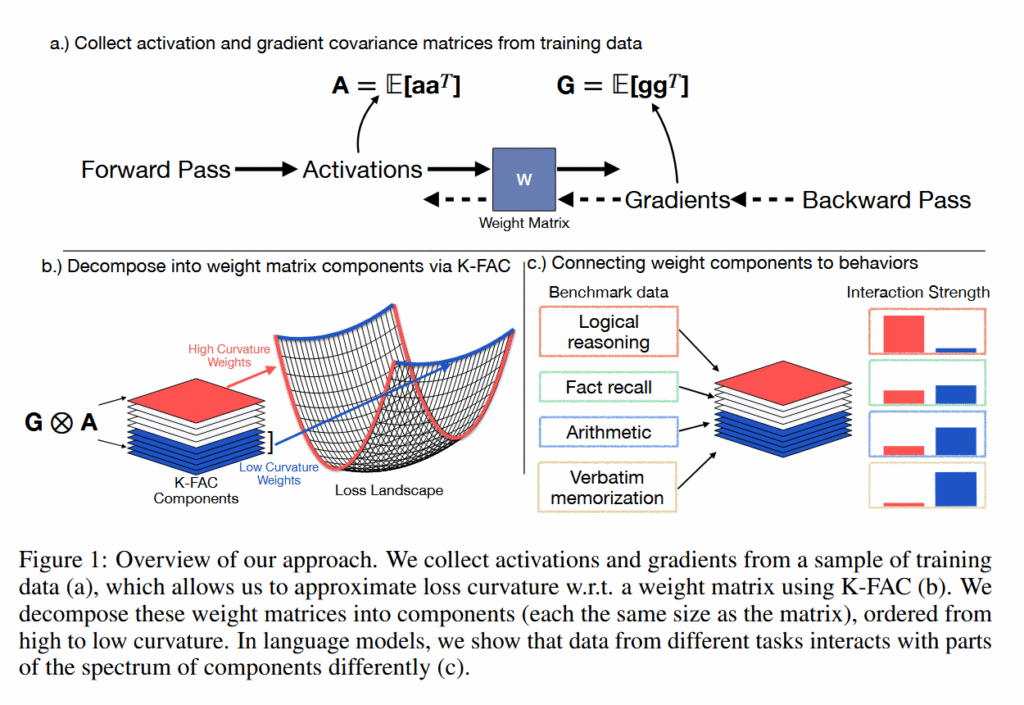
To understand how researchers from Goodfire distinguished memorization from reasoning in these neural networks, it helps to know about a concept in AI called the “loss landscape.” The “loss landscape” is a way of visualizing how wrong or right an AI model’s predictions are as you adjust its internal settings (which are called “weights”).
Imagine you’re tuning a complex machine with millions of dials. The “loss” measures the number of mistakes the machine makes. High loss means many errors, low loss means few errors. The “landscape” is what you’d see if you could map out the error rate for every possible combination of dial settings.
During training, AI models essentially “roll downhill” in this landscape (gradient descent), adjusting their weights to find the valleys where they make the fewest mistakes. This process provides AI model outputs, like answers to questions.
Credit:
Merullo et al.
The researchers analyzed the “curvature” of the loss landscapes of particular AI language models, measuring how sensitive the model’s performance is to small changes in different neural network weights. Sharp peaks and valleys represent high curvature (where tiny changes cause big effects), while flat plains represent low curvature (where changes have minimal impact).
Using a technique called K-FAC (Kronecker-Factored Approximate Curvature), they found that individual memorized facts create sharp spikes in this landscape, but because each memorized item spikes in a different direction, when averaged together they create a flat profile. Meanwhile, reasoning abilities that many different inputs rely on maintain consistent moderate curves across the landscape, like rolling hills that remain roughly the same shape regardless of the direction from which you approach them.