dailynewsnblog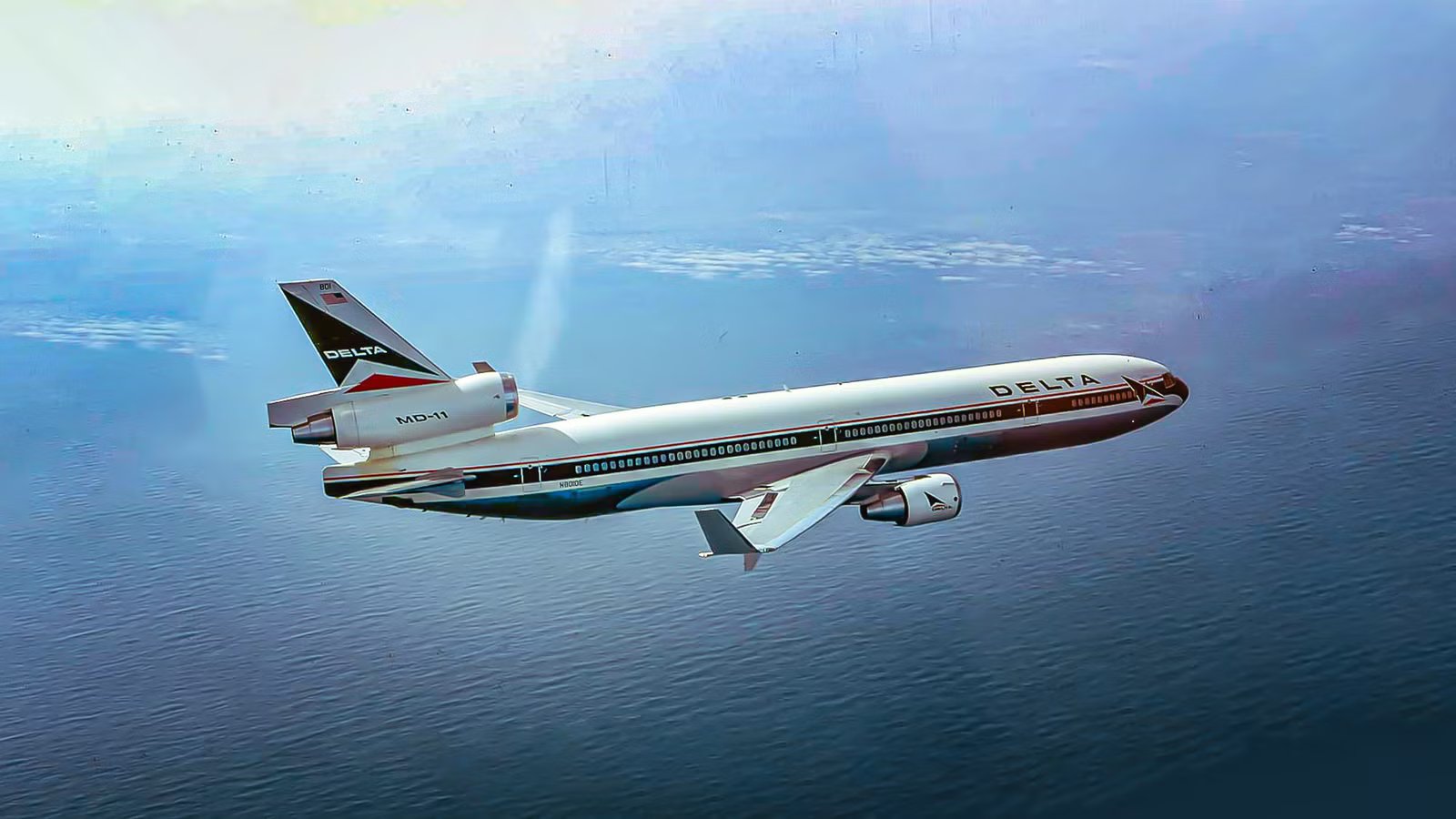
The McDonnell Douglas MD-11 was aviation’s last major three-engine aircraft, and it was a late Cold War-era design that entered service just as airline economics began shifting decisively toward long-range twin-engine aircraft. Ultimately built as a modernized evolution of the DC-10, the MD-11 brought a stretched fuselage, winglets, updated avionics, and a two-pilot cockpit to a platform that carriers already understood operationally. On paper, it promised more range and better fuel burn than earlier widebodies while preserving the cargo volume and runway performance airlines prized for long-haul missions. In practice, the MD-11 became a transitional aircraft. Several major passenger airlines adopted it in the early 1990s to bridge growth and fleet-renewal cycles.
Then, they mostly retired the aircraft sooner than expected as ETOPS-capable twin-engine aircraft improved, and fuel prices became less forgiving for three-engine aircraft. Nonetheless, the jet’s strong payload and structural durability helped it remain highly valued in freight service long after many passenger operators bowed out of operations. The seven airlines that we will discuss, which span across North America, Europe, and Asia, highlight the jet’s full arc, including early enthusiasm for the type, distinctive network capabilities, and retirements that often aligned with broader shifts toward Boeing 777s, Airbus A330s, and A340s. We use fleet data made available to Simple Flying by aviation database ch-aviation for this analysis.
American Airlines
Fleet Size: 18

 American Airlines used the McDonnell Douglas MD-11 as a high-capacity long-range workhorse during a decade when global networks were expanding and widebody utilization mattered just as much as raw range. The aircraft fit American’s need for an efficient heavy-lifting jet on international routes without stepping up to the use of a Boeing 747.
|
MD-11 Milestone |
Year |
|---|---|
|
Service Introduction |
1991 |
|
Retirement |
2001 |
In many ways, the MD-11 was American’s bridge between the classic widebody era and the coming dominance of long-range twin-engine models. It offered modern cockpit commonality improvements, strong cargo capability, and the kind of passenger volume that made sense on trunk routes and peak-demand schedules.
But the economics that defined the 2000s (fuel sensitivity, fleet simplification, and the steady improvement of twin-engine performance) worked against tri-jets across the industry. American’s MD-11s ultimately became emblematic of that pivot, as they are valuable when capacity and range were the priority. They became increasingly out of step with the cost and flexibility advantages of newer twin-engine models.
China Airlines
Fleet Size: 4

For China Airlines, the McDonnell Douglas MD-11 represented a targeted widebody solution rather than the centerpiece of a long-haul fleet. The carrier operated just a few models, with the deliberate purpose of supporting long-haul capabilities by adding peak capacity where demand warranted. The airline operated this jet through a contract agreement with Mandarin Airlines.
|
MD-11 Milestone |
Year |
|---|---|
|
Service Introduction |
1992 |
|
Retirement |
2002 |
The carrier also sought to leverage the aircraft’s combination of passenger volume and belly cargo potential. In the 1990s, many Asian carriers were balancing rapid traffic growth with the practical realities of fleet complexity and capital allocation. A limited MD-11 fleet could deliver meaningful network lift without committing an airline to a large, single-type widebody strategy.
The airline’s relatively short period of MD-11 passenger operations mirrors a broader industry pattern, with long-haul carriers retiring three-engine aircraft once capable twin-engine programs matured, and route economics began to tighten. China Airlines’ MD-11 does read like a valuable example of how a capable aircraft can be adopted for a specific purpose, but then transitioned once the market and technology shift in a fundamental manner.

The Striking Differences Between The McDonnell Douglas DC-10 & MD-11
Discover how the DC-10 and MD-11 reshaped wide-body design, defined the trijet era, and why their legacy still lingers in today’s skies.
Delta Air Lines
Fleet Size: 17

The  Delta Air Lines MD-11 story is one of both ambition and longevity, at least by the standards of three-engine passenger aircraft. With the jet entering service in 1990, the aircraft provided Delta with a modern widebody tool at a time when international competition and route opportunities continued to expand. The MD-11’s appeal to a network carrier like Delta was relatively straightforward, as the plane can efficiently transport a large number of passengers, carry a substantial amount of cargo, and do so with a flight deck and systems architecture that improved upon that of older widebodies.
Over time, however, these same forces encouraged the industry to move away from three-engine behemoths and to standardize fleets and decision-making around capable, fuel-efficient models. Twinjets quickly proved they could deliver a comparable range with lower operating complexity, and the MD-11 quickly became a specialized asset rather than the default choice of operators.
|
MD-11 Milestone |
Year |
|---|---|
|
Service Introduction |
1990 |
|
Retirement |
2005 |
Delta Air Lines kept the type in service through 2005, significantly later than most of its peers, a move that suggests it was still working operationally on the right missions. Eventually, simplification and fuel economics made a stronger case for the aircraft to be retired, and the airline began to focus almost exclusively on long-haul twinjets.
Finnair
Fleet Size: 7

Finnair’s MD-11 operation stands out for how well it has matched the airline’s overall geographic logic. With a Helsinki-based network naturally lending itself to long-haul flying where aircraft utilization is high, and stage lengths that reward efficient cruise performance, the jet could really shine when it was deployed effectively.
With seven aircraft, Finnair operated enough scale to carefully integrate the type meaningfully into long-haul planning while still keeping overall fleet complexity very manageable. The MD-11 helped define an era in which Finnair strengthened its intercontinental identity and relied on widebodies that could combine passenger traffic with robust cargo carriage.
|
MD-11 Milestone |
Year |
|---|---|
|
Service Introduction |
1990 |
|
Retirement |
2010 |
This being said, by the time the late 2000s came around, competitive pressure and fuel economics increasingly favored newer twinjets and more standardized widebody families. Finnair’s 2010 retirement reflects a common inflection point, as next-generation aircraft made long-haul operations more fuel-efficient and predictable. The jet’s departure marked a clean transition into the modern twin-engine era.

Is It True That The McDonnell Douglas MD-11’s Tail Engine Has A Fan?
Surprising facts about the MD-11’s iconic rear engine and how it breaks from trijet tradition.
Garuda Indonesia
Fleet Size: 5

Garuda Indonesia’s period of MD-11 operations was comparatively brief. The MD-11 was a capable long-haul aircraft, but it also demanded the kind of stable economic cycles that can make it difficult to sustain profitable operations over time. The MD-11 is gas-guzzling and difficult to maintain, and it was especially so in the environment of the late 1990s.
The airline operated just five of the type, using it to serve specific long-haul and high-capacity needs, likely aiming to modernize and elevate its international offering during the early to mid 1990s. Small fleets, however, can be unforgiving as training costs and scheduling resilience become more volatile.
|
MD-11 Milestone |
Year |
|---|---|
|
Service Introduction |
1991 |
|
Retirement |
1998 |
The broader industry soon began to favor simpler, twin-engine long-haul jets, and that pressure was amplified for carriers with small and expensive MD-11 fleets. By the time 1998 came around, the operational and financial logic of a small tri-jet fleet was incredibly difficult to defend. The airline exited the program quickly.
Japan Airlines
Fleet Size: 10

Japan Airlines’ MD-11 fleet exemplified how major network carriers experimented with right-sized long-haul capacity in the late 1990s. With ten jets, JAL had meaningful scale, more than enough to easily embed the MD-11 into scheduling and overall product planning, all while still maintaining flexibility to deploy larger jumbo jets or smaller widebody models when needed.
|
MD-11 Milestone |
Year |
|---|---|
|
Service Introduction |
1993 |
|
Retirement |
2004 |
The McDonnell Douglas MD-11 offered a strong blend of passenger capacity and volume, both of which are traits that align well with the hub-to-hub flying and high demand of international corridors. Nonetheless, JAL’s MD-11 retirement in 2004 reflects how quickly the long-haul landscape evolved. As twin-engine models gained range and efficiency and airlines prioritized operational simplicity, the aircraft’s operational use case weakened.
The MD-11 served for JAL as a strategic tool for an era of network building, but not much beyond then. It was retired once it was proved to the carrier that widebody twinjets were the solution for their long-haul network.

Is The McDonnell Douglas MD-11 Done Flying For Good?
The aircraft was once a long-haul workhorse.
KLM Royal Dutch Airlines
Fleet Size: 10

KLM is arguably the passenger MD-11’s most iconic operator, both for the scale of its overall commitment to the jet and for how long it managed to keep the type in front-line service. Operating ten jets through 2014, KLM demonstrated that the jet could be a reliable and high-performing asset when it was integrated into a network with disciplined overall momentum, consistent utilization, and route structures that rewarded the plane’s strengths.
The airline used the jet as a distinctive capacity tool, as it is big enough to matter on trunk markets and flexible enough to rotate through a variety of long-haul missions without requiring Boeing 747-level demand every day. The jet’s long tenure also highlights a key truth about aircraft economics.
|
MD-11 Milestone |
Year |
|---|---|
|
Service Introduction |
1993 |
|
Retirement |
2014 |
This aircraft offered a few key benefits for the operator. For starters, it had already been paid down, was a well-understood kind of plane, and it was supported by a mature maintenance program. Eventually, even a well-run MD-11 operation faced the same industry headwinds, with twin-engine jets increasingly becoming more and more appealing.