dailynewsnblog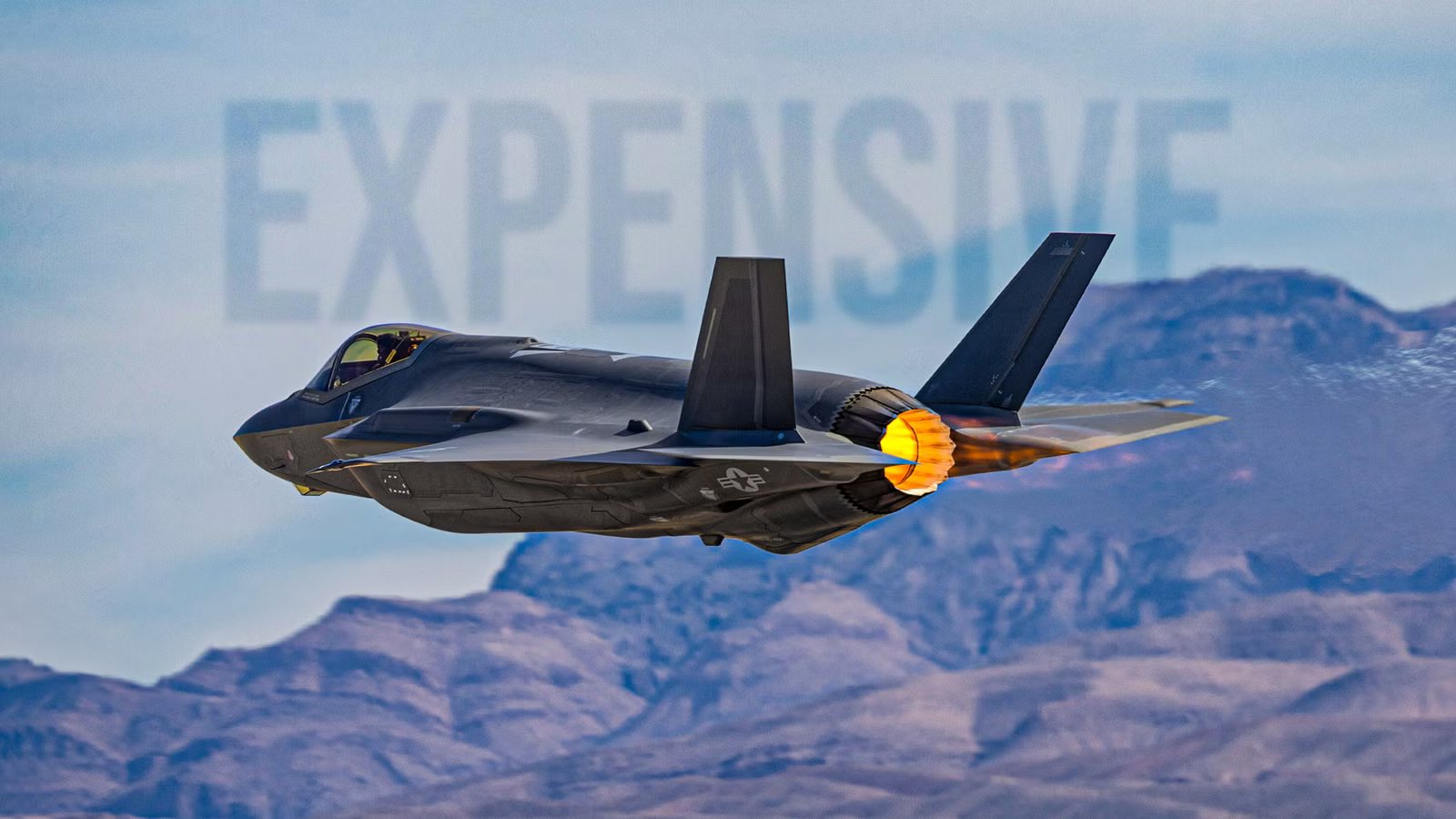
The F-35, particularly the F-35A variant, is not very expensive to buy, but it is expensive to maintain and operate. The flyaway cost of an F-35A can be as low as $82 million, which is lower than many of the world’s 4th-generation fighter jets like the Boeing F-15EX, Dassault Rafale, and Eurofighter Typhoon. But the total ownership costs can be far larger than those of legacy jets. It is largely nonsensical to compare the cost of an F-35 with the cost of a lower-end, lighter fighter like the Saab Gripen. They are different machines built for different missions.
There are many reasons why the sustainment costs of the F-35 are high, although these expenses are often exaggerated due to the F-35’s high profile. For example, the F-35, like almost all fighter jet programs, has faced delays, and these have been highly reported. The Gripen’s seven-to-eight-year delay in its Brazilian contract is rarely reported. Here are some things to know about why the F-35 is so expensive to sustain, even if the flyaway costs are now surprisingly cheap.
6
Provides Unique Capabilities
From $82 million flyaway cost

When discussing the F-35’s costs in relation to other jets, it’s important not to compare apples with oranges. The F-35 is in a capability class of its own, and one F-35 does not equal one 4th-generation fighter jet. The Rafale and Eurofighter Typhoon can be broadly compared, as can the Saab Gripen E with the F-16 Block 70, but there is simply no comparison that is not horribly misleading for the F-35. There is no other stealth fighter on the market with the sensor fusion and ability to penetrate enemy air defenses and dismantle them as the F-35 can.
When considering F-35 costs, it is important to keep several things in mind. Not only are F-35 operators able to carry out missions no one else is able to, but there are many unseen savings and benefits. According to the Swiss Government, while the F-35 has a higher per-hour flight cost relative to other fighter jets, it requires “about 50% fewer take-offs and landings” relative to its current legacy Hornets. The F-35 networks and offers a ‘God’s-eye view’ to other fighter jets, like Typhoons, boosting their capability.
The F-35 means it is less imperative to operate electronic warfare/AWACS aircraft with them. For example, Canada and Finland considered F/A-18 Super Hornets paired with EA-18G Growlers, Saab Gripens paired with Saab GlobalEyes, and F-35s alone. A leaked Canadian report shows the F-35 won by a mile. Additionally, to achieve a required capability, air forces typically need to purchase fewer F-35s relative to the number of 4th-generation jets they would need to otherwise purchase.
5
Support Infrastructure
Approx. $10-15 million for F-35 Full Mission Simulator

When any air force purchases any fighter jet, it is not just purchasing an aircraft, but an entire ecosystem for sustaining that jet. Older 4th-generation fighter jets operate more as stand-alone aircraft, although this changes to some degree as they are upgraded. By contrast, the F-35 is designed from the ground up as a node in a much larger ecosystem. An air force purchasing a jet also needs to purchase a classified cloud and data fusion architecture.
The F-35 requires different supporting ground infrastructure. Air forces may need to build new climate-controlled hangars for coating work, specialized repair facilities for radar-absorbent materials, precision measurement tools, and much more. Other jets like F-16s and F/A-18s can make do with fairly basic shelters. An air force upgrading from an F-15C to an F-15EX or from a legacy Hornet to a Super Hornet may be able to mostly use their existing infrastructure.
Operating bases need secure vaults for mission data files. Those operating naval F-35s (F-35Bs and F-35Cs) may need to modify their aircraft carriers and amphibious assault ships to tolerate the hotter exhaust and adjust their hangars to fit the larger aircraft. The list of supporting infrastructure changes goes on. While all this is largely true for all modern fighter jets, the scale, specialization, and cost are typically greater for the more advanced F-35.

How Many F-35s Are In Service With The US Air Force?
The US Air Force has over 400 and perhaps closer to 500 F-35s in inventory, while Lockheed has delivered over 1,000 F-35s in total.
4
Specialized Pilots & Maintainers
Approx. $15.7 million pilot training

As already suggested, air forces will generally find it straightforward to retrain their pilots and maintainers to transition from an aircraft like a legacy Hornet to a Super Hornet. But this is not the case with the F-35; it is a completely different machine from all that came before it. Air forces need to purchase expensive, high-fidelity simulators, integrated training networks, and more.
According to some estimates, F-35 pilots are one of the most expensive to train in the US Air Force, perhaps behind only the F-22’s pilots. Adjusting a 2018 report for military-indexed inflation, it may cost around $15.7 million to train a basic F-35A pilot. F-35 training is less about raw flying skill alone, with more emphasis on information management and systems understanding.
Just as important as pilots are the maintainers. For these, an air force needs to establish a new training pipeline for software diagnostics, stealth repair, advanced avionics, and more. Maintainers are not just trained in a one-time qualification; it is a continuous, software-driven process. All this adds up and makes operating the F-35 expensive.
3
Weapons Integration & Compatibility
Approx. $1.37 million to $2.4 million per AIM-120 AMRAAM

As per USAF, another source of expense is that the F-35 is certified to carry only certain types of munitions. Again, this may be common on some other modern fighter jets, but it may be more acute with the F-35. Modern high-end munitions are exquisite computer systems in their own right, and the US tightly controls what missile programs can integrate with the F-35’s computers.
Air forces operating the F-35 are not able to jerry-rig other munitions to the F-35, as Ukraine did with British help with its old Su-24s to carry Storm Shadow missiles. Additionally, munitions need to fit into the F-35’s internal weapons bay. Many legacy munitions for F-16s or other older jets just don’t fit the F-35 or would downgrade the jet’s stealth if they were to be carried externally.
This all means that air forces often can’t use their stockpiles of munitions and need to procure new and often exquisite munitions. Example integrated US munitions include the AIM-120 AMRAAM, the AIM-9X Sidewinder, and the GBU-53/B StormBreaker. That said, the US does allow some foreign munitions to be integrated with the European MBDA Meteor air-to-air missile being integrated now.
2
Longer Planned Service
11 more years of sustainment

There are often disingenuous headlines that say the program cost of the F-35 has increased. One major example came in 2024, when the US confirmed it would keep the Lightning II in operation for longer. The US decided to sustain them for another 11 years, to 2088, beyond the previously planned 2077. This increased the F-35’s estimated lifecycle costs, as would be expected.
It is also worth pointing out that the F-35 may be the final mass-produced US fighter jet ever made. Currently, the US is envisioning a future of Manned-Unmanned Teaming (MUM-T) with F-35s paired with advanced loyal wingman drones. But as the century rolls on, unmanned combat aircraft are expected to become more capable and take over increasing roles from manned fighters. Future 6th-generation fighter jets are expected to be much more expensive than the F-35.
The F-35 is currently being delivered at a rate about equal to all other frontline US, European, and Russian fighter jets combined. A total of over 1,310 F-35s have been produced, with around 156 expected to be delivered annually. Production is expected to stretch into the 2040s. By contrast, the US Air Force is now rushing the 6th-generation F-47, for which it only currently intends to purchase around 185+ examples. More F-35s were delivered in 2025 (191 deliveries) than the entire currently-floated F-47 procurement. It’s unclear how many F/A-XXs the Navy wants to produce, but it seems like they will also be in historically modest numbers.

Why The F-35 Is The US Air Force’s Most Important Fighter Jet
Discover why the F-35 is the US Air Force’s most critical fighter — from stealth and sensors to strategy, readiness, and future upgrades
1
Constant Upgrades & Improvements
Block 4 upgrade costs balloon well above early estimates

Another major factor driving the F-35’s cost is development. The F-35 doesn’t reach the point where Lockheed Martin has the perfect design and sticks with it; it is constantly being redesigned and upgraded. One of the issues was that Lockheed promised future capabilities that it wasn’t able to deliver on then. This led to the first examples being purchased without some promised features, with planned upgrades later.
It should be pointed out that this is not uncommon. For example, the Russian Su-57 is still being delivered with legacy unstealthy engines, and Russia is only now testing the new engines. The F-35 is not a mature aircraft; it is still building up and working up to the aircraft it is intended to be. The latest upgrade, the Technology Refresh 3, ran into a range of issues that interrupted deliveries. But now that it’s done, the road is paved for Block 4.
Lockheed is busy working on its Block 4 upgrade, which will significantly boost its capabilities. It would be cheaper to operate an aircraft mostly frozen in time technologically, but that is not what the F-35 is intended to be. It is intended to be the most advanced fighter jet in the world and stay at the cutting edge. That requires continuous improvements and upgrades, and that is expensive.