dailynewsnblog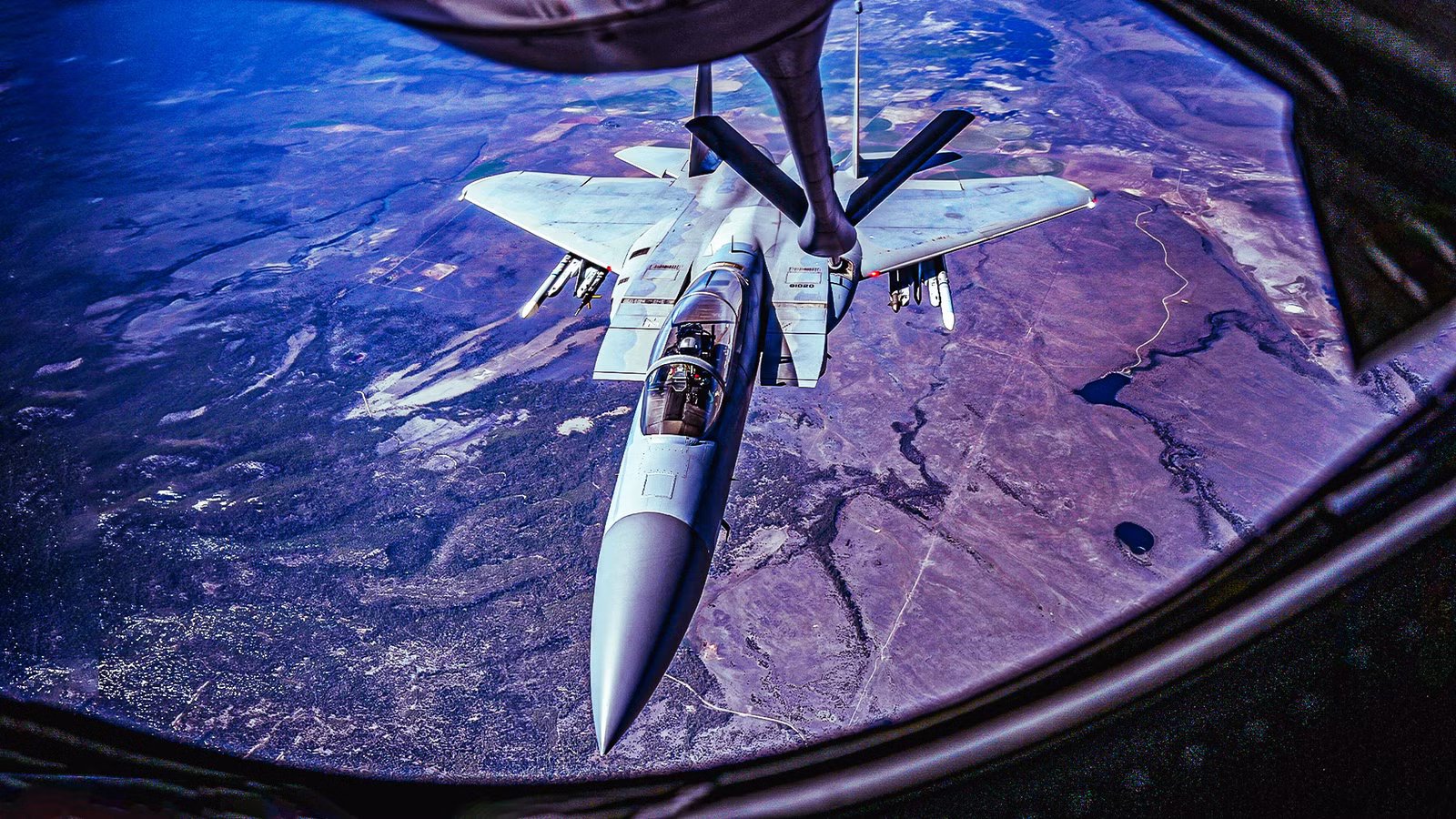
In modern aerial warfare, inflight refueling has become a critical capability for many fighter jets, allowing aircraft to extend their range, stay on station longer, and respond to dynamic mission requirements without returning to base. Fighters with refueling capability can conduct long-range strikes, maintain air superiority over larger distances, and support expeditionary operations, giving military planners far greater flexibility in deploying air power.
As technology and tactics evolve, the ability to refuel in the air is no longer just an advantage. Rather, it’s often a necessity for operational effectiveness and flexibility. Not all fighter jets are equally suited for aerial refueling, however. Differences in airframe design, refueling system compatibility, and endurance determine which aircraft can fully take advantage of tanker support.
Join us as we explore six fighter jets that stand out for their ability to integrate with in-flight refueling operations, and the advantage they present over rivals by having this capability.
1
F/A-18 Super Hornet
Refueling Flexibility & Extended Carrier Operations

The F/A-18 Hornet, and its larger variant, the Super Hornet, are twin-engine multirole fighters developed by  Boeing (originally McDonnell Douglas) for the US Navy and Marine Corps. The Hornet first flew in 1978 and has since been a versatile platform for air-to-air combat, ground attack, and reconnaissance missions. The Super Hornet was introduced in the late 1990s, and it features a larger airframe, increased payload capacity, and upgraded avionics.
Equipped for probe-and-drogue in-flight refueling, both the Hornet and Super Hornet can receive fuel from US Navy tankers such as the KC-130 or KC-46. This capability extends their combat radius significantly, allowing for longer patrols and extended strike missions without returning to the carrier or base. The Super Hornet’s larger fuel capacity, combined with refueling capability, enables sustained operations over long distances, including expeditionary missions far from friendly bases.
The aircraft’s multirole flexibility is complemented by advanced radar and weapons systems. The Super Hornet can carry a variety of air-to-air and air-to-ground ordnance, including AIM-120 AMRAAMs, JDAMs, and laser-guided bombs, while operating seamlessly with naval assets. When paired with in-flight refueling, these capabilities allow the F/A-18 family to maintain a persistent presence in contested airspaces, providing both offensive and defensive power for carrier strike groups.
2
F-16 Fighting Falcon
Lightweight Agility With Long-Range Reach

The F-16 Fighting Falcon is a single-engine multirole fighter developed by General Dynamics (now Lockheed Martin) and introduced in 1978. With over 4,600 units built, the F-16 is one of the most widely used fighters worldwide, operated by more than 25 countries. It is known for its agility, lightweight airframe, and versatile combat capabilities, performing air superiority, ground attack, and close air support missions with equal proficiency.
The F-16 can refuel using both boom and probe-and-drogue methods, depending on the operator and available tanker aircraft. With aerial refueling, its combat radius, which is normally around 340 miles (547km) for a typical mission, can extend to over 1,000 miles (1609km), depending on various outside factors. This capability allows the F-16 to reach distant targets, perform extended patrols, and redeploy quickly without relying solely on forward bases.
Despite its smaller size compared to twin-engine fighters, the F-16 carries a formidable weapons load and advanced avionics, making it one of the most capable fighter jets. It can be equipped with AIM-120 AMRAAMs, AGM-65 Mavericks, precision-guided bombs, and an M61 Vulcan cannon. When combined with in-flight refueling, the F-16’s flexibility and reach make it an extremely effective platform for rapid-response missions and coalition operations.

Top 5: The World’s Most Advanced Fighter Jets
The US arguably has the most capable fighter jets, with China, Europe, and Russia also boasting advanced fighters.
3
Sukhoi Su-30
Long-Endurance Multirole Capability

The Su-30 is a twin-engine, multirole fighter developed by Russia’s Sukhoi Design Bureau as part of the Flanker family. Introduced in the late 1990s, the Su-30 is a heavy fighter with excellent range, payload capacity, and maneuverability, capable of air-to-air combat as well as precision strikes. Variants of the Su-30, such as the Su-30MKI operated by India, feature thrust-vectoring engines and advanced avionics, enhancing maneuverability and combat effectiveness.
It is compatible with probe-and-drogue in-flight refueling, typically using the Russian Il-78 tanker. This capability allows the Su-30 to maintain extended air patrols, conduct long-range strike missions, and operate far from its home base without sacrificing fuel reserves. The combination of high endurance and refueling makes the Su-30 suitable for both defensive air superiority roles and expeditionary strike operations.
The Su-30 carries a heavy weapons payload, including long-range air-to-air missiles, precision-guided bombs, and a 30mm GSh-30-1 cannon. It also features advanced radar and electronic warfare systems, making it a formidable platform in both offensive and defensive scenarios. Refueling in-flight amplifies these capabilities by increasing mission duration, allowing it to stay on station longer or reach targets at extended ranges.
4
Dassault Rafale
NATO-Compatible Refueling For Extended Missions

The Dassault Rafale is a French twin-engine multirole fighter designed by Dassault Aviation, first flying in 1986 and entering service in 2001. It is designed for a wide range of missions, including air superiority, ground attack, reconnaissance, and nuclear strike. The Rafale features advanced avionics, sensor fusion, and a delta-canard wing design, giving it excellent maneuverability and versatility in both land-based and carrier operations.
This French fighter jet supports probe-and-drogue in-flight refueling, and it is also compatible with NATO tankers, which allows it to extend operational range and stay on station longer during missions. This capability is crucial for France’s expeditionary operations, enabling the Rafale to project air power across Africa, the Middle East, and other theaters far from home bases. Refueling ensures that the aircraft can complete long-duration missions without returning to land, increasing operational effectiveness.
Equipped with a wide variety of weapons, the Rafale can carry MBDA Meteor and MICA missiles, laser-guided bombs, and SCALP cruise missiles. Its advanced radar and electronic warfare systems, combined with in-flight refueling capability, allow it to operate effectively in complex combat environments. The Rafale’s versatility and extended reach make it one of the most capable multirole fighters in NATO service.
5
HAL Tejas
Indigenous Fighter With Enhanced Operational Reach

The HAL Tejas is India’s indigenous lightweight, single-engine multirole fighter, developed by Hindustan Aeronautics Limited. Introduced in 2015, the Tejas is designed for air-to-air combat, ground attack, and reconnaissance missions. Its compact size, agility, and modern avionics suite make it suitable for operations from shorter runways, while its indigenous development enhances India’s self-reliance in defense technology.
The Tejas is equipped for probe-and-drogue in-flight refueling, which significantly extends its limited combat radius of around 290 miles (466km). With aerial refueling, the Tejas can participate in longer patrols, cross-border missions, and joint operations alongside heavier multirole fighters. This capability compensates for its smaller internal fuel capacity and allows it to integrate effectively into larger task forces.
|
Parameter (HAL) |
Value |
|---|---|
|
Length |
43 feet, 4 inches (13.2 meters) |
|
Wingspan |
26 feet, 11 inches (8.2 meters) |
|
Height |
14 feet, 5 inches (4.4 meters) |
|
Wing area |
413 feet² (38.4 meters²) |
|
Maximum take‑off mass (MTOW) |
29,762 lb (13,500 kg) |
|
Engine |
1 × General Electric F404‑IN20 afterburning turbofan |
|
Engine thrust (afterburner) |
19,000 lbf (85 kN) |
|
Maximum speed |
1,228–1,230 mph (~Mach 1.6–1.8 / 1,975–1,980 km/h) |
|
Service ceiling |
52,500 feet (16,000 meters) |
|
Combat radius |
310 mi (500 km) with drop tanks, depending on loadout |
|
Internal fuel capacity |
5,420 lb (2,458 kg), plus optional external tanks |
|
Payload / External stores capacity |
Up to 11,680 lb (5,300 kg), 9 hardpoints |
The Tejas can carry a variety of weapons, including Python and Derby missiles, laser-guided bombs, and a 23mm cannon. It also features modern avionics, including an Israeli-sourced radar and electronic warfare systems. In-flight refueling enhances the Tejas’ operational flexibility, making it a viable option for sustained missions and extended air defense coverage in a range of regional operations.

Explained: The 6 Generations Of Fighter Jets
There are six generally accepted generations of fighter jets, with each leap frogging the previous generation.
6
F-35 Lightning II
Stealth & Longevity In Global Operations

The F-35 Lightning II is a fifth-generation stealth multirole fighter developed by Lockheed Martin, first flying in 2006 and entering service in 2015. Designed for air superiority, strike, and intelligence-gathering missions, it features low-observable stealth technology, advanced sensor fusion, and networked combat capabilities. The F-35 comes in three variants: F-35A (conventional takeoff), F-35B (STOVL), and F-35C (carrier-based).
The F-35 supports both boom (US) and probe-and-drogue (allied) refueling systems, allowing long-duration missions without compromising stealth or situational awareness. Aerial refueling extends its combat radius from roughly 590 miles (949 km) to over 1,200 miles (1931 km), depending on mission profile, enabling global strike and reconnaissance operations. This capability is critical for maintaining air superiority and force projection in distant theaters.
Equipped with a wide array of weapons, including AIM-120 AMRAAMs, JDAMs, and internal stealth payloads, the F-35 combines firepower with advanced avionics and sensor systems. Its inflight refueling capability allows pilots to stay on station longer, strike targets at extended ranges, and operate in coalition networks, maximizing the effectiveness of both stealth and multirole functionality.