dailynewsnblog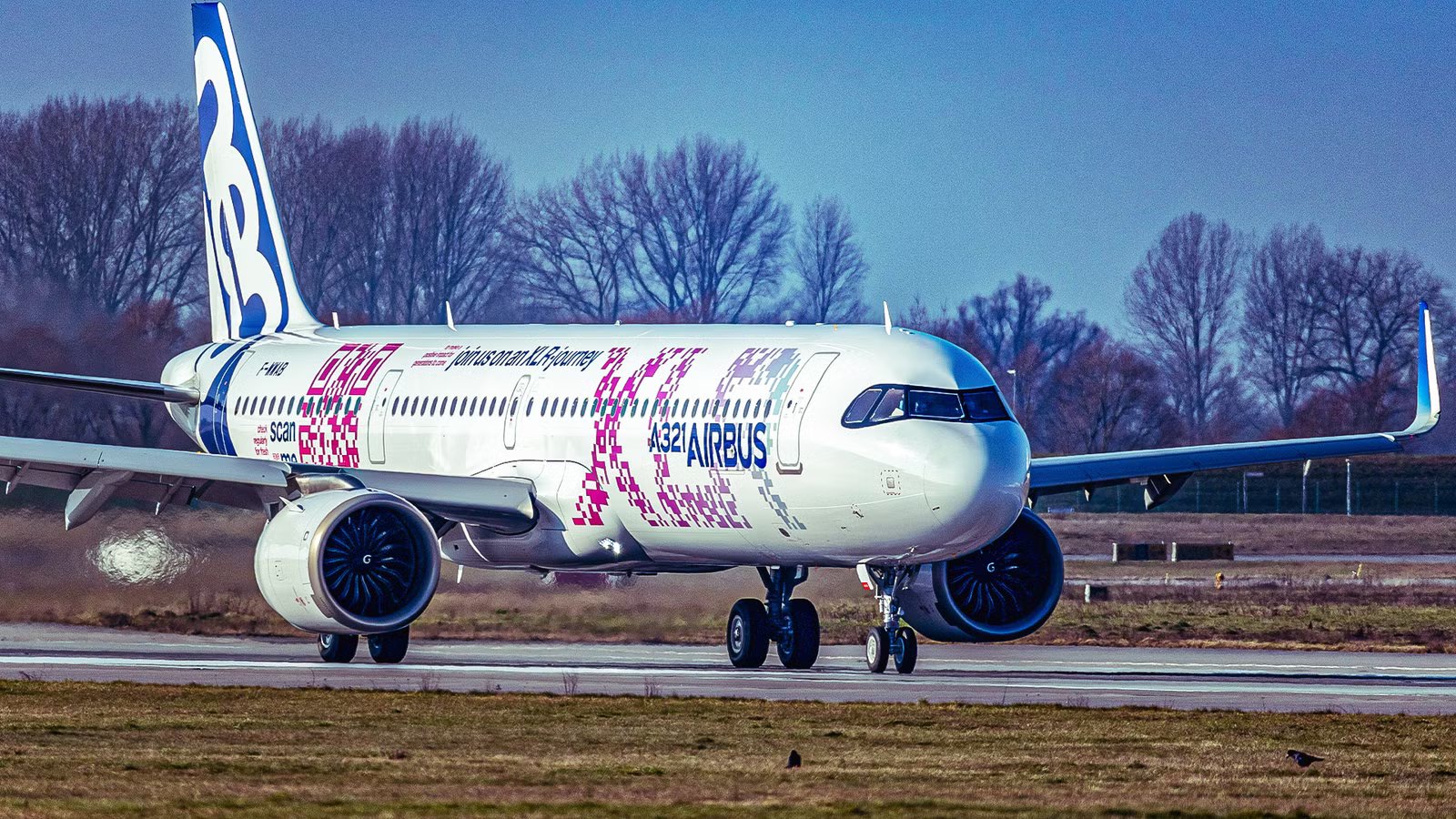
The Airbus A321XLR is the hottest new aircraft in service. Although it’s only a sub-variant of the A321neo, its upgrades to it have enabled it to become the world’s longest-range narrowbody aircraft. It will open up countless new routes for airlines, including between the US, Europe, and South America, as well as between Europe and Asia. It essentially serves as the successor to the Boeing 757-200, and the variant has already attracted over 500 orders, which is more than the number of 757s that were ever used on long-haul routes.
Given that the A321XLR is expected to operate routes that last nine hours or even more, the onboard passenger experience is more important than ever for the A321neo family. This is why Airbus has paid close attention to the A321XLR’s interior, improving the cabin’s visual aesthetics and practicality. What’s more, because it’s essentially an upgraded A321neo, the improvements that can be found on the A321XLR are also making their way to the rest of the Airbus A320neo family.
Lie-flat Seats On Most Airlines
Not Specifically An Airbus Feature

This is not a feature that comes from Airbus itself: rather, it’s a benefit unique to the Airbus A321XLR on account of how airlines plan to use it. The primary benefit of the A321XLR is its 4,700 NM (8,700 km) range, which is more than any twin-engine narrowbody aircraft in history. This means that it will primarily be used on long-haul flights. As such, the majority of A321XLR operators are installing lie-flat seats for business class passengers, with several new seat models coming out in recent years that are optimized for the aircraft.
The staggered Thompson Vantage has long been a popular seat model for narrowbodies, and so has the four-abreast Collins Aerospace Diamond. However, Thompson is now also selling the VantageSOLO, a direct-aisle access herringbone seat. Collins Aerospace now sells the similar Aurora, which debuted with American Airlines on the A321XLR, while Elevate will soon introduce the Altitude, another direct-aisle access herringbone seat, with United Airlines on the A321neo and A321XLR.
The A321XLR has received strong sales from legacy carriers in particular, who aim to use the A321XLR to supplement their widebody operations. As such, full-service operators are aiming to offer an onboard experience that’s comparable to what you’ll find on widebodies, with lie-flat seats and direct aisle access increasingly becoming an expectation. In addition, privacy doors, like what you’ll find on American’s A321XLRs, are becoming increasingly common.
Larger Interior Window Panes Compared To Before
The Actual Cutouts In The Fuselage Are The Same

While Airbus and Boeing both promote the benefits of their aircraft for passengers, one of the advantages that Boeing has always held is the size of its windows, as Airbus jets tend to have smaller windows than their Boeing rivals. The A320 has the smallest windows of any in-production Airbus aircraft, but increasing the size of the windows can be expensive and decreases parts commonality with older examples, which is why manufacturers rarely change window size/design when refreshing existing designs.
Commercial aircraft windows consist of multiple layers, and with the Airspace interior, Airbus has increased the size of the interior window panes. This is a common ‘trick’ that you also see with the Boeing Sky Interior on the 737 and the Airbus A380, where the interior pane is significantly larger than the actual window. This makes the interior appear more aesthetic and makes the windows appear similar in size to those of a newer aircraft, like the Airbus A220, without requiring the engineering effort of designing a new window cutout.
Since the cutouts in the fuselage are the same, passengers don’t have any more viewing area than on a 1988 A320-100. However, the enlarged interior window pane modernizes the cabin, which is important for the A320neo’s marketability, given that the type is almost 40 years old. Beyond this, the other benefit for passengers is that this materially increases natural light into the cabin, which can otherwise be limited with the older window design.

How Much Does An Airbus A321XLR Cost?
The range and efficiency of the XLR commands a premium over other narrowbody aircraft currently on the market.
Brand New Sidewall Designs & Lighting
Refreshing The A320 Family’s Interior

The larger interior window panes are part of Airbus’s Airspace Interior. Airspace was first introduced with the A350 in 2015, and then refined with the A330neo in 2018. Shortly thereafter, Airbus announced that Airspace would come to the A320neo family. Airspace is essentially Airbus’s equivalent to the Boeing Sky Interior found on the 737 and the 787. The Airspace Interior features modernized sidewalls, ceiling panels, and overhead bin designs to create a more relaxing space.
The Airspace Interior includes advanced LED mood lighting as well as an optional ‘hero light’, a panel of lit geometric shapes that runs over the aisle and can be customized to display different color patterns. In addition, Airspace includes new window trim panels, while the design of the sidewalls adds slightly more width at shoulder level compared to before. While Airspace can be installed on any A320neo family aircraft, it’s on the A321XLR where passengers will experience the most benefits from Airspace, given the longer flights that it will operate.
|
Airbus A320ceo Family |
Airbus A320neo Family |
|---|---|
|
Airbus A318-100 |
Airbus A319neo |
|
Airbus A319-100 |
Airbus A320neo |
|
Airbus A320-100/200 |
Airbus A321neo/LR/XLR |
|
Airbus A321-100/200 |
The last major upgrade that Airbus made to the A320 was in 2007 as part of the A320 Enhanced program. This included adding a trim panel around the windows, a new overhead bin design, a flatter sidewall design, and improved lighting. While it was an improvement from the A320’s previous 20th-century interior, it was quite simple compared to the Boeing Sky Interior on the 737, and hardly screams ‘modern’ today. The Airspace Interior, by contrast, is significantly more striking.
New, Larger Overhead Bins
The World’s Largest Single-Aisle Overhead Bins

The general trend in the aviation industry has been to move towards pivot-style bins, as they fit more bags and protrude less into the cabin. Airbus didn’t go for pivot bins with the Airspace Interior on the A320neo family, but it instead offers a larger shelf-style bin. It calls this the ‘Airspace XL Bin’, and claims that it is the largest overhead bin of any narrowbody in service. This is despite the bins being a shelf design rather than a pivot bin like you’ll find on the 737.
Airbus advertises that each XL Bin can accommodate up to four bags, as opposed to three in the prior bin design, and the XL Bins can fit bags up to 24 inches (60.96 centimeters) by 16 inches (40.64 centimeters) by 10 inches (25.4 centimeters) on their side. The XL Bins actually debuted before the Airspace Interior, in 2019 with  American Airlines on the A321neo, and they’re also available as a retrofit option on older A320ceo aircraft. Airbus also offers the Airspace L Bin, which is cheaper and quicker to retrofit onto existing airframes.
|
Overhead Bin |
Dimenions |
|---|---|
|
Airspace XL Bin |
24 inches (60.96 centimeters) by 16 inches (40.64 centimeters) by 10 inches (25.4 centimeters) |
|
Airspace L Bin |
22.8 inches (57.91 centimeters) by 16 inches (40.64 centimeters) by 10 inches (25.4 centimeters) |
The larger overhead bins decrease turnaround times and help flight attendants focus more on providing pre-departure service rather than needing to assist with bags. In addition, the larger bins mean that most, if not all, passengers on a low-density A321XLR can bring an individual carry-on. This increases customer satisfaction on long-haul flights where passengers are more likely to bring carry-ons, and this also increases available cargo hold space.
How Much Does An Airbus A321XLR Cost?
The range and efficiency of the XLR commands a premium over other narrowbody aircraft currently on the market.
The Widest Fuselage Of Any In-Production Narrowbody
More Interior Room Than A Boeing 737 Or 757

The Airbus A321XLR (which shares the same fuselage as the rest of the A320 family) has a cabin width of 12 feet two inches (3.70 meters), while the Boeing 737 and 757 have the same interior cabin width of 11 feet seven inches (3.54 meters). The A321XLR has the widest fuselage of any in-production single-aisle airliner, which means 18-inch (45.72 centimeter) wide seats in economy and wider premium seats. Meanwhile, a  Boeing narrowbody can only accommodate 17-inch (43.18 centimeter) wide seats in economy.
The difference in seat width might not be much on a one-hour or even a four-hour flight, but on an intercontinental flight like those that the A321XLR will be operating, it makes a significant difference. In addition to seat width, the wider cabin also results in more shoulder space for passengers, and the A321XLR has a wider aisle than the 737, improving service flows. With the Airspace Interior, A321XLR passengers have additional shoulder space due to the redesigned sidewalls.
The increased width gives passengers more space and results in more efficient service flows, which becomes more important the longer a flight is. With this, the Airbus A321neo is quickly becoming the premier narrowbody aircraft for longer flights, with the A321LR and A321XLR now operating a majority of the world’s long-distance narrowbody flights.