dailynewsnblog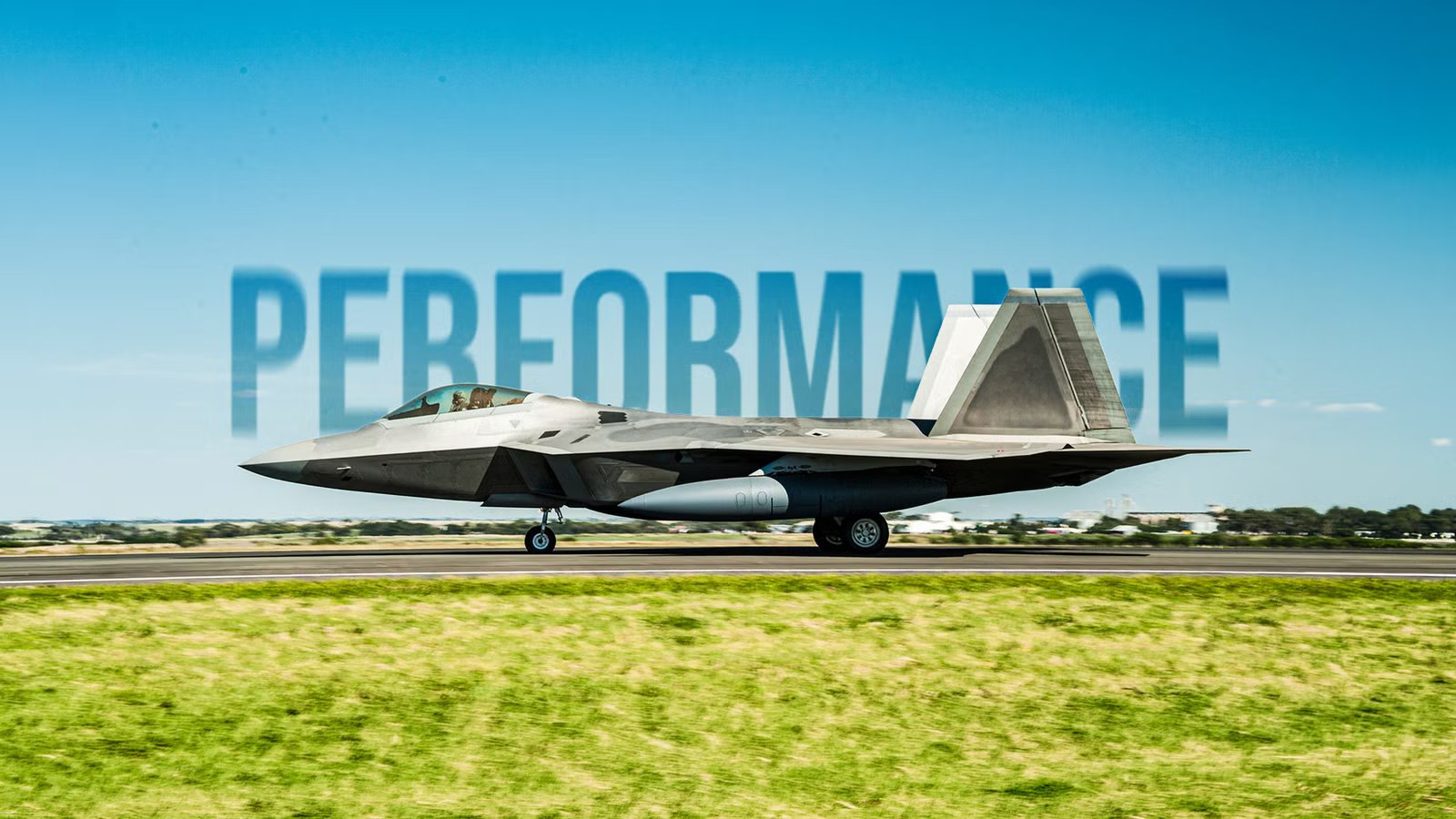
In the year 2026, the world’s first fifth-gereration fighter remains the apex predator of the air warfare domain. The Lockheed Martin F-22 Raptor is the final word in air power. Despite being decades older than its competition, the incredible stealth fighter from Skunk Works is still the gold standard in aerial combat. The incredible F-22 Raptor boasts a lower radar profile than anything else. Its signature is roughly the size of a marble, putting it in the league of its own even among other fifth generation stealth fighters.
On top of that baseline stealth superiority, the F-22 goes on to compound its tactical advantage with all-aspect stealth, higher top speeds, longer range, superior weapons employment envelope, and even better maneuverability. Not only does the Raptor own the high ground, it can also easily dispatch virtually any foe in a close-in ‘knife fight’ as well. And when all the clever tactics fail, the Raptor still leverages the fact that it has more sheer engine power than any other aircraft in its class.
Most 5th-gen fighters are a compromise: they trade speed for fuel, or stealth for payload. The F-22 is the only jet that refused to compromise on kinematics. It is faster, flies higher, turns tighter, and is harder to see than any other aircraft ever built. It wasn’t designed just to participate in the air war; it was designed to end it before the enemy even knows it started. So now that we’ve established the facts, let’s lay it all out by the numbers.
The Lowest Radar Cross-Section Of Any Stealth Fighter
0.0001 square meters

Unlike many other stealth fighters, the F-22 Raptor is designed for all-aspect stealth. The aircraft has a very low radar signature from the front, sides, or rear. The aircraft is aggressively shaved with a continuous curvature profile to deflect as many radar waves away from the receiver as possible. All the major leading and trailing edges have specific angles that concentrate radar deflections into narrow spikes that are difficult to track.
Low observability determines how close an aircraft can get to a radar before being ‘painted,’ or detected. This also determines how difficult it is for an adversary to use its integrated air defense system to develop a weapons quality track and fire surface-to-air missiles. For example, Russia’s Sukhoi Su-57 Felon lacks the same quality of radar absorbent material and all aspect-stealth design, which results in it having an RCS of 0.5 square meters, or around 5,000 times bigger than the F-22.
Even the Raptor’s engine exhaust nozzles have a chevron shape, unlike the round exhaust nozzles on virtually every other fighter jet. Those same engine nozzles are designed to minimize infrared signature as well, improving their low observability signature on the thermal detection spectrum. The F-22 also operates in electronic silence for the majority of its missions, only activating targeting systems at the last moment before striking. The use of data link allows the aircraft to fly silently and remain undetected by electronic warfare systems as well.
The Highest Operational Ceiling Of Any 5th-Gen
60,000+ feet

The US Air Force did not officially disclose exactly what the service ceiling of the F-22 Raptor is, but it does state that it is above 50,000 feet. Many experts estimate that it can achieve at least 60,000 feet, but potentially even beyond. This puts it far beyond the reach of the F-35 Lightning and while the J-20 or Su-57 may be able to achieve a similar maximum altitude, each of these competing fighter jets has lower-performance engines, which gives the Raptor the advantage.
It’s not just that the F-22 can fly to such a high altitude, but it can do it at extremely high speeds. The jet can achieve supercruise above Mach 1 or fly to Mach 2 for high-speed dashes. One of the main tactical advantages that this grants the Raptor is the firing of air-to-air missiles from extremely high altitude at high speed, granting it an enormous range advantage. The missile benefits significantly from the aircraft’s already high altitude and speed, which makes its own performance even better.
In the fall of 2024, a US Air Force F-22 Raptor successfully executed the longest known hit on an airborne target using an AIM-120 AMRAAM. The milestone was officially announced by Raytheon and the Air Force in September 2025 following a series of tests in the airspace near Eglin Air Force Base, Florida.
The F-22’s ability to fly at extremely high altitudes and supersonic speeds provides the missile with higher initial kinetic energy, allowing it to glide further and maintain a longer time-of-flight. While the exact distance remains classified, experts estimate the latest AMRAAM versions have a range exceeding 100 miles (160 kilometers). It surpassed the previous record set in 2021 by an F-15C Eagle.

America’s 5 Fastest Fighter Jets Of All Time
The speed kings of TACAIR.
Superior Vertical Agility To Any Other Fighter Jet
1:1 or higher thrust-to-weight ratio

Until Lockheed Martin’s F-35 debuted, the F-22 Raptor’s Pratt & Whitney F119 engines were the most powerful fighter jet turbofans ever made. While the F-35 may have a more powerful single engine, the F-22 still has greater overall thrust because it has two engines. The immense amount of power that these two engines combine to produce allows the jet to perform maneuvers that are impossible for most other aircraft. The Raptor can perform Herbst maneuvers or cobra turns, where it points its nose straight up while its flight path stays level.
In a dogfight, energy is life. Vertical agility is the ability to convert speed into altitude faster than your opponent. The F-22 can climb at over 60,000 feet per minute. If a Raptor and an F-35 or J-20 both pull into a vertical climb, the Raptor will create distance and reach ‘the high ground’ faster. In a close-range fight, the F-22 can use its thrust to flip its nose toward an enemy much faster than a jet relying only on air flowing over its wings, like the F-35 or J-20. This allows the pilot to get a missile or gun solution first.
The simple fact is, not only is the Raptor more stealthy, but it also has a far higher performance than any of its competition. The J-20 is a large, heavy interceptor. While fast in a straight line, it lacks the thrust-to-weight and specialized vectoring to match the Raptor’s gymnastics in a vertical fight. The Su-57 has impressive 3D thrust vectoring, but it lacks the low-speed engine stability and stealth integration of the F-22. The Raptor can perform these vertical stunts while remaining nearly invisible to radar; the Su-57’s engines are much more exposed.

Supercruise: How Fighter Jets Can Sustain Supersonic Flight Without Afterburners
Supercruise is one of the most exclusive features any aircraft can possess, with only a handful in history ever achieving it.
The Fastest Supercruise Of Any Fighter Jet In The World
Mach 1.5+

The F-22 Raptor’s supercruise capability is a hallmark of its reputation as the gold standard of air dominance. Many modern fighters can briefly touch Mach 1.2+ without afterburners under perfect conditions. However, the F-22 is the only fighter that can supercruise while carrying a full internal combat load for the majority of its mission. The F-22 can supercruise at speeds officially exceeding Mach 1.5, with some estimates placing its sustainable speed as high as Mach 1.82.
The F-22’s Pratt & Whitney F119 engines are highly mature and specifically built for the stresses of prolonged supersonic flight. While China’s J-20 is showing promise with its new WS-15 engines, the long-term reliability and fuel efficiency of these engines in a high-stress combat environment remain unproven compared to the decades of operational data for the F119.
This is not only a performance advantage on a strategic and tactical level, thanks to rapid redeployment and fuel savings, but also a stealth-enhancing feature. Most aircraft must use afterburners to reach supersonic speeds, which creates a massive infrared (IR) signature that can be tracked by enemy heat-seeking sensors. The F-22’s ability to maintain high speed without afterburners keeps its IR signature low, preserving its stealth while it rapidly closes in on or escapes from a threat.

Here’s Why Air Forces Are Expanding Their Stealth Fighter Programs
The global race for the ultimate stealth jet.
The Undisputed Dogfighting Champion: Supermaneuverability
2D thrust vectoring

The combination of two-dimensional thrust vectoring engine exhaust nozzles and extremely advanced fly-by-wire digital avionics has given the F-22 what the Air Force dubs ‘supermaneuverability.’ The F-22’s engine nozzles can tilt up or down by 20 degrees. This allows the pilot to use the raw power of the engines to push the nose of the plane in any direction, even at near-zero airspeed. The F-22 can perform post-stall maneuvers, like the J-turn or power loop, that would cause other jets to literally fall out of the sky.
Most 5th-gen jets, like the F-35, rely on air moving over their wings and tails to turn. If the plane slows down too much, there isn’t enough air pressure to move the jet, causing it to stall or become sluggish. In a dogfight, this means the F-22 pilot can flip the nose of the jet to point at the enemy and fire a missile or the 20mm cannon while the enemy is still struggling to complete a traditional turn.
This is almost entirely thanks to the incredible F119 engines. The aerodynamics of the aircraft are important, of course. However, thanks to the Pratt & Whitney power plants, the F-22 can perform incredible feats like a maximum-G turn and then accelerate vertically to regain altitude almost instantly. It is true that the 3D nozzle vectoring on the Su-57 allows it to perform more spectacular feats at air shows; however, it is far less stealth optimized and therefore tactically more vulnerable in a real-world scenario.