dailynewsnblog
Modern commercial aircraft typically cruise within a relatively narrow speed range, usually between Mach 0.78 and Mach 0.86, as this represents the optimal balance between fuel efficiency and travel time. However, a select group of aircraft operate at the very top of this range, with some capable of reaching maximum cruise speeds close to Mach 0.90.
While the difference between Mach 0.84 and Mach 0.86 may seem small, it can still translate into time savings, especially on long-haul flights. In this list, we take a closer look at five of the fastest commercial aircraft in service today, including the Boeing 747-8I and Airbus A380, and explore how speed fits into their overall performance.
5
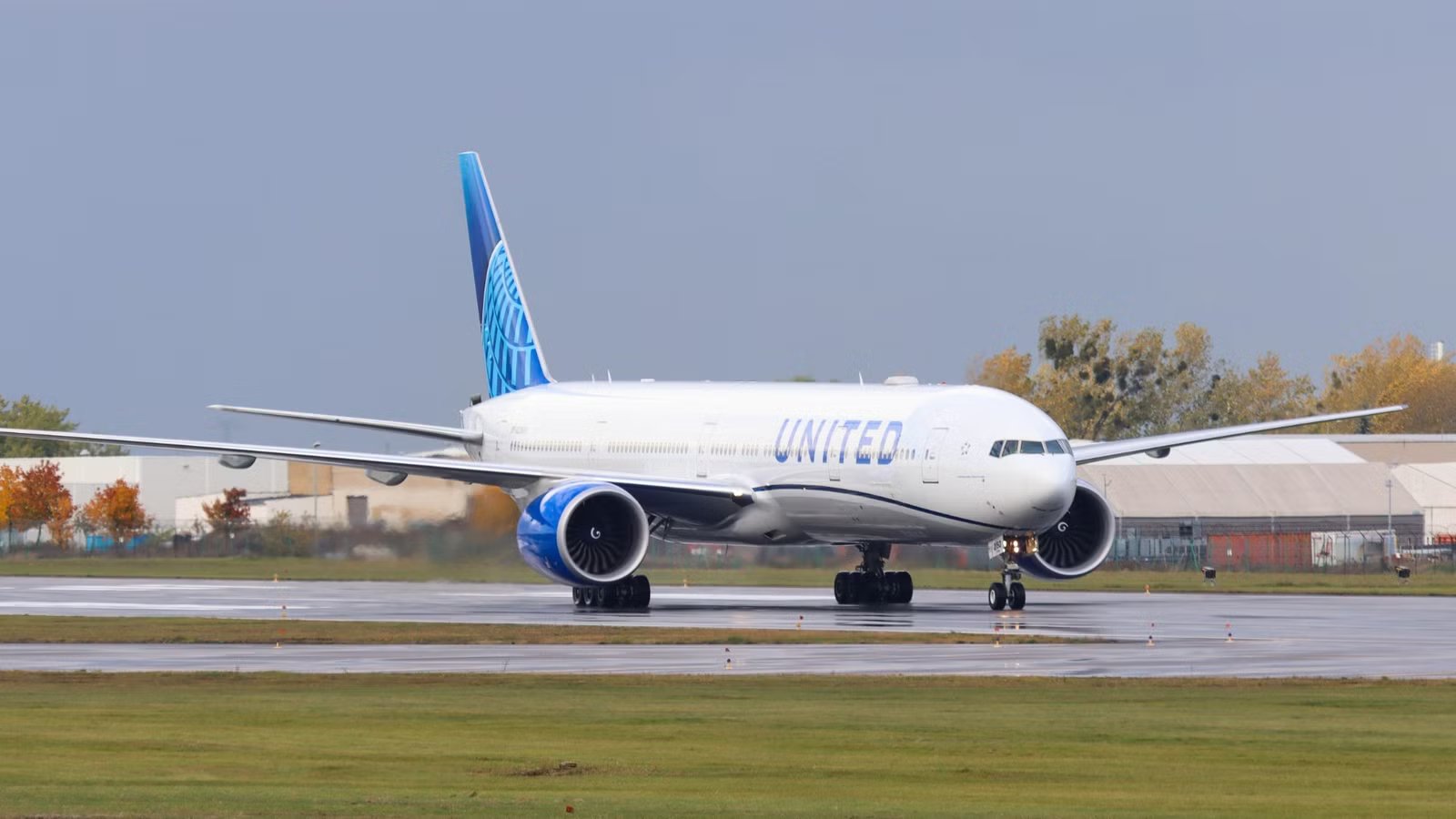
Boeing 777
Mach 0.84

The Boeing 777 is one of the world’s most popular widebody aircraft ever built. And while the aircraft type has multiple variants with various engine options, all the type’s variants have the same cruising speed, making them some of the fastest commercial aircraft in the skies today. The aircraft has a cruising speed of, Mach 0.84 while the maximum cruising speed can reach upwards of Mach 0.89. The first generation of the twin-engined widebody aircraft, the B777-200(ER) and B777-300, had multiple engine options including Pratt & Whitney‘s PW4000, the Rolls-Royce Trent 800, and the General Electric GE90. This latter one was, however, not available for the B777-300. These engines delivered a maximum thrust of around 77,200 lbf (343 kN) for the -200, 93,700 lbf (417 kN) for the -200ER, and 98,000 lbf (440 kN) for the -300. The second generation of B777 aircraft, the 777-300ER and 777-200LR, only had one engine option, the GE90, albeit, a newer, redeveloped version of the engine. This engine provided the aircraft types with a maximum thrust of up to 115,300 lbf (513 kN).
 Boeing delivered the first 777, the 777-200, to
  United Airlines on May 15, 1995. A few years later, in 1997, this variant was followed by the 777-300ER, and a year after its commercial introduction of this variant, Boeing also introduced the larger Boeing 777-300, seating up to 368 passengers in a typical three-class configuration. However, this variant had a reduced range compared to the Boeing 777-200ER, prompting the development of the Boeing 777-300ER. First introduced in 2004, this aircraft provided airlines with an even longer range than the Boeing 777-200ER offered before, combined with the increased capacity of the Boeing 777-300. A combination that turned out to be a success for Boeing, as it became the best-selling variant of the Boeing 777 family with a total of 838 orders placed. In addition to the 777-300ER, Boeing also introduced the long-range (LR) version of the Boeing 777-200 back in 2005, which had a similar range as the 777-300ER but with less capacity. This variant of the Boeing 777 was initially intended for high-yield routes requiring a longer range, but it did not have enough demand for the large Boeing 777-300ER.
4
Airbus A380
Mach 0.85

The Airbus A380-800 is the world’s largest passenger aircraft and the only true full-length double-deck jet aircraft. This quadjet aviation icon is also one of the fastest commercial aircraft, with a cruise speed of Mach 0.85 and a maximum cruise speed of Mach 0.89. The A380 is powered by either the Rolls-Royce Trent 900 or Engine Alliance GP7000, a joint venture of General Electric and Pratt & Whitney. Each engine produces approximately 70,000 lbf (340 kN) of thrust, allowing the aircraft to operate fast and efficiently despite its size. The aircraft has a range of up to 7,991 nautical miles (14,800 kilometers) and typically seats around 525 passengers. Despite its powerful engines, the A380 requires around 9,800 feet (3,000 meters) of runway length to successfully get off the ground with its 1,268,000 lb (575 metric) ton Maximum Take-off Weight (MTOW).
Important to the aircraft’s impressive performance is the extensive research and development phase the A380 underwent. Airbus had already started studies to develop the aircraft back in 1988, while the aircraft’s first flight was only in 2005. However, it wasn’t until 1990 that the project was publicly announced. Its first commercial flight wasn’t until 2007, when it entered service with Singapore Airlines. After the aircraft successfully entered commercial service in 2007, production peaked in 2012, with 30 new aircraft being constructed. Over the course of the aircraft’s production, 254 units were built, including the three test aircraft. By 2021, in the midst of the COVID-19 pandemic, Airbus made the decision to discontinue production of the aircraft after less than two decades, as the A380 did not succeed in the modern aviation market on a large enough scale. This short production was also not enough to recover the massive development costs of the aircraft.

6 Commercial Aircraft With The Largest Wingspans Flying Today
The biggest wings in the sky in 2026.
3
Airbus A350
Mach 0.85

Similar to the A380, both the Airbus A350 variants have a cruise speed of Mach 0.85 and a maximum cruise speed of Mach 0.89. The smaller A350-900 is powered exclusively by the Rolls-Royce Trent XWB-84 engine, while the A350-1000 is equipped with a higher-thrust variant, the Trent XWB-97. The -900 has around 84,000 lbs (374 kN) of thrust per engine, while the -1000 boasts around 97,000 lbs (430 kN) of thrust per engine. This enables these aircraft to operate efficiently at high cruising speeds while maintaining a range of up to 9,000 nautical miles (16,700 km), in the case of the A350-1000.
The A350 family is one of the most popular long-haul aircraft types in today’s aviation market. The aircraft was developed by Airbus in response to the Boeing 787, with the initial design having been introduced back in 2004. At first, the A350 was planned as a new iteration of the older Airbus A330, with composite wings, more advanced winglets, and new, more efficient engines. However, due to the poor response of airlines to the proposal, Airbus changed its proposed plans and designed a new widebody from scratch, with an extra widebody (XWB). The A350-900 first flew in June 2013 and entered service with  Qatar Airways in January 2015, followed by the A350-1000 in February 2018 with the same airline. As of February 2026, over 700 aircraft have been built and delivered to airlines around the world.

This Is How Powerful The Airbus A350 Is
Its power isn’t just in raw thrust.
2
Boeing 787 Dreamliner
Mach 0.85

The Boeing 787 has, similar to the Boeing 777 and Airbus A350, the same cruise speed of Mach 0.85 for all of its variants. The maximum speed of the aircraft is Mach 0.90, and across all variants, the same two engine types are available. These are the
General Electric GEnx and the Rolls-Royce Trent 1000. For the 787-8, -9, and -10, these engines deliver a maximum thrust of 64,000 lbf (280 kN), 71,000 lbf (320 kN), and 76,000 lbf (340 kN), respectively. Unique to the 787 family is that, while all aircraft have different capacities and cabin lengths, the wings of all variants are the same, with a wingspan of 197 feet 3 inches (60.12 meters) and a surface area of 4,058 sq ft (377 m2).
Boeing officially launched the Boeing 787 program in 2004, with an order from All Nippon Airways (ANA). At the time, Boeing targeted the aircraft to enter service in 2008. However, the aircraft’s first flight wouldn’t be until the end of 2009. Almost two years later, in September 2011, the first aircraft was delivered to ANA, with the first commercial flight taking place a month later in October 2011. Since then, 1,257 have been built (as of February 2026), and another 1,108 orders are still outstanding.

787-8 Vs 787-9 Vs 787-10: How The Dreamliner Variants Differ
The three 787 variants are tailored to different market segments to fill niches and offer a placement for different previous-generation aircraft.
1
Boeing 747-8
Mach 0.86

The Boeing 747 or “Queen of the Skies”, is a true icon of aviation, and contributing to that even further is the fact that the type’s youngest variant, the Boeing 747-8 Intercontinental, has the fastest cruise speed of any commercial aircraft. On regular cruise, the aircraft has a speed of Mach 0.86, while the aircraft’s maximum speed can reach upward of Mach 0.90. In contrast to older 747 variants, the 747-8 only came with one engine option: the General Electric GEnx-2B67. The reason for this is to reduce production costs and leverage newer technology, as the engine is a more efficient, smaller version of the General Electric GEnx turbofan engine from the 787.
Each engine produces around 66,500 pounds (296 kN) of thrust, powering the aircraft’s 246 feet, 10 inches (75.23 meters) long fuselage and wingspan of 224 feet, 5 inches (68.40 meters). The 747 has an MTOW of 987,000 lb (448 metric tons) and seats around 467 passengers in a typical three-class configuration and carries 640 cu feet (18.1 m3) of bulk cargo, and either 12 full-width ULD containers or 38 LD1 half-width containers. In terms of range, the aircraft can reach up to 7,730 nautical miles (14,310 kilometers).
|
Specification |
|
|---|---|
|
Capacity |
467 passengers (three-class) |
|
Length |
246 feet, 10 inches (75.23 meters) |
|
Wingspan |
224 feet, 5 inches (68.40 meters) |
|
Fuselage width |
21 feet, 4 inches (6.50 meters) |
|
Height |
64 feet (19.51 meters) |
|
Wing area |
5,960 sq feet (554 m²) |
|
Maximum takeoff weight |
987,000 lb (448 tons) |
|
Powerplant |
4 × General Electric GEnx-2B67 |
|
Maximum speed |
Mach 0.9 |
|
Range |
7,730 nautical miles (14,310 km) |
The 747-8I was the last 747 variant developed by Boeing. For decades, the 747 served as the flagship of the global aviation industry, shaping long-haul travel as we know it today. However, with the first aircraft entering commercial service back in 1970 with Pan Am, and only a handful of passenger airlines still operating the type, the end of an era is approaching as production ended back in 2023. The aircraft’s first-ever flight was on February 9, 1969, marking the start of the widebody age of jet travel, as the four-engined, partially double-decked aircraft was the first widebody to ever take to the skies. From that moment, it quickly earned itself the nickname “Jumbo Jet.” Since that first delivery, more than 1,500 aircraft of the type have been delivered to airlines around the world, including the last 747 aircraft ever produced in December 2022.