dailynewsnblog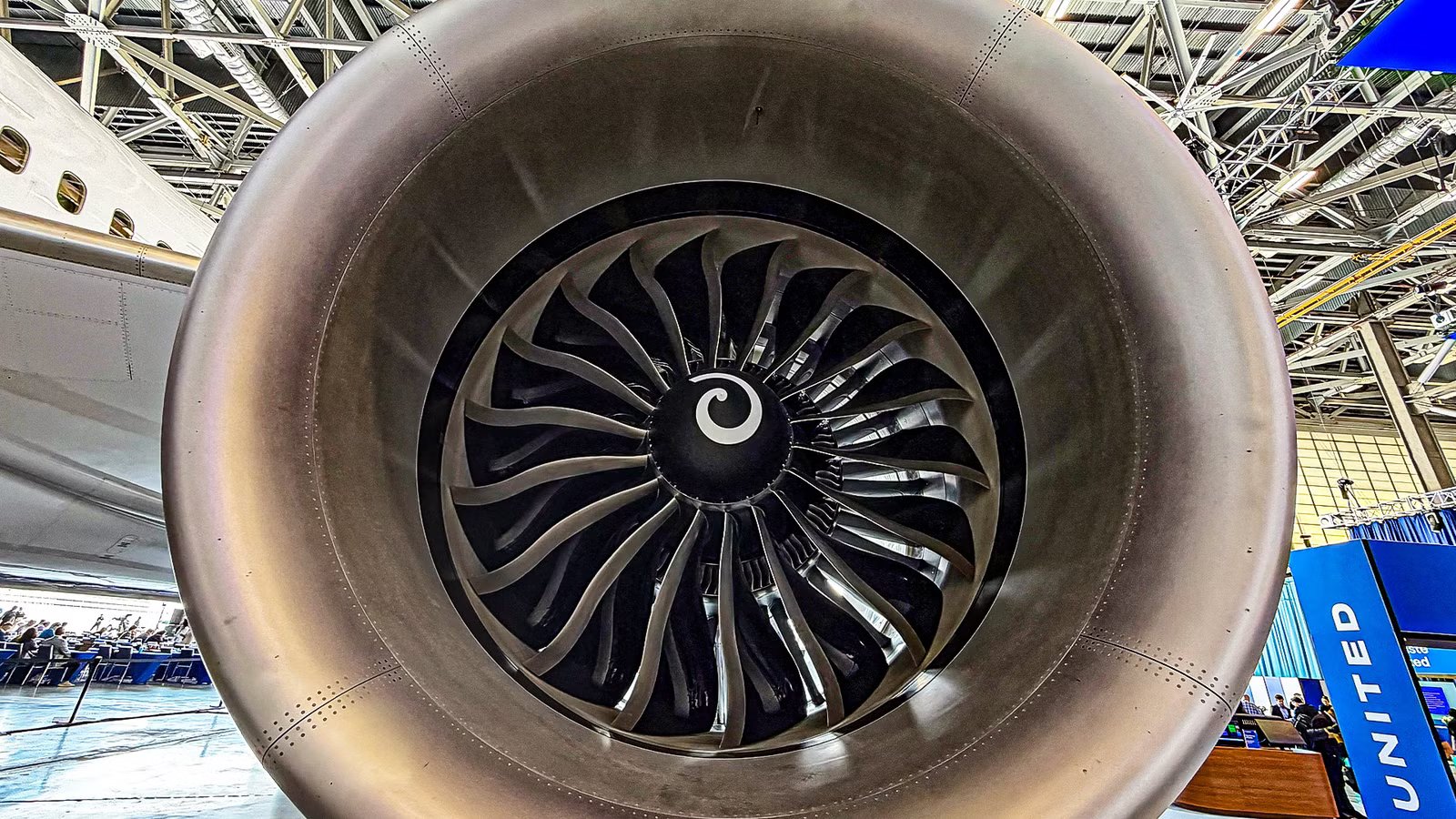
The aircraft with the most powerful engines are not necessarily the ultra-large widebody Airbus A380s and Boeing 747s. Those are quadjets and so can afford to have smaller engines compared with the largest twin-engined widebodies. Today, all commercial airliners in production are twin-jets, and this has been driven by engines getting more reliable and more powerful. Once the engines are reliable and powerful enough, it is typically more efficient to have two engines instead of four.
One of the most extreme examples of aircraft having lots of lower-powered engines is the military Boeing B-52 Stratofortress strategic bomber with eight engines. The B-52 was built at a time when jet engines were comparatively unreliable and weaker, plus military aircraft needed more engines for redundancy. Today, military bombers and transport aircraft are typically built with four engines, and commercial aircraft are built with two. This list will include the peak engine variant by certified thrust and the top aircraft variant by type or generation (so only one Boeing 777 Classic and A350 example).
5
Airbus A380
84,100 lbf

The Airbus A380 is by a considerable margin the largest commercial aircraft in the world. However, because it has four engines, it needs less thrust from each of those engines than the largest twin-jet aircraft in service. The A380 is powered by the Engine Alliance GP7000 and the Rolls-Royce Trent 900 family of aircraft. The Trent 900, in particular, has multiple block upgrades with the highest thrust block, pushing the A380 into fifth position on this list.
The base certified variants came with thrust ratings of between 75,100 lbf and 84,100 lbf. The Trent 970-84 is rated at 75,100 lbf, the Trent 972-84 at around 76,700 lbf, the Trent 977-84 at around 80,800 lbf, and the Trent 980-84 at around 84,100 lbf. Incremental and block upgrades boosted the thrust on the 970, 972, and 977 variants, although the base 980 remained the highest rated at 84,100 lbf. The upgraded block variants are labeled “B,” e.g., 970B, etc. This means that Airbus A380s equipped with Trent 980-84 variant engines have more or less the same certified thrust rating as the Airbus A350-900, but not the A350-1000.
It’s worth noting that most A380s are powered by lower Trent 900 thrust variants and the lower thrust GP7000 family, not the peak Trent 980-84. It is difficult to know which aircraft have these engines, as airlines don’t typically market the engine variants separately. The Airbus A380-800 may be the largest commercial passenger aircraft ever built, but it wasn’t meant to be. Airbus was bullish about the future of extra-large widebody aircraft when it built the A380-800 and had plans to stretch it to the A380-900. But that never happened; it’s unclear if Rolls-Royce and Engine Alliance had plans to scale their engines for that extra-long Superjumbo.
4
Airbus A350-1000
97,000 lbf

The Airbus A350-1000 is exclusively powered by the Rolls-Royce Trent XWB turbofan, specifically the Trent XWB-97 variant rated for 97,000 lbf. The shorter A350-900 is exclusively powered by the Trent XWB-84 that has an 84,000-lbf rating. The XWB-97 is the most powerful non-GE aerospace engine in production and is the most powerful engine found on any Airbus aircraft. These engines power the world’s longest-range commercial aircraft. The Airbus A350-900ULR (Ultra Long Range) aircraft has a range of up to 9,700 nautical miles, which is about to be matched by the A350-1000ULR currently in production for Qantas.
With a hiatus of Boeing 777 passenger aircraft delivered in 2025 and 2026, the Trent XWB-84 is also the world’s most powerful engine being actively delivered on new-production passenger jets (freighters excluded). After Airbus terminated the A350-800 Superjumbo in 2021, the A350-1000 became the largest Airbus aircraft on the market. Separately, it seems likely the Trent XWB could jump in the engine rankings in the future.
Airbus has confirmed it is actively studying a stretched derivative of the A350-1000, typically dubbed the A350-2000. This aircraft would target 400+ seats and would rival the 777-9. Given that Rolls-Royce scaled the thrust from 84,000 lbf for the -900 to 97,000 lbf for the -1000, it seems likely it would scale it again to the 100,000 to 105,000 lbf range for a -2000. Rolls-Royce is also working on its massive UltraFan experimental engine, from which it could potentially derive an engine.

These Are The Most Powerful Commercial Aircraft Engines Today
The world’s most powerful commercial aircraft engine has up to 134,000 lbs of thrust.
3
Boeing 777-300
99,040 lbf

The versatile Pratt & Whitney PW4000 powers a range of widebody aircraft, including the Boeing 767 family, the Boeing 747-400, the Boeing 777 Classic (first generation), Airbus A330ceo, Airbus A300-600, Airbus A310-300, Boeing KC-46A Pegasus, and the McDonnell Douglas MD-11. Importantly, the two-shaft PW4000 family (first introduced in 1987) has a wider range of thrust ratings from 50,000 to 99,040 lbf, depending on the model. The PW4000-112 series, specifically the PW4098, has the highest rating of 99,040 lbf or 441 kN.
That variant is found exclusively on the Boeing 777-300, making the Boeing 777-300 the highest thrust airliner per engine in its day. However, the Boeing 777-300 is now largely retired from active fleets due to its age. Cathay Pacific was the launch customer and remains the largest operator of the Boeing 777-300, and it still has 17 examples in its fleet. Other operators include Rossiya Airlines, All Nippon Airways, and Korean Air.
Airlines like Korean Air have been compelled to keep the old aircraft in service due to delays with Airbus and Boeing delivering replacement aircraft. The only aircraft still produced with the PW4000 engine is the Boeing KC-46A military tanker based on the Boeing 767. That aircraft is delivered with the PW4060, which delivers 60,000 to 62,000 lbfs, much lower than the most powerful model. Technically, other 777 Classics, including the 777-200 and -200ER, could have been listed here, displacing the A380 as they had PW4000 engine variants that reached 86,760 lbf and 91,790 lbf. However, they are left off the list as they are just sister variants of the PW4098 engine.
2
Boeing 777X
110,000 lbf

The Boeing 777X, including the 777-8, 777-8F, and 777-9 variants, is to be exclusively powered by the GE Aerospace GE9X turbofan developed from the GE90 that powered the second-generation Boeing 777-200LR and Boeing 777-300ER. GE Aerospace says of the engine, “The GE9X is the largest and most powerful commercial aircraft engine ever built, incorporating advanced technologies that enable more efficient, quieter flight with fewer emissions.” When the Boeing 777-9 enters service (expected 2027), it will be the largest commercial jet on the market.
GE Aerospace also says that it has the highest thrust of any commercial jet engine, equivalent to 597.396 kN or 134,300 lbf. However, this is where things get a little tricky; the GE9X is not certified for 134,300 lbf, which was the record-breaking output it achieved in a test in 2017. It is certified for 110,000 lbf, and this puts it behind its older and weaker GE90, which is certified for 115,300 lbf.
The GE9X is a reminder that on-paper numbers and reality are two different things. Something similar is seen in the Boeing 777-9’s range versus the older 777-300ER it is replacing. Even though the Boeing 777-9 has more efficient engines and is more aerodynamic, it is advertised with a range of 7,285 nautical miles. By contrast, the 777-300ER is advertised with a range of 7,370 nautical miles or 45 nautical miles more. The reason is that estimating the range has become more conservative and realistic with appropriate fuel reserves. The Boeing 777-9 may actually have more powerful engines and be longer ranged than the 777-300ER, but on paper, it is less powerful and is shorter ranged, due to changes in how things are measured.

Rolls-Royce Trent XWB Vs. General Electric GE9X? Which Engine Is More Powerful?
The GE9X is more powerful than the Trent XWB, although there is more than thrust that makes a good engine.
1
Boeing 777-200LR & -300ER
115,300 lbf

The Boeing 777 second generation, including the 777-300ER and 777-200LR, is exclusively powered by the powerful GE90 turbofan. As stated, this engine has the world’s highest certified max thrust of 115,300 lbf. That said, it has only been tested to 127,900-lbf, placing it second, behind its successor GE9X’s 134,300 lbf. As of the time of writing (March 2026), the GE9X is not in service, meaning the GE90 is the most powerful engine in active commercial service.
The GE90 is also the largest engine in service by fan diameter, measuring 128 inches. It is to be overtaken by the GE9X and its gaping 134-inch diameter. The GE90 was launched in 1990 and became the first GE engine to reach 100,000 lbf. As the Boeing 777-9 is not yet being delivered pending its delayed certification, the Boeing 777-300ER technically remains the largest aircraft on the market. In reality, production for the passenger variant ended in 2024, with five more doubtful orders remaining on Boeing’s books for Pakistan International Airlines.
The only 777 aircraft being delivered in 2026 is the Boeing 777F freighter variant, which is based on the 777-200LR ultra-long range variant and is informally called the 777-200LRF by some cargo operators. According to Boeing, it has 47 more examples of the Boeing 777F on back order for Emirates, FedEx, National Airlines, Silk Way West, Volga-Dnepr, and unidentified customers. Due to sanctions, the six slated for Volga-Dnepr are likely bad orders, adjusting the actual backlog to 41 or possibly less, depending on the status of the 17 orders for unidentified customers.